
Join Our JEE Preparation Group
Prep with like-minded aspirants; Get access to free daily tests and study material.
Sign in
Please select an account to continue using cracku.in
↓ →
Join Our JEE Preparation Group
Prep with like-minded aspirants; Get access to free daily tests and study material.
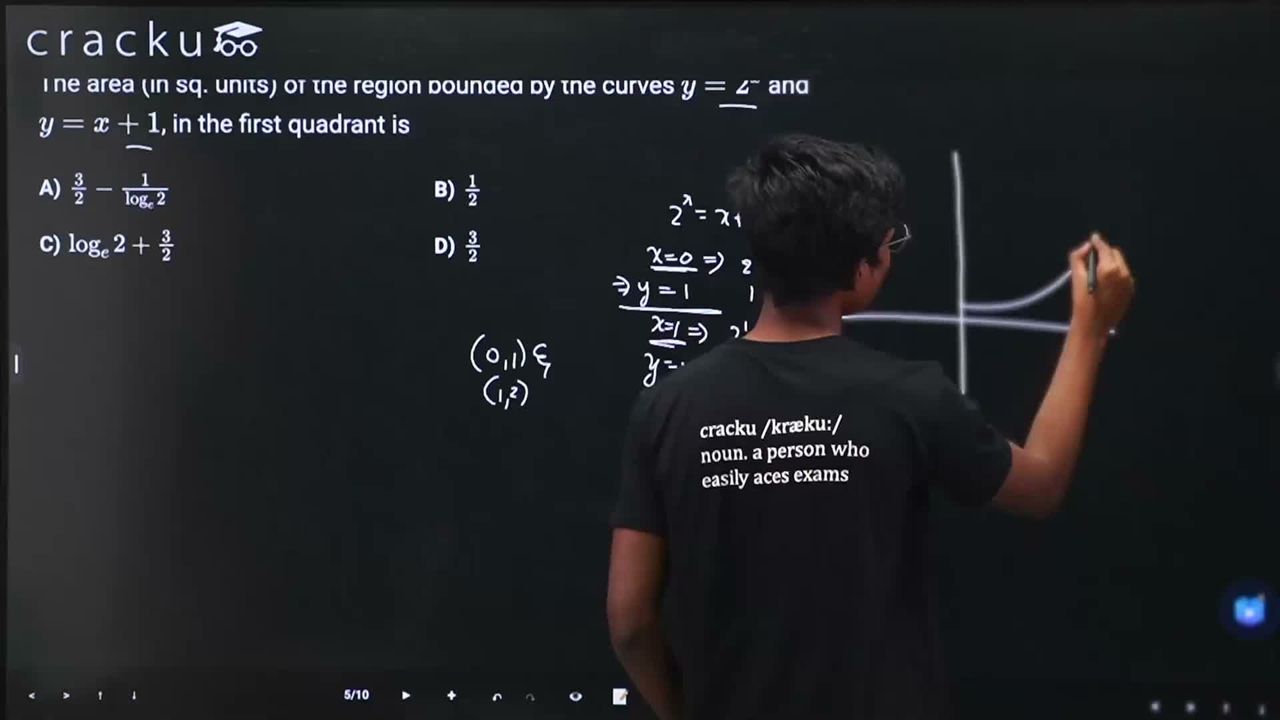
The area (in sq. units) of the region bounded by the curves $$y = 2^x$$ and $$y = x + 1$$, in the first quadrant is
We are asked to find the area, in square units, enclosed by the two curves
$$y = 2^{x} \quad\text{and}\quad y = x + 1$$
in the first quadrant. “First quadrant’’ means we restrict ourselves to points where $$x \ge 0$$ and $$y \ge 0$$.
To set up the required definite integral, we first need the points where the two graphs meet. Intersection points are obtained by equating the two expressions for $$y$$:
$$2^{x} = x + 1.$$
We solve this equation step by step.
• Try $$x = 0$$: $$2^{0} = 1,\; x+1 = 0+1 = 1.$$ Both sides are equal, so $$x = 0$$ is a solution.
• Try $$x = 1$$: $$2^{1} = 2,\; x+1 = 1+1 = 2.$$ Again both sides are equal, so $$x = 1$$ is also a solution.
To check whether there are any further solutions for $$x \ge 0$$, consider the function
$$f(x) = 2^{x} - (x + 1).$$
We have already found $$f(0) = 0$$ and $$f(1) = 0$$. Differentiate to see the behaviour between and beyond these points:
$$f'(x) = (\ln 2)\,2^{x} - 1.$$
At $$x = 0$$, $$f'(0) = (\ln 2)\cdot 1 - 1 = \ln 2 - 1 \lt 0.$$ At $$x = 1$$, $$f'(1) = (\ln 2)\cdot 2 - 1 = 2\ln 2 - 1 \gt 0.$$
Since $$f'(x)$$ changes from negative to positive only once, $$f(x)$$ can cross the $$x$$-axis at most twice. We have already identified two crossings, so those are the only intersections in the first quadrant:
$$\bigl(0,\,1\bigr)\quad\text{and}\quad\bigl(1,\,2\bigr).$$
Next, we decide which curve lies above the other between these two $$x$$-values. Pick a convenient test point such as $$x = 0.5$$:
$$y = 2^{0.5} = \sqrt{2} \approx 1.414,$$ $$y = 0.5 + 1 = 1.5.$$
Clearly $$1.5 \gt 1.414,$$ so throughout the interval $$0 \le x \le 1$$ the straight line $$y = x + 1$$ is the upper curve and the exponential curve $$y = 2^{x}$$ is the lower curve.
The standard formula for the area between two curves, when the region is projected on the $$x$$-axis from $$x = a$$ to $$x = b$$, is
$$A = \int_{a}^{b} \bigl[y_{\text{upper}} - y_{\text{lower}}\bigr]\,dx.$$
In our case:
$$a = 0, \quad b = 1,$$ $$y_{\text{upper}} = x + 1, \quad y_{\text{lower}} = 2^{x}.$$
Hence
$$ \begin{aligned} A &= \int_{0}^{1} \Bigl[(x + 1) - 2^{x}\Bigr]\,dx \\[4pt] &= \int_{0}^{1} (x + 1)\,dx \;-\; \int_{0}^{1} 2^{x}\,dx. \end{aligned} $$
We evaluate each integral separately.
For the first integral, recall the power-rule of integration:
$$\int x^{n}\,dx = \frac{x^{n+1}}{n+1} + C.$$
Applying it term by term,
$$ \int_{0}^{1} (x + 1)\,dx = \int_{0}^{1} x\,dx + \int_{0}^{1} 1\,dx = \left[\frac{x^{2}}{2}\right]_{0}^{1} + \left[x\right]_{0}^{1} = \left(\frac{1^{2}}{2} - \frac{0^{2}}{2}\right) + (1 - 0) = \frac{1}{2} + 1 = \frac{3}{2}. $$
For the second integral, we recall the exponential-base-$$2$$ integration rule:
$$\int 2^{x}\,dx = \frac{2^{x}}{\ln 2} + C,$$
because differentiating $$\dfrac{2^{x}}{\ln 2}$$ gives back $$2^{x}$$.
Therefore,
$$ \int_{0}^{1} 2^{x}\,dx = \left[\frac{2^{x}}{\ln 2}\right]_{0}^{1} = \frac{2^{1}}{\ln 2} - \frac{2^{0}}{\ln 2} = \frac{2}{\ln 2} - \frac{1}{\ln 2} = \frac{1}{\ln 2}. $$
Substituting the two evaluated parts back into the expression for $$A$$, we obtain
$$ A = \frac{3}{2} - \frac{1}{\ln 2}. $$
This numerical expression exactly matches Option A.
Hence, the correct answer is Option A.
Was this solution helpful?
Click on the Email ☝️ to Watch the Video Solution
Create a FREE account and get:
_1.webp)

Educational materials for JEE preparation

Ask our AI anything

AI can make mistakes. Please verify important information.
AI can make mistakes. Please verify important information.
