
Join Our JEE Preparation Group
Prep with like-minded aspirants; Get access to free daily tests and study material.
Sign in
Please select an account to continue using cracku.in
↓ →
Join Our JEE Preparation Group
Prep with like-minded aspirants; Get access to free daily tests and study material.
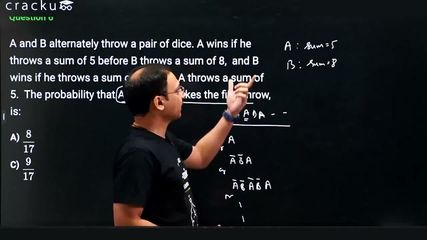
A and B alternately throw a pair of dice. A wins if he throws a sum of 5 before B throws a sum of 8, and B wins if he throws a sum of 8 before A throws a sum of 5. The probability that A wins if A makes the first throw, is:
When a pair of dice is thrown, the ways in which we can get a sum of $$5$$ are: $$(1,4)$$, $$(4,1)$$, $$(2,3)$$ and $$(3,2)$$, giving the total probability among all the $$6\times 6$$ possibilities as $$\dfrac{4}{36}$$
When a pair of dice is thrown, the ways in which we can get a sum of $$8$$ are: $$(2,6)$$, $$(6,2)$$, $$(5,3)$$, $$(3,5)$$, and $$(4,4)$$, giving the total probability among all the $$6\times 6$$ possibilities as $$\dfrac{5}{36}$$
The probability that A wins in the very first throw is $$\dfrac{4}{36}$$
The probability that A wins in the second time he throws is $$\dfrac{36-4}{36}\times \dfrac{36-5}{36} \times \dfrac{4}{36}$$
The probability that A wins in the third time he throws is $$\dfrac{36-4}{36}\times \dfrac{36-5}{36} \times \dfrac{36-4}{36}\times \dfrac{36-5}{36} \times \dfrac{4}{36}$$
And so on,
The cases form a GP with the first term $$\dfrac{4}{36}$$ and the common ratio of $$\dfrac{36-4}{36}\times \dfrac{36-5}{36}$$
Thus, the combined probability will be;
$$\dfrac{4/36}{1- \left(\dfrac{36-4}{36}\times \dfrac{36-5}{36}\right)} = \dfrac{144}{304} = \dfrac{36}{76} = \dfrac{9}{19}$$
Option B is the correct answer.
Was this solution helpful?
Click on the Email ☝️ to Watch the Video Solution
Create a FREE account and get:
_1.webp)

Educational materials for JEE preparation

Ask our AI anything

AI can make mistakes. Please verify important information.
AI can make mistakes. Please verify important information.
