
Join Our JEE Preparation Group
Prep with like-minded aspirants; Get access to free daily tests and study material.
Sign in
Please select an account to continue using cracku.in
↓ →
Join Our JEE Preparation Group
Prep with like-minded aspirants; Get access to free daily tests and study material.
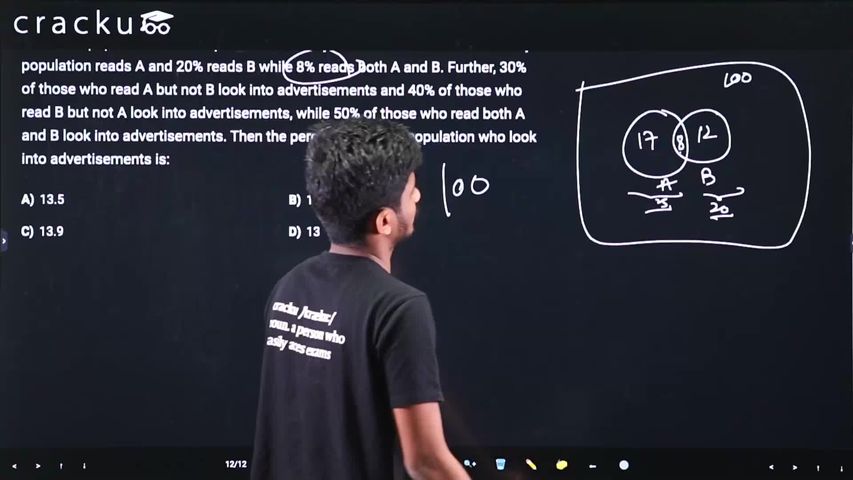
Two newspapers A and B are published in a city. It is known that 25% of the city population reads A and 20% reads B while 8% reads both A and B. Further, 30% of those who read A but not B look into advertisements and 40% of those who read B but not A look into advertisements, while 50% of those who read both A and B look into advertisements. Then the percentage of the population who look into advertisements is:
Let us begin by taking the total population of the city as $$100$$ units so that every percentage mentioned in the question can be treated directly as that many “people out of 100”.
We are told that $$25\%$$ of the population reads newspaper A and $$20\%$$ reads newspaper B, while $$8\%$$ reads both A and B. Using these figures we first separate the population into mutually exclusive groups.
For the readers of only A, we subtract the overlap from the total A-readers:
We have $$\text{Only A readers}=25-8=17.$$ Thus $$17\%$$ of the population reads A but not B.
Similarly, for the readers of only B we subtract the overlap from the total B-readers:
We have $$\text{Only B readers}=20-8=12.$$ Thus $$12\%$$ of the population reads B but not A.
The readers of both papers have already been given as $$8\%.$$ All the above groups account for $$17+12+8=37$$ out of the $$100$$ people. The remaining $$100-37=63$$ people read neither A nor B, but they will not concern us further because the advertisement-looking percentages are given only for the three reading groups.
Now we incorporate the information about advertisements. The question specifies three different percentages:
• $$30\%$$ of those who read A but not B look into advertisements.
• $$40\%$$ of those who read B but not A look into advertisements.
• $$50\%$$ of those who read both A and B look into advertisements.
We multiply each percentage with the corresponding group size to find the actual proportion of the whole population that looks into advertisements from each group.
For the “only A” group:
$$\text{Ads from only A}=30\%\times17=\frac{30}{100}\times17=5.1.$$
For the “only B” group:
$$\text{Ads from only B}=40\%\times12=\frac{40}{100}\times12=4.8.$$
For the “both A and B” group:
$$\text{Ads from both}=50\%\times8=\frac{50}{100}\times8=4.$$
We now add these three mutually exclusive contributions to obtain the overall percentage of the city’s population that looks into advertisements:
$$\text{Total ad-lookers}=5.1+4.8+4=13.9.$$
So, $$13.9\%$$ of the entire population looks into advertisements.
Hence, the correct answer is Option C.
Was this solution helpful?
Click on the Email ☝️ to Watch the Video Solution
Create a FREE account and get:
_1.webp)

Educational materials for JEE preparation

Ask our AI anything

AI can make mistakes. Please verify important information.
AI can make mistakes. Please verify important information.


