
Join Our JEE Preparation Group
Prep with like-minded aspirants; Get access to free daily tests and study material.
Sign in
Please select an account to continue using cracku.in
↓ →
Join Our JEE Preparation Group
Prep with like-minded aspirants; Get access to free daily tests and study material.
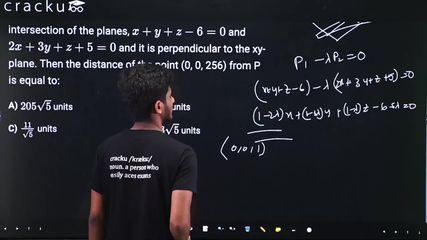
Let P be the plane, which contains the line of intersection of the planes, $$x + y + z - 6 = 0$$ and $$2x + 3y + z + 5 = 0$$ and it is perpendicular to the xy-plane. Then the distance of the point (0, 0, 256) from P is equal to:
First, we collect the two given planes:
$$\Pi_1:\;x+y+z-6=0 \qquad\text{and}\qquad \Pi_2:\;2x+3y+z+5=0.$$
Every plane that contains their line of intersection can be written with the one-parameter family
$$\Pi:\;(\Pi_1)+\lambda(\Pi_2)=0.$$
That is,
$$\bigl(x+y+z-6\bigr)+\lambda\bigl(2x+3y+z+5\bigr)=0.$$
Expanding and collecting like terms we obtain
$$\;(1+2\lambda)\,x+(1+3\lambda)\,y+(1+\lambda)\,z+(-6+5\lambda)=0.$$
For the required plane to be perpendicular to the $$xy$$-plane, its normal vector must lie completely inside the $$xy$$-plane. The normal of the $$xy$$-plane (which is $$z=0$$) is $$\langle 0,0,1\rangle$$, so our plane’s normal must be orthogonal to this vector; therefore its $$z$$-component must vanish. Hence we set
$$1+\lambda=0\;\;\Longrightarrow\;\;\lambda=-1.$$
Substituting $$\lambda=-1$$ into the coefficients above gives
$$\begin{aligned} 1+2\lambda&=1+2(-1)=-1,\\[2pt] 1+3\lambda&=1+3(-1)=-2,\\[2pt] 1+\lambda&=0,\\[2pt] -6+5\lambda&=-6+5(-1)=-11. \end{aligned}$$
Thus the required plane $$P$$ is
$$-x-2y-11=0.$$
Multiplying by $$-1$$ for neatness, we may write
$$P:\;x+2y+11=0.$$
(Notice that if a point lies on the intersection line of $$\Pi_1$$ and $$\Pi_2$$, then from those two equations we have $$x+2y=-11$$, exactly the condition $$x+2y+11=0$$, verifying that the line indeed lies in $$P$$.)
Now we calculate the perpendicular distance from the point $$A(0,0,256)$$ to this plane. The distance formula from a point $$(x_0,y_0,z_0)$$ to a plane $$Ax+By+Cz+D=0$$ is
$$\text{Distance}=\dfrac{\lvert Ax_0+By_0+Cz_0+D\rvert}{\sqrt{A^2+B^2+C^2}}.$$
For the plane $$x+2y+11=0$$ we have $$A=1,\;B=2,\;C=0,\;D=11.$$ Substituting the coordinates of $$A$$ gives
Numerator:
$$\lvert 1\cdot0+2\cdot0+0\cdot256+11\rvert=\lvert 11\rvert=11.$$
Denominator:
$$\sqrt{1^2+2^2+0^2}=\sqrt{1+4}=\sqrt5.$$
Therefore
$$\text{Distance}=\dfrac{11}{\sqrt5}\;\text{units}.$$
Hence, the correct answer is Option C.
Was this solution helpful?
Click on the Email ☝️ to Watch the Video Solution
Create a FREE account and get:
_1.webp)

Educational materials for JEE preparation

Ask our AI anything

AI can make mistakes. Please verify important information.
AI can make mistakes. Please verify important information.


