
Join Our JEE Preparation Group
Prep with like-minded aspirants; Get access to free daily tests and study material.
Sign in
Please select an account to continue using cracku.in
↓ →
Join Our JEE Preparation Group
Prep with like-minded aspirants; Get access to free daily tests and study material.
The vertices B and C of a $$\triangle ABC$$ lie on the line, $$\frac{x + 2}{3} = \frac{y - 1}{0} = \frac{z}{4}$$ such that $$BC = 5$$ units. Then the area (in sq. units) of this triangle, given the point $$A(1, -1, 2)$$, is:
We note first that the points B and C lie on the line
$$\frac{x+2}{3}=\frac{y-1}{0}=\frac{z}{4}.$$
The middle ratio contains the number 0 in the denominator, which forces
$$y-1=0 \;\Longrightarrow\; y=1$$
for every point of the line. Let the common value of the three ratios be the parameter $$t$$. Then we have
$$\frac{x+2}{3}=t,\qquad \frac{z}{4}=t,$$
which gives the parametric form
$$x = 3t-2,\qquad y = 1,\qquad z = 4t.$$
Hence we may write
$$B\bigl(3t_1-2,\;1,\;4t_1\bigr),\qquad C\bigl(3t_2-2,\;1,\;4t_2\bigr)$$
for some real parameters $$t_1$$ and $$t_2$$.
We are told that $$BC=5$$ units. Using the three-dimensional distance formula,
$$BC \;=\;\sqrt{\bigl(3t_1-2-(3t_2-2)\bigr)^2+\bigl(1-1\bigr)^2+\bigl(4t_1-4t_2\bigr)^2}.$$
Simplifying the differences inside the squares, we get
$$BC \;=\;\sqrt{\bigl(3(t_1-t_2)\bigr)^2 + 0 + \bigl(4(t_1-t_2)\bigr)^2} \;=\;\sqrt{9(t_1-t_2)^2 + 16(t_1-t_2)^2} \;=\;\sqrt{25(t_1-t_2)^2} \;=\;5\,|t_1-t_2|.$$
Since $$BC=5$$, we obtain
$$5\,|t_1-t_2|=5 \;\Longrightarrow\; |t_1-t_2|=1.$$
Without loss of generality we let
$$t_2=t_1+1.$$
Let us write $$t_1=t$$ for brevity. Then
$$B\bigl(3t-2,\;1,\;4t\bigr),\qquad C\bigl(3(t+1)-2,\;1,\;4(t+1)\bigr) \;=\;\bigl(3t+1,\;1,\;4t+4\bigr).$$
Point $$A$$ is fixed as $$A(1,-1,2).$$ We set up the two vectors emanating from $$A$$:
$$\vec{AB}=B-A =\bigl(3t-2-1,\;1-(-1),\;4t-2\bigr) =\bigl(3t-3,\;2,\;4t-2\bigr),$$
$$\vec{AC}=C-A =\bigl(3t+1-1,\;1-(-1),\;4t+4-2\bigr) =\bigl(3t,\;2,\;4t+2\bigr).$$
To find the area of $$\triangle ABC$$ we use the formula
$$\text{Area}=\tfrac12\bigl|\vec{AB}\times\vec{AC}\bigr|,$$
where $$\times$$ denotes the vector cross product.
We now compute $$\vec{AB}\times\vec{AC}$$. Writing the determinant explicitly,
$$ \vec{AB}\times\vec{AC}= \begin{vmatrix} \mathbf{i} & \mathbf{j} & \mathbf{k}\\[4pt] 3t-3 & 2 & 4t-2\\[4pt] 3t & 2 & 4t+2 \end{vmatrix}. $$
Expanding along the first row,
$$ \vec{AB}\times\vec{AC} = \mathbf{i}\bigl(2(4t+2)-(4t-2)2\bigr) -\mathbf{j}\bigl((3t-3)(4t+2)-(4t-2)(3t)\bigr) +\mathbf{k}\bigl((3t-3)2-2(3t)\bigr). $$
Let us simplify each component one by one.
For $$\mathbf{i}$$:
$$2(4t+2)-(4t-2)2 =2(4t+2-4t+2) =2(4) =8.$$
For $$\mathbf{j}$$ (remembering the minus sign in front):
$$(3t-3)(4t+2) =12t^2-12t+6t-6 =12t^2-6t-6,$$
$$(4t-2)(3t)=12t^2-6t.$$
Taking the difference gives
$$(3t-3)(4t+2)-(4t-2)(3t) =12t^2-6t-6-(12t^2-6t) =-6.$$
Thus the $$\mathbf{j}$$ component equals $$-(-6)=6.$$
For $$\mathbf{k}$$:
$$(3t-3)2-2(3t) =2(3t-3-3t) =2(-3) =-6.$$
Putting the three components together, we have
$$\vec{AB}\times\vec{AC}=(8,\,6,\,-6).$$
Its magnitude is
$$|\vec{AB}\times\vec{AC}| =\sqrt{8^2+6^2+(-6)^2} =\sqrt{64+36+36} =\sqrt{136} =\sqrt{4\cdot34} =2\sqrt{34}.$$
Therefore, the required area is
$$\text{Area} =\tfrac12\bigl|\vec{AB}\times\vec{AC}\bigr| =\tfrac12\,(2\sqrt{34}) =\sqrt{34}.$$
Notice that the parameter $$t$$ has vanished from the final expression, so the area is indeed unique.
Hence, the correct answer is Option C.
Was this solution helpful?
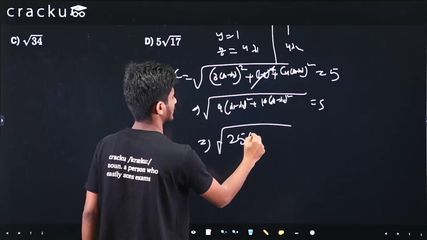
Click on the Email ☝️ to Watch the Video Solution
Create a FREE account and get:
_1.webp)

Educational materials for JEE preparation

Ask our AI anything

AI can make mistakes. Please verify important information.
AI can make mistakes. Please verify important information.


