
Join Our JEE Preparation Group
Prep with like-minded aspirants; Get access to free daily tests and study material.
Sign in
Please select an account to continue using cracku.in
↓ →
Join Our JEE Preparation Group
Prep with like-minded aspirants; Get access to free daily tests and study material.
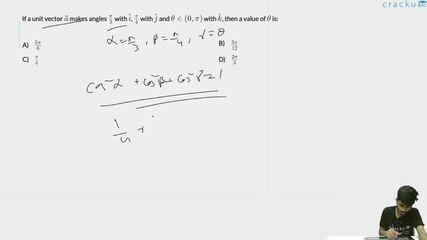
If a unit vector $$\vec{a}$$ makes angles $$\frac{\pi}{3}$$ with $$\hat{i}$$, $$\frac{\pi}{4}$$ with $$\hat{j}$$ and $$\theta \in (0, \pi)$$ with $$\hat{k}$$, then a value of $$\theta$$ is:
For any vector in three-dimensional space, if the angles made with the positive coordinate axes are $$\alpha,\;\beta,\;\gamma,$$ then (direction-cosine identity)
$$\cos^{2}\alpha+\cos^{2}\beta+\cos^{2}\gamma = 1.$$
Here the given angles are $$\alpha=\dfrac{\pi}{3},\;\beta=\dfrac{\pi}{4},\;\gamma=\theta,$$ so we substitute them into the identity.
First we evaluate each cosine:
$$\cos\dfrac{\pi}{3} = \dfrac12 \quad\Longrightarrow\quad \cos^{2}\dfrac{\pi}{3}=\left(\dfrac12\right)^{2}=\dfrac14.$$
$$\cos\dfrac{\pi}{4} = \dfrac{1}{\sqrt2}=\dfrac{\sqrt2}{2}\quad\Longrightarrow\quad \cos^{2}\dfrac{\pi}{4}=\left(\dfrac{\sqrt2}{2}\right)^{2}=\dfrac12.$$
Now we place these values in the identity and solve for $$\cos^{2}\theta$$:
$$\cos^{2}\dfrac{\pi}{3}+\cos^{2}\dfrac{\pi}{4}+\cos^{2}\theta = 1$$
$$\Longrightarrow\quad \dfrac14+\dfrac12+\cos^{2}\theta = 1.$$
We add the fractions on the left:
$$\dfrac14+\dfrac12 = \dfrac14+\dfrac24 = \dfrac34.$$
So we have
$$\dfrac34+\cos^{2}\theta = 1.$$
Subtracting $$\dfrac34$$ from both sides gives
$$\cos^{2}\theta = 1-\dfrac34 = \dfrac14.$$
Taking the square root, we obtain
$$\cos\theta = \pm\dfrac12.$$
Because $$\theta\in(0,\pi),$$ both values are possible in principle, yielding
$$\theta = \dfrac{\pi}{3}\quad\text{or}\quad\theta = \dfrac{2\pi}{3}.$$
Among the options provided, only $$\dfrac{2\pi}{3}$$ appears.
Hence, the correct answer is Option D.
Was this solution helpful?
Click on the Email ☝️ to Watch the Video Solution
Create a FREE account and get:
_1.webp)

Educational materials for JEE preparation

Ask our AI anything

AI can make mistakes. Please verify important information.
AI can make mistakes. Please verify important information.


