
Join Our JEE Preparation Group
Prep with like-minded aspirants; Get access to free daily tests and study material.
Sign in
Please select an account to continue using cracku.in
↓ →
Join Our JEE Preparation Group
Prep with like-minded aspirants; Get access to free daily tests and study material.
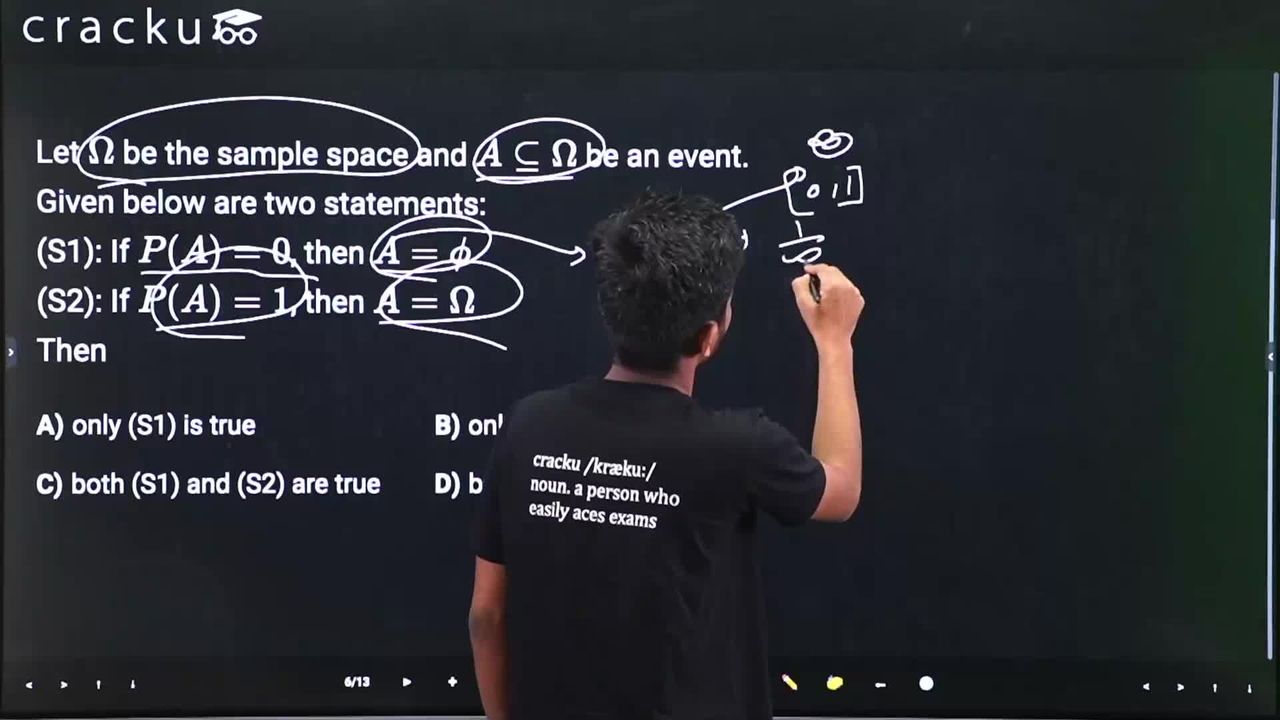
Let $$\Omega$$ be the sample space and $$A \subseteq \Omega$$ be an event. Given below are two statements:
(S1): If $$P(A) = 0$$, then $$A = \phi$$
(S2): If $$P(A) = 1$$, then $$A = \Omega$$
Then
We need to analyze the two statements about probability.
(S1): If $$P(A) = 0$$, then $$A = \phi$$.
This is false. In a continuous sample space (e.g., choosing a real number uniformly from $$[0, 1]$$), any singleton event $$\{x\}$$ has probability 0 but is not the empty set. Even in discrete cases with countably infinite sample spaces, events can have probability 0 without being empty.
(S2): If $$P(A) = 1$$, then $$A = \Omega$$.
This is also false. For example, if $$\Omega = [0, 1]$$ with uniform probability, then $$A = (0, 1)$$ (open interval) has $$P(A) = 1$$ but $$A \neq \Omega$$ since it doesn't contain the endpoints.
Both statements are false.
The answer is Option 4: both (S1) and (S2) are false.
Was this solution helpful?
Click on the Email ☝️ to Watch the Video Solution
Create a FREE account and get:
_1.webp)

Educational materials for JEE preparation

Ask our AI anything

AI can make mistakes. Please verify important information.
AI can make mistakes. Please verify important information.
