
Join Our JEE Preparation Group
Prep with like-minded aspirants; Get access to free daily tests and study material.
Sign in
Please select an account to continue using cracku.in
↓ →
Join Our JEE Preparation Group
Prep with like-minded aspirants; Get access to free daily tests and study material.
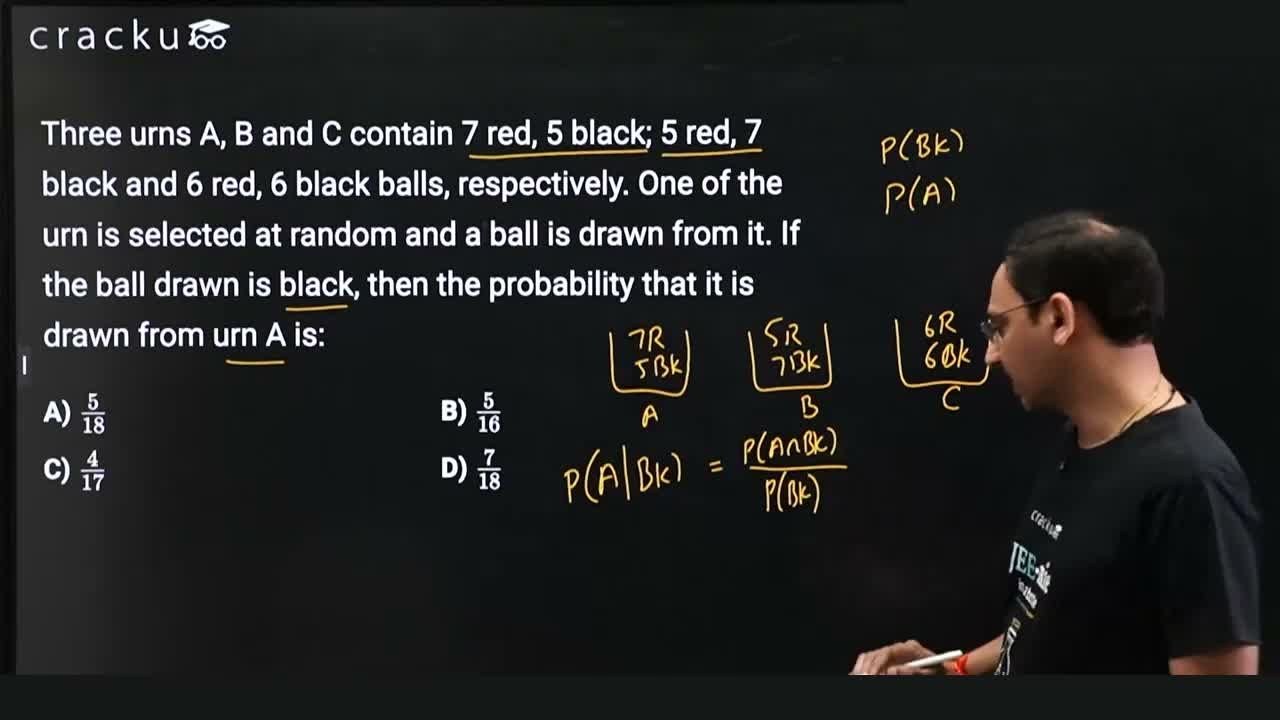
Three urns A, B and C contain 7 red, 5 black; 5 red, 7 black and 6 red, 6 black balls, respectively. One of the urn is selected at random and a ball is drawn from it. If the ball drawn is black, then the probability that it is drawn from urn A is:
We can use the Bayes Theorem:
$$E_1$$: Selecting Urn A
$$E_2$$: Selecting Urn B
$$E_3$$: Selecting Urn C
Because the urn is chosen completely at random, the probability of selecting any single urn is equal:
$$P(E_1) = P(E_2) = P(E_3) = \dfrac{1}{3}$$
Let $$B$$ be the event of drawing a black ball. We have to find the probability of drawing a black ball from each specific urn.
Each urn contains exactly 12 balls in total (7+5 = 12, 5+7 = 12, 6+6 = 12).
Urn A has 5 black balls: $$P(B|E_1) = \dfrac{5}{12}$$
Urn B has 7 black balls: $$P(B|E_2) = \dfrac{7}{12}$$
Urn C has 6 black balls: $$P(B|E_3) = \dfrac{6}{12}$$
Bayes Theorem: $$P(E_1|B) = \dfrac{P(E_1) \cdot P(B|E_1)}{P(E_1) \cdot P(B|E_1) + P(E_2) \cdot P(B|E_2) + P(E_3) \cdot P(B|E_3)}$$
$$P(E_1|B) = \dfrac{\left(\dfrac{1}{3}\right) \cdot \left(\dfrac{5}{12}\right)}{\left(\dfrac{1}{3}\right) \cdot \left(\dfrac{5}{12}\right) + \left(\dfrac{1}{3}\right) \cdot \left(\dfrac{7}{12}\right) + \left(\dfrac{1}{3}\right) \cdot \left(\dfrac{6}{12}\right)}$$
$$P(E_1|B) = \dfrac{5}{5 + 7 + 6}$$
$$P(E_1|B) = \dfrac{5}{18}$$
Was this solution helpful?
Click on the Email ☝️ to Watch the Video Solution
Create a FREE account and get:
_1.webp)

Educational materials for JEE preparation

Ask our AI anything

AI can make mistakes. Please verify important information.
AI can make mistakes. Please verify important information.
