
Join Our JEE Preparation Group
Prep with like-minded aspirants; Get access to free daily tests and study material.
Sign in
Please select an account to continue using cracku.in
↓ →
Join Our JEE Preparation Group
Prep with like-minded aspirants; Get access to free daily tests and study material.
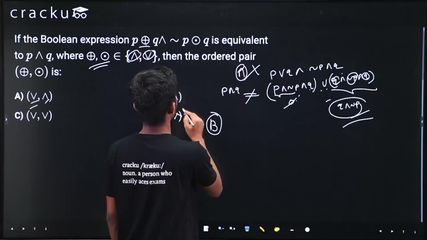
If the Boolean expression $$p \oplus q \wedge \sim p \odot q$$ is equivalent to $$p \wedge q$$, where $$\oplus$$, $$\odot \in \{\wedge, \vee\}$$, then the ordered pair $$(\oplus, \odot)$$ is:
We begin with the symbolic sentence
$$p \;\oplus\; q \wedge \sim p \;\odot\; q$$
The tilde $$\sim$$ (negation) always has the highest precedence. Among the binary connectives we remember the usual rule “AND binds more strongly than OR”. Therefore the fixed connective $$\wedge$$ (which is written explicitly in the statement) is evaluated before whichever symbol will finally be placed in $$\oplus$$. In the same way, the symbol $$\odot$$ will first be replaced by either $$\wedge$$ or $$\vee$$ and then be evaluated inside the parentheses that we shall introduce for clarity.
So, whatever the final choice of $$\oplus$$ and $$\odot$$ is, the expression can be read as
$$p \;\oplus\; \bigl(q \wedge (\sim p \;\odot\; q)\bigr).$$
We are told that, after the two replacements are made, the above statement must be identically equal to the simple conjunction $$p \wedge q$$. There are only four possible ordered pairs
$$(\oplus,\;\odot)\;=\; (\vee,\wedge),\; (\wedge,\wedge),\; (\vee,\vee),\; (\wedge,\vee).$$
We shall substitute each pair one by one, simplify by ordinary Boolean algebra, and see which pair really gives $$p\wedge q$$.
1. $$(\oplus,\odot)=(\vee,\wedge)$$
$$\begin{aligned} p\vee\bigl(q\wedge(\sim p\wedge q)\bigr) &=p\vee\bigl(q\wedge\sim p\wedge q\bigr)\\[2mm] &=p\vee\bigl(q\wedge q\wedge\sim p\bigr)\\[2mm] &=p\vee(q\wedge\sim p)\\[2mm] &\;=\;(p\vee q)\wedge(p\vee\sim p)\qquad\text{[distributive law]}\\[2mm] &=p\vee q. \end{aligned}$$
This is $$p\vee q$$, not $$p\wedge q$$, so the first pair fails.
2. $$(\oplus,\odot)=(\wedge,\wedge)$$
$$\begin{aligned} p\wedge\bigl(q\wedge(\sim p\wedge q)\bigr) &=p\wedge q\wedge\sim p\wedge q\\[2mm] &=p\wedge\sim p\wedge q\\[2mm] &=\text{False}. \end{aligned}$$
This is the zero (contradiction) function, not $$p\wedge q$$, so the second pair is also rejected.
3. $$(\oplus,\odot)=(\vee,\vee)$$
$$\begin{aligned} p\vee\bigl(q\wedge(\sim p\vee q)\bigr) &=p\vee\bigl((q\wedge\sim p)\vee(q\wedge q)\bigr)\\[2mm] &=p\vee\bigl((q\wedge\sim p)\vee q\bigr)\\[2mm] &=p\vee q. \end{aligned}$$
Again the result is $$p\vee q\neq p\wedge q$$, so the third pair does not work either.
4. $$(\oplus,\odot)=(\wedge,\vee)$$
$$\begin{aligned} p\wedge\bigl(q\wedge(\sim p\vee q)\bigr) &=p\wedge\Bigl(q\wedge\bigl[(\sim p\vee q)\bigr]\Bigr)\\[2mm] &\text{Use the distributive law inside the square brackets:}\\[2mm] &\qquad q\wedge(\sim p\vee q) =(q\wedge\sim p)\vee(q\wedge q) =(q\wedge\sim p)\vee q\\[2mm] &\qquad\qquad =q\vee(q\wedge\sim p)=q.\\[4mm] \therefore\; p\wedge\bigl(q\wedge(\sim p\vee q)\bigr) &=p\wedge q. \end{aligned}$$
This time the simplified form is exactly $$p\wedge q$$, the target expression. Hence only the ordered pair $$\bigl(\wedge,\;\vee\bigr)$$ satisfies the requirement.
Therefore the Boolean sentence is equivalent to $$p\wedge q$$ only when
$$ (\oplus,\;\odot)=\;(\wedge,\;\vee). $$
Hence, the correct answer is Option 4.
Was this solution helpful?
Click on the Email ☝️ to Watch the Video Solution
Create a FREE account and get:
_1.webp)

Educational materials for JEE preparation

Ask our AI anything

AI can make mistakes. Please verify important information.
AI can make mistakes. Please verify important information.
