
Join Our JEE Preparation Group
Prep with like-minded aspirants; Get access to free daily tests and study material.
Sign in
Please select an account to continue using cracku.in
↓ →
Join Our JEE Preparation Group
Prep with like-minded aspirants; Get access to free daily tests and study material.
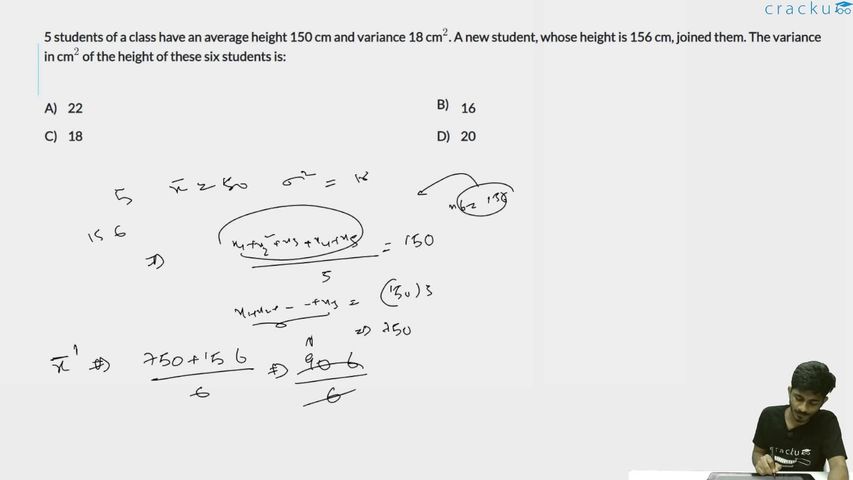
5 students of a class have an average height 150 cm and variance 18 cm$$^2$$. A new student, whose height is 156 cm, joined them. The variance in cm$$^2$$ of the height of these six students is:
We know that for any data set of size $$n$$, the (population) variance formula is stated as
$$\sigma^{2}= \dfrac{\displaystyle\sum_{i=1}^{n}x_{i}^{2}}{n}-\mu^{2},$$
where $$\mu$$ is the mean $$\left(\mu=\dfrac{\sum x_{i}}{n}\right)$$. We first apply this to the original five students. Their mean height is given as $$\mu_{1}=150\ \text{cm}$$ and their variance is $$\sigma_{1}^{2}=18\ \text{cm}^{2}$$. Substituting in the formula, we get
$$\sum_{i=1}^{5}x_{i}^{2}=n\left(\sigma_{1}^{2}+\mu_{1}^{2}\right) =5\left(18+150^{2}\right) =5\left(18+22500\right) =5\times22518 =112590.$$
The sum of their heights is simply $$\sum_{i=1}^{5}x_{i}=n\mu_{1}=5\times150=750.$$
Now a sixth student of height $$x_{6}=156\ \text{cm}$$ joins the group. So the new number of students is $$n_{2}=6$$. The new total height becomes
$$\sum_{i=1}^{6}x_{i}=750+156=906,$$
leading to the new mean
$$\mu_{2}=\dfrac{906}{6}=151\ \text{cm}.$$
In the same way, the new sum of squares is
$$\sum_{i=1}^{6}x_{i}^{2}=112590+156^{2}=112590+24336=136926.$$
Applying the variance formula once more, we obtain
$$\sigma_{2}^{2} =\dfrac{136926}{6}-\mu_{2}^{2} =22821-151^{2} =22821-22801 =20\ \text{cm}^{2}.$$
Hence, the correct answer is Option D.
Was this solution helpful?
Click on the Email ☝️ to Watch the Video Solution
Create a FREE account and get:
_1.webp)

Educational materials for JEE preparation

Ask our AI anything

AI can make mistakes. Please verify important information.
AI can make mistakes. Please verify important information.
