For the following questions answer them individually
A particle is moving with a velocity $$\vec{v} = K(y\hat{i} + x\hat{j})$$, where $$K$$ is a constant. The general equation for its path is:
A copper wire is stretched to make it 0.5% longer. The percentage change in its electrical resistance if its volume remains unchanged is:
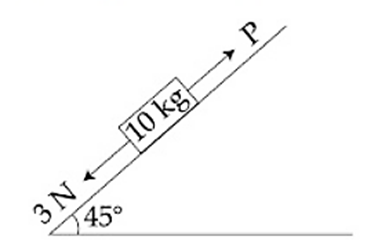
A block of mass 10 kg is kept on a rough inclined plane as shown in the figure. A force of 3 N is applied on the block. The coefficient of static friction between the plane and the block is 0.6. What should be the minimum value of force P, such that the block does not move downward? (take $$g = 10 \; ms^{-2}$$)
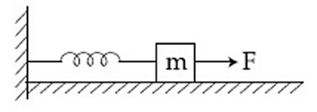
A block of mass $$m$$, lying on a smooth horizontal surface, is attached to a spring (of negligible mass) of spring constant $$k$$. The other end of the spring is fixed, as shown in the figure. The block is initially at rest in its equilibrium position. If now the block is pulled with a constant force $$F$$, the maximum speed of the block is:
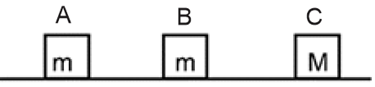
Three blocks A, B and C are lying on a smooth horizontal surface, as shown in the figure. A and B have equal masses, $$m$$ while C has mass $$M$$. Block A is given an initial speed $$v$$ towards B due to which it collides with B perfectly inelastically. The combined mass collides with C, also perfectly inelastically. $$\frac{5}{6}$$th of the initial kinetic energy is lost in the whole process. What is the value of $$M/m$$?
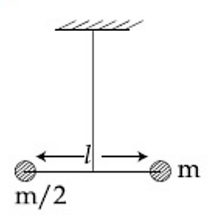
Two masses $$m$$ and $$\frac{m}{2}$$ are connected at the two ends of a massless rigid rod of length $$l$$. The rod is suspended by a thin wire of torsional constant $$k$$ at the centre of mass of the rod-mass system (see figure). Because of torsional constant $$k$$, the restoring torque is $$\tau = k\theta$$ for angular displacement $$\theta$$. If the rod is rotated by $$\theta_0$$ and released, the tension in it when it passes through its mean position will be:
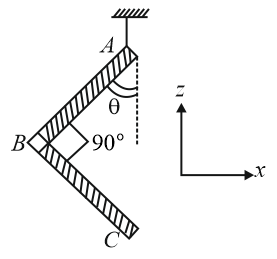
An $$L$$-shaped object, made of thin rods of uniform mass density, is suspended with a string as shown in figure. If $$AB = BC$$, and the angle made by $$AB$$ with downward vertical is $$\theta$$, then:
If the angular momentum of a planet of mass $$m$$, moving around the Sun in a circular orbit is $$L$$, about the center of the Sun, its areal velocity is:
A heavy ball of mass $$M$$ is suspended from the ceiling of a car by a light string of mass $$m$$ ($$m \ll M$$). When the car is at rest, the speed of transverse waves in the string is 60 ms$$^{-1}$$. When the car has acceleration $$a$$, the wave-speed increases to 60.5 ms$$^{-1}$$. The value of $$a$$, in terms of gravitational acceleration $$g$$, is closest to:
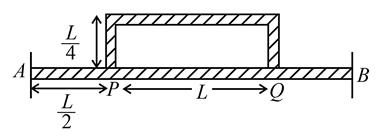
A rod, of length $$L$$ at room temperature and uniform area of cross section $$A$$, is made of a metal having coefficient of linear expansion $$\alpha$$ /$$^{\circ}$$C. It is observed that an external compressive force $$F$$ is applied on each of its ends, prevents any change in the length of the rod when its temperature rises by $$\Delta T$$ K. Young's modulus, $$Y$$ for this metal is: