
Join Our JEE Preparation Group
Prep with like-minded aspirants; Get access to free daily tests and study material.
Sign in
Please select an account to continue using cracku.in
↓ →
Join Our JEE Preparation Group
Prep with like-minded aspirants; Get access to free daily tests and study material.
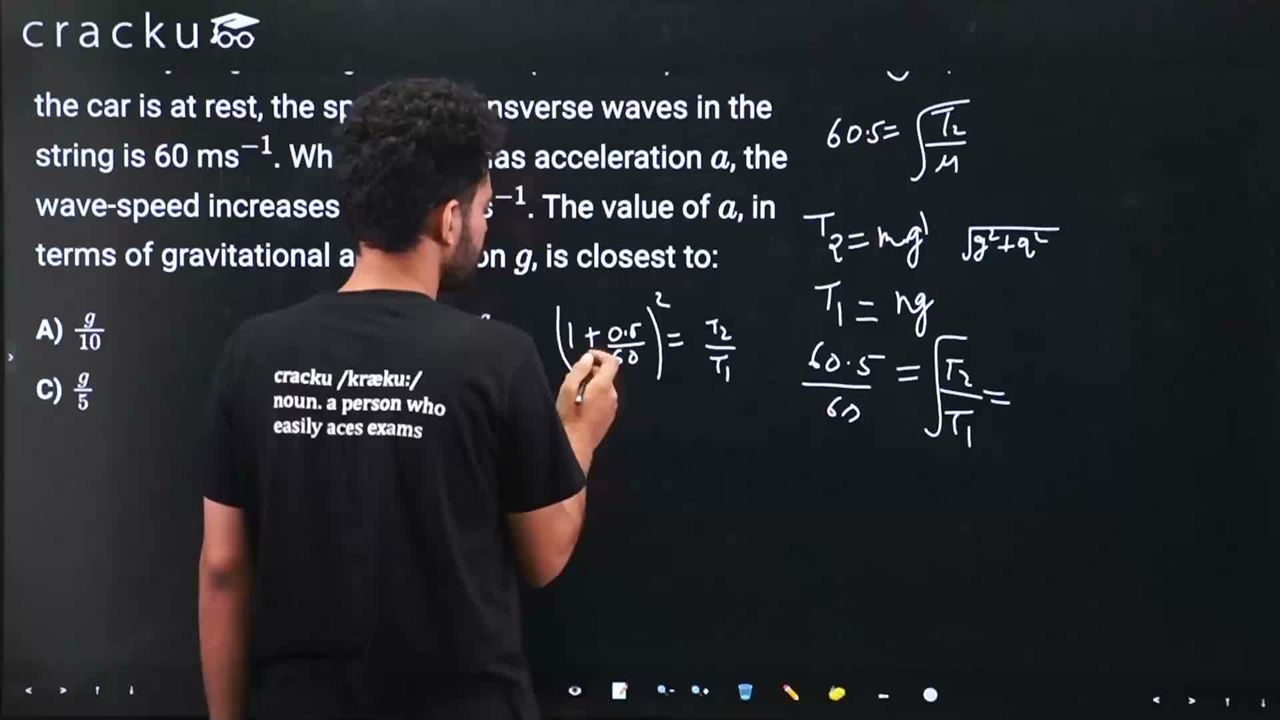
A heavy ball of mass $$M$$ is suspended from the ceiling of a car by a light string of mass $$m$$ ($$m \ll M$$). When the car is at rest, the speed of transverse waves in the string is 60 ms$$^{-1}$$. When the car has acceleration $$a$$, the wave-speed increases to 60.5 ms$$^{-1}$$. The value of $$a$$, in terms of gravitational acceleration $$g$$, is closest to:
Let the length of the string be $$L$$. Its linear mass‐density is
$$\mu=\dfrac{m}{L}\,.$$
The speed of a transverse wave on a stretched string is given by the well-known relation
$$v=\sqrt{\dfrac{T}{\mu}},$$
where $$T$$ is the tension in the string.
When the car is at rest the only force on the heavy ball is its weight. Hence the tension equals the weight:
$$T_1 = Mg.$$
The corresponding wave-speed is given to be
$$v_1 = 60\ \text{m s}^{-1}.$$
Therefore
$$v_1^2=\dfrac{T_1}{\mu}\quad\Longrightarrow\quad 60^2=\dfrac{Mg}{\mu}.$$
When the car accelerates horizontally with acceleration $$a$$, a backward pseudo-force $$Ma$$ acts on the ball in the non-inertial frame of the car. The ball is now in equilibrium under three forces: its weight $$Mg$$ downward, the pseudo-force $$Ma$$ horizontally, and the string tension $$T_2$$ along the string. Balancing the components, the magnitude of the tension is
$$T_2 = M\sqrt{g^{2}+a^{2}}.$$
The new speed of transverse waves is given to be
$$v_2 = 60.5\ \text{m s}^{-1}.$$
Again using the wave-speed formula,
$$v_2^2=\dfrac{T_2}{\mu}\quad\Longrightarrow\quad 60.5^{2}=\dfrac{M\sqrt{g^{2}+a^{2}}}{\mu}.$$
Taking the ratio of the two speed equations eliminates $$\mu$$ and $$M$$:
$$\left(\dfrac{v_2}{v_1}\right)^{2}=\dfrac{T_2}{T_1} =\dfrac{M\sqrt{g^{2}+a^{2}}}{\mu}\;\Big/\;\dfrac{Mg}{\mu} =\dfrac{\sqrt{g^{2}+a^{2}}}{g}.$$
Substituting the numerical values of the speeds,
$$\left(\dfrac{60.5}{60}\right)^{2}=\dfrac{\sqrt{g^{2}+a^{2}}}{g}.$$
First evaluate the left side step by step:
$$\dfrac{60.5}{60}=1+\dfrac{0.5}{60}=1+\dfrac{1}{120}=1.008\overline{3},$$
so
$$\left(1.008\overline{3}\right)^{2}\approx1.016736.$$
Hence
$$1.016736=\dfrac{\sqrt{g^{2}+a^{2}}}{g}.$$
Multiplying by $$g$$ and then squaring both sides,
$$\sqrt{g^{2}+a^{2}}=1.016736\,g,$$
$$g^{2}+a^{2}=1.016736^{2}\,g^{2}.$$
Now compute the square:
$$1.016736^{2}\approx1.033752.$$
Substituting,
$$g^{2}+a^{2}=1.033752\,g^{2},$$
so
$$a^{2}=(1.033752-1)\,g^{2}=0.033752\,g^{2}.$$
Taking the square root,
$$a=g\sqrt{0.033752}\approx g(0.1838)\approx0.18\,g.$$
This value is most nearly $$\dfrac{g}{5}=0.20\,g$$ among the listed options.
Hence, the correct answer is Option C.
Was this solution helpful?
Click on the Email ☝️ to Watch the Video Solution
Create a FREE account and get:
_1.webp)

Educational materials for JEE preparation

Ask our AI anything

AI can make mistakes. Please verify important information.
AI can make mistakes. Please verify important information.
