
Join Our JEE Preparation Group
Prep with like-minded aspirants; Get access to free daily tests and study material.
Sign in
Please select an account to continue using cracku.in
↓ →
Join Our JEE Preparation Group
Prep with like-minded aspirants; Get access to free daily tests and study material.
Three blocks A, B and C are lying on a smooth horizontal surface, as shown in the figure. A and B have equal masses, $$m$$ while C has mass $$M$$. Block A is given an initial speed $$v$$ towards B due to which it collides with B perfectly inelastically. The combined mass collides with C, also perfectly inelastically. $$\frac{5}{6}$$th of the initial kinetic energy is lost in the whole process. What is the value of $$M/m$$?
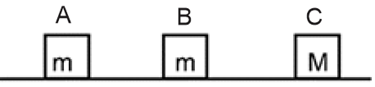
Initial kinetic energy of the system: $$K_i = \frac{1}{2}mv^2$$
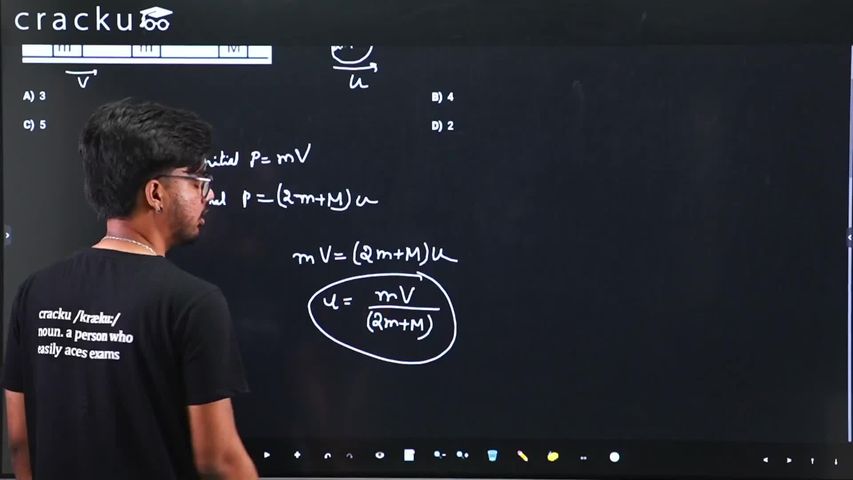
Conservation of linear momentum for the final state (all blocks stick together): $$mv = (m + m + M)v_f \implies v_f = \frac{mv}{2m + M}$$
Final kinetic energy of the system: $$K_f = \frac{1}{2}(2m + M)v_f^2 = \frac{1}{2}(2m + M)\left(\frac{mv}{2m + M}\right)^2 = \frac{m^2v^2}{2(2m + M)}$$
Given fractional loss of kinetic energy is $$\frac{5}{6}$$, the fraction remaining is:
$$\frac{K_f}{K_i} = 1 - \frac{5}{6} = \frac{1}{6}$$
$$\frac{\frac{m^2v^2}{2(2m + M)}}{\frac{1}{2}mv^2} = \frac{1}{6} \implies \frac{m}{2m + M} = \frac{1}{6}$$
$$6m = 2m + M \implies M = 4m$$
$$\frac{M}{m} = 4$$
Was this solution helpful?
Click on the Email ☝️ to Watch the Video Solution
Create a FREE account and get:
_1.webp)

Educational materials for JEE preparation

Ask our AI anything

AI can make mistakes. Please verify important information.
AI can make mistakes. Please verify important information.
