
Join Our JEE Preparation Group
Prep with like-minded aspirants; Get access to free daily tests and study material.
Sign in
Please select an account to continue using cracku.in
↓ →
Join Our JEE Preparation Group
Prep with like-minded aspirants; Get access to free daily tests and study material.
Two masses $$m$$ and $$\frac{m}{2}$$ are connected at the two ends of a massless rigid rod of length $$l$$. The rod is suspended by a thin wire of torsional constant $$k$$ at the centre of mass of the rod-mass system (see figure). Because of torsional constant $$k$$, the restoring torque is $$\tau = k\theta$$ for angular displacement $$\theta$$. If the rod is rotated by $$\theta_0$$ and released, the tension in it when it passes through its mean position will be:
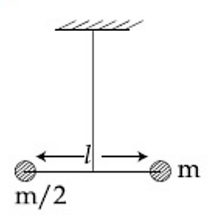
Let the heavier mass $$m$$ be placed at the left end of the light, rigid rod and the lighter mass $$\dfrac{m}{2}$$ at the right end. The total length of the rod is $$l$$. The rod is suspended from its centre of mass by a thin torsion wire whose torsional constant is $$k$$, so the restoring torque supplied by the wire is $$\tau = k\theta$$ whenever the system is given a small angular displacement $$\theta$$ about the vertical.
First we determine the position of the centre of mass along the rod. Measuring the distance $$x$$ from the heavier mass, we have
$$x \;=\; \frac{m\,(0) \;+\; \dfrac{m}{2}\,(l)}{m + \dfrac{m}{2}} \;=\; \frac{\dfrac{m}{2}\,l}{\dfrac{3m}{2}} \;=\; \frac{l}{3}.$$
Hence the centre of mass lies at a distance $$\dfrac{l}{3}$$ from the mass $$m$$ and therefore at a distance $$\dfrac{2l}{3}$$ from the mass $$\dfrac{m}{2}$$.
Writing these two distances explicitly,
$$r_1 = \frac{l}{3}, \qquad r_2 = \frac{2l}{3},$$
where $$r_1$$ and $$r_2$$ are the radii of circular motion of the two masses about the suspension (centre of mass) when the system oscillates.
Next we need the moment of inertia of the system about this suspension point. Because the rod itself is massless,
$$I = m\,r_1^{2} + \frac{m}{2}\,r_2^{2} = m\!\left(\frac{l}{3}\right)^{2} + \frac{m}{2}\!\left(\frac{2l}{3}\right)^{2}.$$
Expanding the squares,
$$I = m\,\frac{l^{2}}{9} + \frac{m}{2}\,\frac{4l^{2}}{9} = \frac{m l^{2}}{9} \;\Bigl(1 + 2\Bigr) = \frac{m l^{2}}{3}.$$
For a torsional oscillator the angular frequency is given by the standard formula
$$\omega = \sqrt{\frac{k}{I}}.$$
The rod is rotated through an initial angle $$\theta_0$$ and released from rest. The elastic potential energy stored in the wire at that extreme position is
$$U = \frac{1}{2}\,k\,\theta_0^{2}.$$
When the system swings back and passes through its mean position $$\theta = 0$$, this potential energy is completely converted into rotational kinetic energy. Thus, by conservation of mechanical energy,
$$\frac{1}{2}\,I\,\omega_{\!m}^{2} = \frac{1}{2}\,k\,\theta_0^{2},$$
where $$\omega_{\!m}$$ is the angular speed at the mean position. Cancelling the common factor $$\frac{1}{2}$$, we obtain
$$\omega_{\!m}^{2} = \frac{k}{I}\,\theta_0^{2}.$$
Substituting the value of $$I$$ found earlier,
$$\omega_{\!m}^{2} = \frac{k}{\dfrac{m l^{2}}{3}}\;\theta_0^{2} = \frac{3k}{m l^{2}}\,\theta_0^{2}.$$
We now turn to the tension in the rod when it passes through the mean position. At that instant both masses move in horizontal circles with the angular speed $$\omega_{\!m}$$. The rod must supply the necessary centripetal force to each mass, and because the rod is light, the internal tensile force (tension) will be the same throughout its length provided the net axial force on the rod is zero.
The centripetal force required for the heavier mass $$m$$ is
$$T_1 = m\,r_1\,\omega_{\!m}^{2} = m\left(\frac{l}{3}\right)\omega_{\!m}^{2}.$$
For the lighter mass $$\dfrac{m}{2}$$ the required centripetal force is
$$T_2 = \frac{m}{2}\,r_2\,\omega_{\!m}^{2} = \frac{m}{2}\left(\frac{2l}{3}\right)\omega_{\!m}^{2} = m\left(\frac{l}{3}\right)\omega_{\!m}^{2}.$$
Notice that $$T_1 = T_2$$, so the same magnitude of tension acts at both ends of the rod. Calling this common value simply $$T$$ we have
$$T = m\left(\frac{l}{3}\right)\omega_{\!m}^{2}.$$
Finally substitute the expression for $$\omega_{\!m}^{2}$$ obtained earlier:
$$T = m\left(\frac{l}{3}\right)\left(\frac{3k}{m l^{2}}\,\theta_0^{2}\right) = \cancel{m}\,\frac{l}{3}\,\frac{3k}{\cancel{m}\,l^{2}}\,\theta_0^{2} = \frac{k}{l}\,\theta_0^{2}.$$
Thus the magnitude of the tension in the rod when it sweeps through its mean position is
$$T = \frac{k\theta_0^{2}}{l}.$$
Hence, the correct answer is Option D.
Was this solution helpful?
Create a FREE account and get:
_1.webp)

Educational materials for JEE preparation

Ask our AI anything

AI can make mistakes. Please verify important information.
AI can make mistakes. Please verify important information.
