
Join Our JEE Preparation Group
Prep with like-minded aspirants; Get access to free daily tests and study material.
Sign in
Please select an account to continue using cracku.in
↓ →
Join Our JEE Preparation Group
Prep with like-minded aspirants; Get access to free daily tests and study material.
An $$L$$-shaped object, made of thin rods of uniform mass density, is suspended with a string as shown in figure. If $$AB = BC$$, and the angle made by $$AB$$ with downward vertical is $$\theta$$, then:
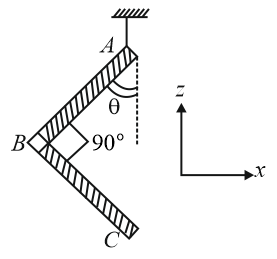
Let $$AB = BC = L$$, and the mass of each uniform rod segment be $$m$$.
Let the point of suspension $$A$$ be the origin $$(0,0)$$.
Taking the downward vertical as the reference line.
Coordinates of the center of mass of rod AB ($$G_1$$): $$x_1 = -\frac{L}{2}\sin\theta, \quad z_1 = -\frac{L}{2}\cos\theta$$
Coordinates of the center of mass of rod BC ($$G_2$$): $$x_2 = -L\sin\theta + \frac{L}{2}\cos\theta, \quad z_2 = -L\cos\theta - \frac{L}{2}\sin\theta$$
For rotational equilibrium about the suspension point $$A$$:
$$\tau_A = 0 \implies m g |x_1| + m g x_2 = 0 \implies x_{\text{cm}} = 0$$
$$m\left(-\frac{L}{2}\sin\theta\right) + m\left(-L\sin\theta + \frac{L}{2}\cos\theta\right) = 0$$
$$-\frac{3}{2}L\sin\theta + \frac{1}{2}L\cos\theta = 0 \implies 3\sin\theta = \cos\theta$$
$$\tan\theta = \frac{1}{3}$$
Was this solution helpful?
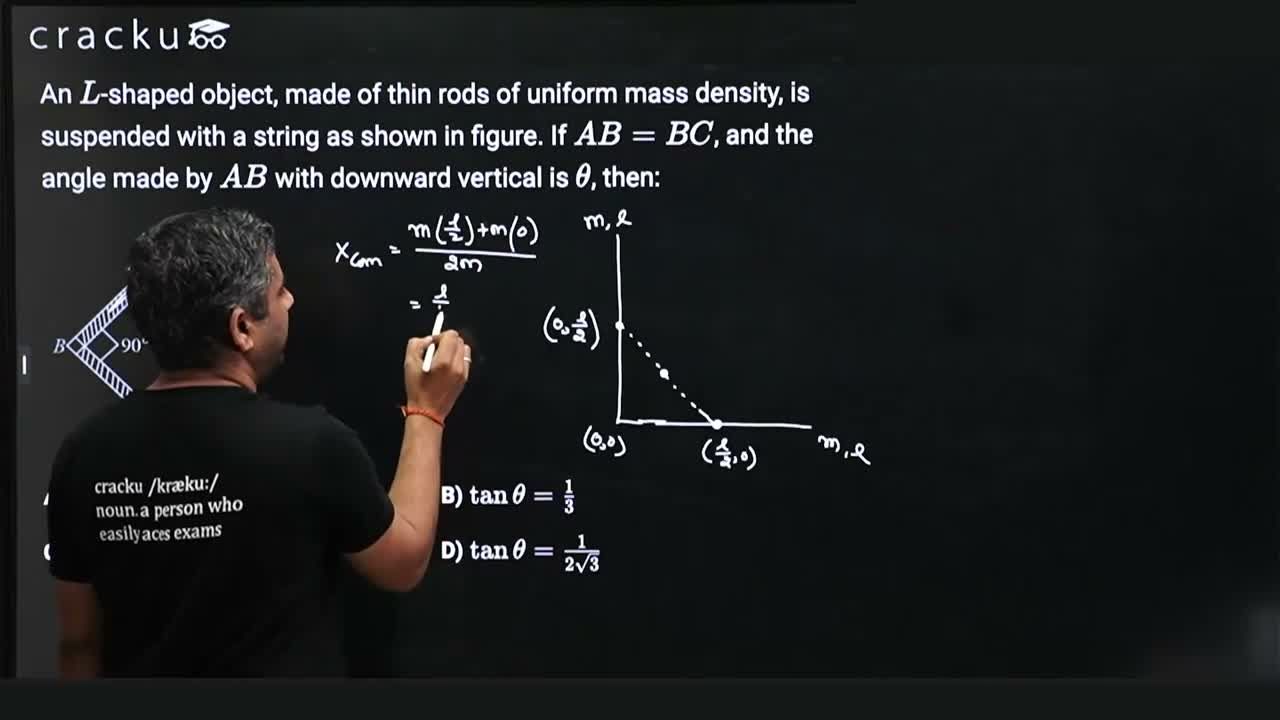
Click on the Email ☝️ to Watch the Video Solution
Create a FREE account and get:
_1.webp)

Educational materials for JEE preparation

Ask our AI anything

AI can make mistakes. Please verify important information.
AI can make mistakes. Please verify important information.
