
Join Our JEE Preparation Group
Prep with like-minded aspirants; Get access to free daily tests and study material.
Sign in
Please select an account to continue using cracku.in
↓ →
Join Our JEE Preparation Group
Prep with like-minded aspirants; Get access to free daily tests and study material.
A block of mass $$m$$, lying on a smooth horizontal surface, is attached to a spring (of negligible mass) of spring constant $$k$$. The other end of the spring is fixed, as shown in the figure. The block is initially at rest in its equilibrium position. If now the block is pulled with a constant force $$F$$, the maximum speed of the block is:
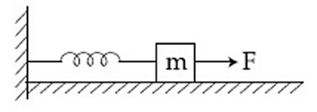
At maximum speed, net force on the block is zero (mean position of new SHM): $$F_{\text{net}} = 0 \implies F = kx_0 \implies x_0 = \frac{F}{k}$$
Applying the Work-Energy Theorem from the initial position to this point of maximum speed: $$W_{\text{all}} = \Delta K$$
$$W_F + W_{\text{spring}} = \frac{1}{2}mv_{\text{max}}^2 - 0$$
$$F \cdot x_0 - \frac{1}{2}kx_0^2 = \frac{1}{2}mv_{\text{max}}^2$$
$$F\left(\frac{F}{k}\right) - \frac{1}{2}k\left(\frac{F}{k}\right)^2 = \frac{1}{2}mv_{\text{max}}^2$$
$$\frac{F^2}{k} - \frac{F^2}{2k} = \frac{1}{2}mv_{\text{max}}^2 \implies \frac{F^2}{2k} = \frac{1}{2}mv_{\text{max}}^2$$
$$v_{\text{max}} = \frac{F}{\sqrt{mk}}$$
Was this solution helpful?
Create a FREE account and get:
_1.webp)

Educational materials for JEE preparation

Ask our AI anything

AI can make mistakes. Please verify important information.
AI can make mistakes. Please verify important information.
