NTA JEE Main 9th January 2019 Shift 1
For the following questions answer them individually
NTA JEE Main 9th January 2019 Shift 1 - Question 11
Temperature difference of 120$$^{\circ}$$C is maintained between two ends of a uniform rod $$AB$$ of length $$2L$$. Another bent rod $$PQ$$, of same cross-section as $$AB$$ and length $$\frac{3L}{2}$$, is connected across $$AB$$ (See figure). In steady state, temperature difference between $$P$$ and $$Q$$ will be close to: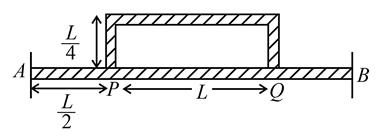
NTA JEE Main 9th January 2019 Shift 1 - Question 12
A gas can be taken from A to B via two different processes ACB and ADB.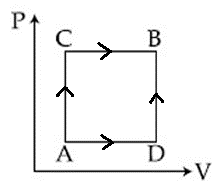
When path ACB is used 60 J of heat flows into the system and 30 J of work is done by the system. If the path ADB is used then work done by the system is 10 J, the heat flows into the system in the path ADB is:
NTA JEE Main 9th January 2019 Shift 1 - Question 13
A mixture of 2 moles of helium gas (atomic mass = 4u), and 1 mole of argon gas (atomic mass = 40 u) is kept at 300 K in a container. The ratio of their rms speeds $$\frac{v_{rms}(helium)}{v_{rms}(argon)}$$, is close to:

NTA JEE Main 9th January 2019 Shift 1 - Question 14
Three charges $$+Q$$, $$q$$, $$+Q$$ are placed respectively, at distance, $$0$$, $$d/2$$ and $$d$$ from the origin, on the $$x$$-axis. If the net force experienced by $$+Q$$, placed at $$x = 0$$, is zero, then value of $$q$$ is:
NTA JEE Main 9th January 2019 Shift 1 - Question 15
For a uniformly charged ring of radius $$R$$, the electric field on its axis has the largest magnitude at a distance $$h$$ from its centre. Then value of $$h$$ is:
NTA JEE Main 9th January 2019 Shift 1 - Question 16
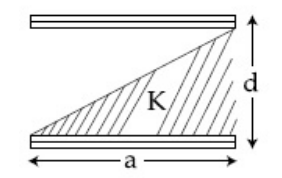
A parallel plate capacitor is made of two square plates of side $$a$$, separated by a distance $$d$$ ($$d \ll a$$). The lower triangular portion filled with a dielectric of dielectric constant $$K$$, as shown in the figure. Capacitance of this capacitor is:
NTA JEE Main 9th January 2019 Shift 1 - Question 17
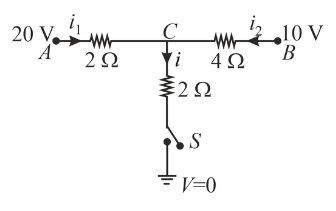
When the switch $$S$$, in the circuit shown, is closed, then the value of current $$i$$ will be:
NTA JEE Main 9th January 2019 Shift 1 - Question 18
Drift speed of electrons, when 1.5 A current flows in a copper wire of cross section 5 mm$$^2$$ is $$v_d$$. If the electron density in copper is $$9 \times 10^{28}$$ m$$^{-3}$$, the value of $$v_d$$ in mm s$$^{-1}$$ is close to (Take charge of an electron to be $$= 1.6 \times 10^{-19}$$ C)
NTA JEE Main 9th January 2019 Shift 1 - Question 19
Mobility of electrons in a semiconductor is defined as the ratio of their drift velocity to the applied electric field. If, for an N-type semiconductor, the density of electrons is $$10^{19}$$ m$$^{-3}$$ and their mobility is 1.6 m$$^2$$ V$$^{-1}$$ s$$^{-1}$$, then the resistivity of the semiconductor (since it is an N-type semiconductor contribution of holes is ignored) is close to:
NTA JEE Main 9th January 2019 Shift 1 - Question 20
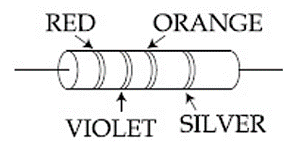
A resistance is shown in the figure. Its value and tolerance are given respectively by: