NTA JEE Main 9th January 2019 Shift 1
For the following questions answer them individually
NTA JEE Main 9th January 2019 Shift 1 - Question 21
A bar magnet is demagnetized by inserting it inside a solenoid of length 0.2 m, 100 turns, and carrying a current of 5.2 A. The coercivity of the bar magnet is:
NTA JEE Main 9th January 2019 Shift 1 - Question 22
A current loop, having two circular arcs joined by two radial lines is shown in the figure. It carries a current of 10 A. The magnetic field at point O will be close to: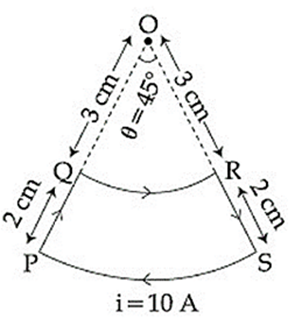
NTA JEE Main 9th January 2019 Shift 1 - Question 23
An infinitely long current carrying wire and a small current carrying loop are in the plane of the paper as shown. The radius of the loop is $$a$$ and distance of its centre from the wire is $$d$$ ($$d \gg a$$). If the loop applies a force $$F$$ on the wire then: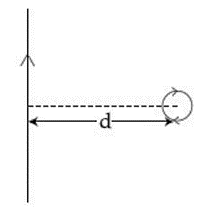

NTA JEE Main 9th January 2019 Shift 1 - Question 24
A conducting circular loop made of a thin wire has area $$3.5 \times 10^{-2}$$ m$$^2$$ and resistance 10 $$\Omega$$. It is placed perpendicular to a time-dependent magnetic field $$B(t) = 0.4 \; T \sin 50\pi t$$. The field is uniform in space. Then the net charge flowing through the loop during $$t = 0$$ s and $$t = 10$$ ms is close to:
NTA JEE Main 9th January 2019 Shift 1 - Question 25
A plane electromagnetic wave of frequency 50 MHz travels in free space along the positive $$x$$-direction. At a particular point in space and time, $$\vec{E} = 6.3 \hat{j}$$ V/m. The corresponding magnetic field $$\vec{B}$$, at that point will be:
NTA JEE Main 9th January 2019 Shift 1 - Question 26
A convex lens is put 10 cm from a light source and it makes a sharp image on a screen, kept 10 cm from the lens. Now a glass block (refractive index 1.5) of 1.5 cm thickness is placed in between the light source and the lens. To get the sharp image again, the screen is shifted by a distance $$d$$. Then $$d$$ is: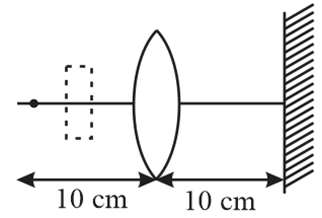
NTA JEE Main 9th January 2019 Shift 1 - Question 27
Two coherent sources produce waves of different intensities which interfere. After interference, the ratio of the maximum intensity to the minimum intensity is 16. The intensity of the waves are in the ratio:
NTA JEE Main 9th January 2019 Shift 1 - Question 28
Consider a tank made of glass (refractive index 1.5) with a thick bottom. It is filled with a liquid of refractive index $$\mu$$. A student finds that, irrespective of what the incident angle $$i$$ (see figure) is for a beam of light entering the liquid, the light reflected from the liquid glass interface is never completely polarized. For this to happen, the minimum value of $$\mu$$ is: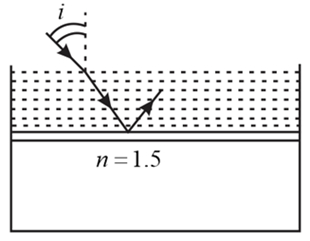
NTA JEE Main 9th January 2019 Shift 1 - Question 29
The surface of certain metal is first illuminated with light of wavelength $$\lambda_1 = 350$$ nm and then, by a light of wavelength $$\lambda_2 = 540$$ nm. It is found that the maximum speed of the photoelectrons in the two cases differ by a factor of 2. The work function of the metal (in eV) is close to (Energy of photon $$= \frac{1240}{\lambda \; in \; nm}$$ eV)
NTA JEE Main 9th January 2019 Shift 1 - Question 30
A Sample of radioactive material A, that has an activity of 10 mCi (1 Ci $$= 3.7 \times 10^{10}$$ decays s$$^{-1}$$), has twice the number of nuclei as another sample of a different radioactive material B which has an activity of 20 mCi. The correct choices for half-lives of A and B would then be, respectively: