
Join Our JEE Preparation Group
Prep with like-minded aspirants; Get access to free daily tests and study material.
Sign in
Please select an account to continue using cracku.in
↓ →
Join Our JEE Preparation Group
Prep with like-minded aspirants; Get access to free daily tests and study material.
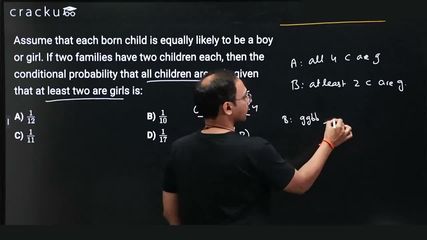
Assume that each born child is equally likely to be a boy or girl. If two families have two children each, then the conditional probability that all children are girls given that at least two are girls is:
Let us list every assumption clearly. Each child is equally likely to be a boy (B) or a girl (G), so the probability of either outcome for a single birth is $$\tfrac12$$. There are two families and each family has two children, giving altogether $$2+2=4$$ children whose genders are independent.
First we establish the complete sample space. Because each of the four children can be B or G, the total number of possible gender strings is $$2^4 = 16.$$ We may write a convenient enumeration:
$$\begin{array}{cccc} 1:&\; GGGG &\quad& 9:&\; BGGG\\ 2:&\; GGGB && 10:&\; GBGG\\ 3:&\; GGBG && 11:&\; GGBB\\ 4:&\; GBGG && 12:&\; BGBG\\ 5:&\; GBGB && 13:&\; BBBG\\ 6:&\; GBBG && 14:&\; BBGB\\ 7:&\; BGGB && 15:&\; BGBB\\ 8:&\; BG BG && 16:&\; BBBB \end{array}$$
Now we introduce two relevant events:
Event $$A$$: “all four children are girls”.
Event $$B$$: “at least two of the four children are girls”.
We want $$P(A\mid B)$$, the conditional probability of $$A$$ given $$B$$. By the definition of conditional probability,
$$P(A\mid B)=\frac{P(A\cap B)}{P(B)}.$$
Observe that if all four children are girls, the condition “at least two are girls” is automatically satisfied, so $$A\subseteq B$$ and therefore $$A\cap B=A$$. Thus the numerator simplifies to $$P(A)$$.
We now compute the cardinalities (counts) of the events inside the 16-point sample space.
Counting the outcomes of event A:
There is exactly one outcome in which every child is a girl, namely $$GGGG$$. Hence
$$|A|=1.$$
Counting the outcomes of event B:
“At least two girls” means “two, three, or four girls.” It is usually easier to count its complement, “fewer than two girls,” i.e. either zero or one girl, and subtract from the total.
• Zero girls: all boys, $$BBBB$$ - that is 1 outcome.
• Exactly one girl: choose which of the four positions is G; there are $$\binom{4}{1}=4$$ such arrangements.
Hence the number of outcomes with fewer than two girls is $$1+4=5.$$
Therefore the number with at least two girls is
$$|B| = 16 - 5 = 11.$$
Converting counts to probabilities:
Because every outcome among the 16 is equally likely, the probability of any specific set of outcomes is simply (number of favorable outcomes)/16. Thus
$$P(A)=\frac{|A|}{16} = \frac{1}{16}, \qquad P(B)=\frac{|B|}{16} = \frac{11}{16}.$$
Applying the conditional-probability formula:
$$ P(A\mid B)=\frac{P(A\cap B)}{P(B)} =\frac{P(A)}{P(B)} =\frac{\tfrac{1}{16}}{\tfrac{11}{16}} =\frac{1}{11}. $$
Hence, the correct answer is Option C.
Was this solution helpful?
Click on the Email ☝️ to Watch the Video Solution
Create a FREE account and get:
_1.webp)

Educational materials for JEE preparation

Ask our AI anything

AI can make mistakes. Please verify important information.
AI can make mistakes. Please verify important information.
