
Join Our JEE Preparation Group
Prep with like-minded aspirants; Get access to free daily tests and study material.
Sign in
Please select an account to continue using cracku.in
↓ →
Join Our JEE Preparation Group
Prep with like-minded aspirants; Get access to free daily tests and study material.
Two cards are drawn successively with replacement from a well-shuffled deck of 52 cards. Let X denote the random variable of number of aces obtained in the two drawn cards. Then $$P(X = 1) + P(X = 2)$$ equals:
First we remind ourselves of the basic facts about a standard deck. A full deck has 52 cards in total, out of which exactly 4 are aces. When we draw a card and then replace it before the next draw, the two draws are statistically independent and each draw is always made from a fresh 52-card deck. Hence the single-draw probabilities never change.
Let us denote by $$p$$ the probability of drawing an ace in one single draw. Because there are 4 aces out of 52 cards, we have
$$ p \;=\; \frac{\text{number of favourable cards}}{\text{total number of cards}} \;=\; \frac{4}{52} \;=\; \frac{1}{13}. $$
Correspondingly, the probability of not drawing an ace in a single draw is
$$ 1-p \;=\; 1-\frac{1}{13} \;=\; \frac{12}{13}. $$
The random variable $$X$$ counts how many aces appear in the two independent draws. It can take the values 0, 1, or 2. The exercise asks us to find
$$ P(X=1) + P(X=2). $$
We shall compute the two probabilities separately and then add them.
Computation of $$P(X=2)$$: Both draws must show an ace. Because the draws are independent, we multiply the single-draw probabilities:
$$ P(X=2) \;=\; p \times p \;=\; \left(\frac{1}{13}\right)\!\left(\frac{1}{13}\right) \;=\; \frac{1}{169}. $$
Computation of $$P(X=1)$$: Exactly one draw must show an ace and the other draw must not. There are two distinct orders in which this can happen—
(i) ace on the first draw and non-ace on the second draw, or
(ii) non-ace on the first draw and ace on the second draw.
We add the probabilities of these two mutually exclusive cases.
For case (i):
$$ \text{Prob(case (i))} \;=\; p \times (1-p) \;=\; \frac{1}{13}\times\frac{12}{13} \;=\; \frac{12}{169}. $$
For case (ii):
$$ \text{Prob(case (ii))} \;=\; (1-p) \times p \;=\; \frac{12}{13}\times\frac{1}{13} \;=\; \frac{12}{169}. $$
Adding these two gives
$$ P(X=1) \;=\; \frac{12}{169} + \frac{12}{169} \;=\; \frac{24}{169}. $$
Now we find the required sum:
$$ P(X=1) + P(X=2) \;=\; \frac{24}{169} + \frac{1}{169} \;=\; \frac{25}{169}. $$
Hence, the correct answer is Option D.
Was this solution helpful?
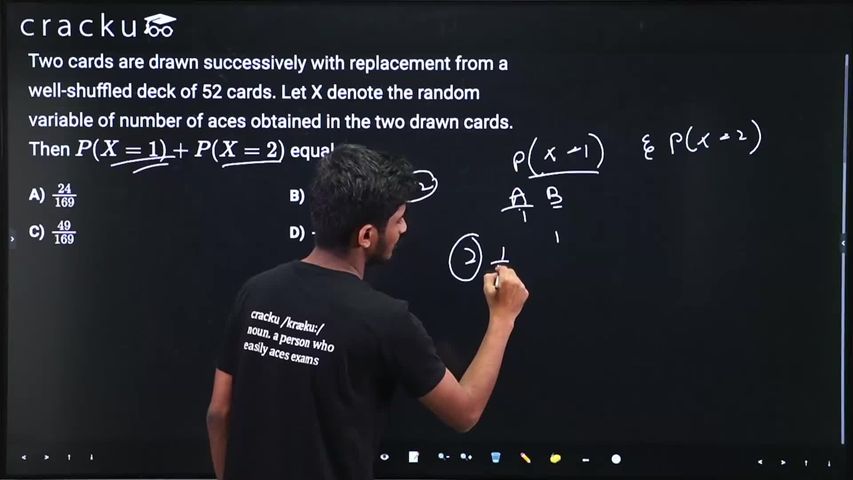
Click on the Email ☝️ to Watch the Video Solution
Create a FREE account and get:
_1.webp)

Educational materials for JEE preparation

Ask our AI anything

AI can make mistakes. Please verify important information.
AI can make mistakes. Please verify important information.
