
Join Our JEE Preparation Group
Prep with like-minded aspirants; Get access to free daily tests and study material.
Sign in
Please select an account to continue using cracku.in
↓ →
Join Our JEE Preparation Group
Prep with like-minded aspirants; Get access to free daily tests and study material.
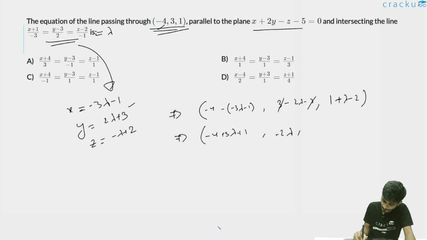
The equation of the line passing through $$(-4, 3, 1)$$, parallel to the plane $$x + 2y - z - 5 = 0$$ and intersecting the line $$\frac{x+1}{-3} = \frac{y-3}{2} = \frac{z-2}{-1}$$ is:
We are looking for a straight line that (i) passes through the fixed point $$P(-4,\,3,\,1)$$, (ii) is parallel to the plane $$x+2y-z-5=0$$ and (iii) meets the line
$$\frac{x+1}{-3}\;=\;\frac{y-3}{2}\;=\;\frac{z-2}{-1}.$$
First note that a plane $$x+2y-z-5=0$$ has a normal vector $$\mathbf{n}=(1,\,2,\,-1).$$ For any line to be parallel to this plane, its direction vector $$\mathbf{d}=(a,\,b,\,c)$$ must be perpendicular to $$\mathbf{n}$$. Using the dot‐product condition of perpendicularity, we must have
$$\mathbf{n}\cdot\mathbf{d}=0\quad\Longrightarrow\quad 1\cdot a+2\cdot b+(-1)\cdot c=0,$$
so
$$a+2b-c=0\quad\Longrightarrow\quad c=a+2b.$$
Let us write the required line through $$P(-4,\,3,\,1)$$ with parameter $$s$$ as
$$x=-4+as,\qquad y=3+bs,\qquad z=1+cs.$$
The given line can be parameterised (putting the common ratio equal to $$t$$) as
$$x=-1-3t,\qquad y=3+2t,\qquad z=2-t.$$
Because the two lines intersect, there exist real numbers $$s_0$$ and $$t_0$$ such that
$$-4+a s_0=-1-3t_0,\qquad 3+b s_0=3+2t_0,\qquad 1+c s_0=2-t_0.$$
Starting with the second equality, we get
$$b s_0 = 2t_0\quad\Longrightarrow\quad t_0=\frac{b s_0}{2}.$$
Substituting this value of $$t_0$$ into the third equality gives
$$1+c s_0 = 2-\frac{b s_0}{2} \;\Longrightarrow\; c s_0 = 1-\frac{b s_0}{2} \;\Longrightarrow\; c = \frac{1}{s_0}-\frac{b}{2}.$$
Similarly, substituting $$t_0=\dfrac{b s_0}{2}$$ into the first equality yields
$$-4+a s_0 = -1-3\left(\frac{b s_0}{2}\right) \;\Longrightarrow\; a s_0 = 3-\frac{3b s_0}{2} \;\Longrightarrow\; a = \frac{3}{s_0}-\frac{3b}{2}.$$
But we must simultaneously satisfy the perpendicularity condition $$c=a+2b.$$ Replacing $$a$$ and $$c$$ by the expressions just found, we have
$$\frac{1}{s_0}-\frac{b}{2}=\left(\frac{3}{s_0}-\frac{3b}{2}\right)+2b.$$
Simplifying the right‐hand side first,
$$\frac{3}{s_0}-\frac{3b}{2}+2b=\frac{3}{s_0}+\frac{b}{2}.$$
Equating the two sides:
$$\frac{1}{s_0}-\frac{b}{2} = \frac{3}{s_0}+\frac{b}{2}.$$
Bringing like terms together gives
$$\frac{1}{s_0}-\frac{3}{s_0} = \frac{b}{2}+\frac{b}{2} \;\Longrightarrow\; -\frac{2}{s_0} = b.$$
Thus
$$b=-\frac{2}{s_0}.$$
Now compute $$a$$ and $$c$$:
$$a=\frac{3}{s_0}-\frac{3b}{2} = \frac{3}{s_0}-\frac{3}{2}\!\left(-\frac{2}{s_0}\right) = \frac{3}{s_0}+\frac{3}{s_0} = \frac{6}{s_0},$$
$$c=\frac{1}{s_0}-\frac{b}{2} = \frac{1}{s_0}-\frac{1}{2}\!\left(-\frac{2}{s_0}\right) = \frac{1}{s_0}+\frac{1}{s_0} = \frac{2}{s_0}.$$
Therefore the proportional direction ratios are
$$a:b:c = 6:-2:2.$$
Dividing each by $$2$$ for simplicity gives
$$3:-1:1.$$
Hence a suitable direction vector is $$\mathbf{d}=(3,\,-1,\,1).$$ Using this vector and the point $$(-4,\,3,\,1)$$, the symmetric form of the desired line is
$$\frac{x+4}{3} = \frac{y-3}{-1} = \frac{z-1}{1}.$$
This matches Option A.
Hence, the correct answer is Option A.
Was this solution helpful?
Click on the Email ☝️ to Watch the Video Solution
Create a FREE account and get:
Educational materials for JEE preparation

Ask our AI anything

AI can make mistakes. Please verify important information.
AI can make mistakes. Please verify important information.

_1.webp)
