
Join Our JEE Preparation Group
Prep with like-minded aspirants; Get access to free daily tests and study material.
Sign in
Please select an account to continue using cracku.in
↓ →
Join Our JEE Preparation Group
Prep with like-minded aspirants; Get access to free daily tests and study material.
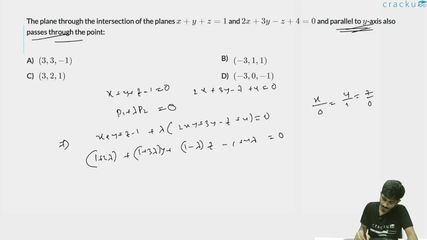
The plane through the intersection of the planes $$x + y + z = 1$$ and $$2x + 3y - z + 4 = 0$$ and parallel to $$y$$-axis also passes through the point:
We have two intersecting planes, namely $$x + y + z = 1$$ and $$2x + 3y - z + 4 = 0$$. The equation of every plane that passes through their line of intersection is written by the standard family-of-planes formula
$$\bigl(x + y + z - 1\bigr) + \lambda \bigl(2x + 3y - z + 4\bigr) = 0,$$
where $$\lambda$$ is a real parameter.
Expanding and collecting the coefficients of $$x$$, $$y$$, $$z$$ and the constant term, we obtain
$$\bigl(1 + 2\lambda\bigr)\,x \;+\; \bigl(1 + 3\lambda\bigr)\,y \;+\; \bigl(1 - \lambda\bigr)\,z \;+\; \bigl(-1 + 4\lambda\bigr) = 0.$$
The required plane is said to be parallel to the $$y$$-axis. A plane is parallel to a given direction precisely when that direction lies in the plane. Since the $$y$$-axis has direction vector $$(0,\,1,\,0)$$, this vector must be perpendicular to the normal of our plane. Hence the component of the normal along $$y$$ must vanish. Concretely, the coefficient of $$y$$ in the plane’s equation must be zero:
$$1 + 3\lambda = 0.$$
Solving, we get
$$\lambda = -\dfrac13.$$
Substituting $$\lambda = -\dfrac13$$ back into each coefficient:
Coefficient of $$x$$: $$1 + 2\lambda = 1 + 2\!\left(-\dfrac13\right) = 1 - \dfrac23 = \dfrac13.$$
Coefficient of $$y$$: $$1 + 3\lambda = 0 \quad\text{(as imposed).}$$
Coefficient of $$z$$: $$1 - \lambda = 1 - \!\left(-\dfrac13\right) = 1 + \dfrac13 = \dfrac43.$$
Constant term: $$-1 + 4\lambda = -1 + 4\!\left(-\dfrac13\right) = -1 - \dfrac43 = -\dfrac73.$$
Thus the particular plane is
$$\dfrac13\,x \;+\; 0\cdot y \;+\; \dfrac43\,z \;-\; \dfrac73 = 0.$$
To simplify, we multiply the entire equation by $$3$$:
$$x \;+\; 4z \;-\; 7 = 0.$$
We now test which of the given points satisfies $$x + 4z - 7 = 0$$.
For $$(3,\,3,\,-1)$$ we have $$3 + 4(-1) - 7 = 3 - 4 - 7 = -8 \neq 0.$$
For $$(-3,\,1,\,1)$$ we have $$-3 + 4(1) - 7 = -3 + 4 - 7 = -6 \neq 0.$$
For $$(3,\,2,\,1)$$ we have $$3 + 4(1) - 7 = 3 + 4 - 7 = 0,$$ so this point lies on the plane.
For $$(-3,\,0,\,-1)$$ we have $$-3 + 4(-1) - 7 = -3 - 4 - 7 = -14 \neq 0.$$
Only the point $$(3,\,2,\,1)$$ satisfies the plane equation.
Hence, the correct answer is Option C.
Was this solution helpful?
Click on the Email ☝️ to Watch the Video Solution
Create a FREE account and get:
_1.webp)

Educational materials for JEE preparation

Ask our AI anything

AI can make mistakes. Please verify important information.
AI can make mistakes. Please verify important information.
