
Join Our JEE Preparation Group
Prep with like-minded aspirants; Get access to free daily tests and study material.
Sign in
Please select an account to continue using cracku.in
↓ →
Join Our JEE Preparation Group
Prep with like-minded aspirants; Get access to free daily tests and study material.
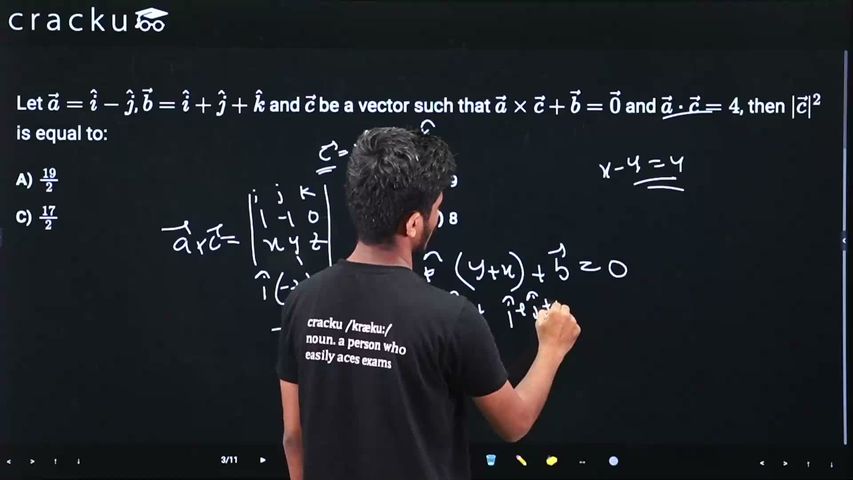
Let $$\vec{a} = \hat{i} - \hat{j}$$, $$\vec{b} = \hat{i} + \hat{j} + \hat{k}$$ and $$\vec{c}$$ be a vector such that $$\vec{a} \times \vec{c} + \vec{b} = \vec{0}$$ and $$\vec{a} \cdot \vec{c} = 4$$, then $$|\vec{c}|^2$$ is equal to:
We have the vectors $$\vec a=\hat i-\hat j$$ and $$\vec b=\hat i+\hat j+\hat k$$. Let us assume the unknown vector $$\vec c$$ to have Cartesian components, so we write $$\vec c=x\hat i+y\hat j+z\hat k$$ where $$x,\;y,\;z$$ are real numbers to be determined.
The first given condition is $$\vec a\times\vec c+\vec b=\vec0$$. Re-writing, we obtain $$\vec a\times\vec c=-\vec b$$. In order to use this relation, we must first compute the cross product $$\vec a\times\vec c$$.
By the determinant formula for a cross product, namely $$ \vec p\times\vec q= \begin{vmatrix} \hat i & \hat j & \hat k\\ p_x & p_y & p_z\\ q_x & q_y & q_z \end{vmatrix}, $$ we substitute $$\vec p=\vec a=(1,-1,0)$$ and $$\vec q=\vec c=(x,y,z)$$ to get
$$ \vec a\times\vec c= \begin{vmatrix} \hat i & \hat j & \hat k\\ 1 & -1 & 0\\ x & y & z \end{vmatrix} =\hat i\bigl((-1)z-0\cdot y\bigr)-\hat j\bigl(1\cdot z-0\cdot x\bigr)+\hat k\bigl(1\cdot y-(-1)\cdot x\bigr). $$
Simplifying each component separately,
$$ \vec a\times\vec c=(-z)\hat i-\,z\hat j+(y+x)\hat k. $$
According to the relationship $$\vec a\times\vec c=-\vec b$$, we must have
$$ (-z)\hat i-\,z\hat j+(x+y)\hat k=(-1)\hat i-1\hat j-1\hat k. $$
Equating the coefficients of the corresponding unit vectors, we obtain three linear equations:
For the $$\hat i$$ component: $$-z=-1\;\Longrightarrow\;z=1.$$
For the $$\hat j$$ component: $$-z=-1\;\Longrightarrow\;z=1,$$ which is consistent with the previous result.
For the $$\hat k$$ component: $$x+y=-1.$$
Thus we already know $$z=1$$ and have the relation $$x+y=-1.$$(1)
The second given condition is the dot-product equation $$\vec a\cdot\vec c=4$$. Using the standard dot product formula $$\vec p\cdot\vec q=p_xq_x+p_yq_y+p_zq_z$$, we find
$$ \vec a\cdot\vec c=(1)(x)+(-1)(y)+(0)(z)=x-y. $$
Hence the dot-product condition provides
$$ x-y=4.\;(2) $$
Now we solve the simultaneous linear equations $$ \begin{cases} x+y=-1 \quad\text{(from (1))}\\ x-y=4 \quad\text{(from (2))} \end{cases} $$
Adding the two equations gives $$ 2x=3\;\Longrightarrow\;x=\dfrac{3}{2}. $$
Substituting $$x=\dfrac{3}{2}$$ into $$x+y=-1$$ yields $$ \dfrac{3}{2}+y=-1\;\Longrightarrow\;y=-1-\dfrac{3}{2}=-\dfrac{5}{2}. $$
We already have $$z=1$$, so the complete vector $$\vec c$$ is
$$ \vec c=\dfrac{3}{2}\hat i-\dfrac{5}{2}\hat j+1\hat k. $$
Finally, we must find $$|\vec c|^2$$. Using the magnitude-squared formula $$|\vec c|^2=x^2+y^2+z^2,$$ we substitute our values:
$$ |\vec c|^2=\left(\dfrac{3}{2}\right)^2+\left(-\dfrac{5}{2}\right)^2+(1)^2 =\dfrac{9}{4}+\dfrac{25}{4}+1. $$
Adding the fractions first, $$\dfrac{9}{4}+\dfrac{25}{4}=\dfrac{34}{4}.$$ Converting $$1$$ to quarters, we have $$1=\dfrac{4}{4}.$$ Therefore,
$$ |\vec c|^2=\dfrac{34}{4}+\dfrac{4}{4}=\dfrac{38}{4}=\dfrac{19}{2}. $$
Hence, the correct answer is Option A.
Was this solution helpful?
Click on the Email ☝️ to Watch the Video Solution
Create a FREE account and get:
Educational materials for JEE preparation

Ask our AI anything

AI can make mistakes. Please verify important information.
AI can make mistakes. Please verify important information.

_1.webp)
