
Join Our JEE Preparation Group
Prep with like-minded aspirants; Get access to free daily tests and study material.
Sign in
Please select an account to continue using cracku.in
↓ →
Join Our JEE Preparation Group
Prep with like-minded aspirants; Get access to free daily tests and study material.
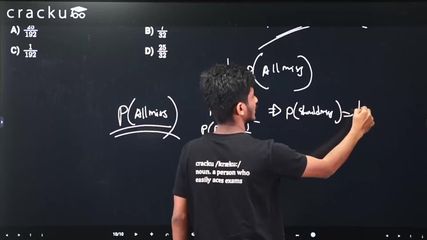
Four persons can hit a target correctly with probabilities $$\frac{1}{2}$$, $$\frac{1}{3}$$, $$\frac{1}{4}$$ and $$\frac{1}{8}$$ respectively. If all hit at the target independently, then the probability that the target would be hit, is:
Let us denote the probabilities of the four persons hitting the target by $$p_1=\dfrac12,\;p_2=\dfrac13,\;p_3=\dfrac14,\;p_4=\dfrac18.$$
We want the probability that the target is hit by at least one of them. A convenient way to calculate this is to first find the probability that none of them hits the target, and then subtract that value from 1.
The probability that a person misses the target is obtained by subtracting the probability of a hit from 1. Thus we have
$$q_1 = 1 - p_1 = 1 - \dfrac12 = \dfrac12,$$
$$q_2 = 1 - p_2 = 1 - \dfrac13 = \dfrac23,$$
$$q_3 = 1 - p_3 = 1 - \dfrac14 = \dfrac34,$$
$$q_4 = 1 - p_4 = 1 - \dfrac18 = \dfrac78.$$
Because the shots are independent, the probability that all four persons miss the target is the product of their individual miss-probabilities:
$$P(\text{all miss}) \;=\; q_1 \times q_2 \times q_3 \times q_4 \;=\; \dfrac12 \times \dfrac23 \times \dfrac34 \times \dfrac78.$$
Step-by-step multiplication gives
$$\dfrac12 \times \dfrac23 = \dfrac{1}{3},$$
$$\dfrac{1}{3} \times \dfrac34 = \dfrac14,$$
$$\dfrac14 \times \dfrac78 = \dfrac{7}{32}.$$
So we have
$$P(\text{all miss}) = \dfrac{7}{32}.$$
Now we apply the complementary probability formula
$$P(\text{at least one hit}) = 1 - P(\text{all miss}).$$
Substituting the value just obtained,
$$P(\text{at least one hit}) = 1 - \dfrac{7}{32} = \dfrac{32}{32} - \dfrac{7}{32} = \dfrac{25}{32}.$$
Hence, the correct answer is Option D.
Was this solution helpful?
Click on the Email ☝️ to Watch the Video Solution
Create a FREE account and get:
_1.webp)

Educational materials for JEE preparation

Ask our AI anything

AI can make mistakes. Please verify important information.
AI can make mistakes. Please verify important information.
