
Join Our JEE Preparation Group
Prep with like-minded aspirants; Get access to free daily tests and study material.
Sign in
Please select an account to continue using cracku.in
↓ →
Join Our JEE Preparation Group
Prep with like-minded aspirants; Get access to free daily tests and study material.
If the line, $$\frac{x - 1}{2} = \frac{y + 1}{3} = \frac{z - 2}{4}$$ meets the plane, $$x + 2y + 3z = 15$$ at a point P, then the distance of P from the origin is:
We are given the symmetric (or one-point two-direction) form of a straight line in three-dimensional space:
$$\frac{x - 1}{2} \;=\; \frac{y + 1}{3} \;=\; \frac{z - 2}{4}$$
To handle such an expression we set the common ratio equal to a real parameter, say $$t$$. Thus
$$\frac{x - 1}{2}=t,\quad \frac{y + 1}{3}=t,\quad \frac{z - 2}{4}=t.$$
Solving each of these simple linear equations for the coordinates of an arbitrary point on the line gives:
$$x - 1 = 2t \;\Longrightarrow\; x = 1 + 2t,$$
$$y + 1 = 3t \;\Longrightarrow\; y = -\,1 + 3t,$$
$$z - 2 = 4t \;\Longrightarrow\; z = 2 + 4t.$$
So every point on the line can be written in the form $$\bigl(1 + 2t,\; -1 + 3t,\; 2 + 4t\bigr).$$
Now we are told that this line meets (intersects) the plane
$$x + 2y + 3z = 15$$
at a particular point $$P$$. To find the value of $$t$$ that pinpoints this intersection, we substitute the parametric expressions for $$x,\,y,\,z$$ into the plane equation. Therefore we replace $$x,\,y,\,z$$ in $$x + 2y + 3z = 15$$ with $$1 + 2t,\; -1 + 3t,\; 2 + 4t$$ respectively:
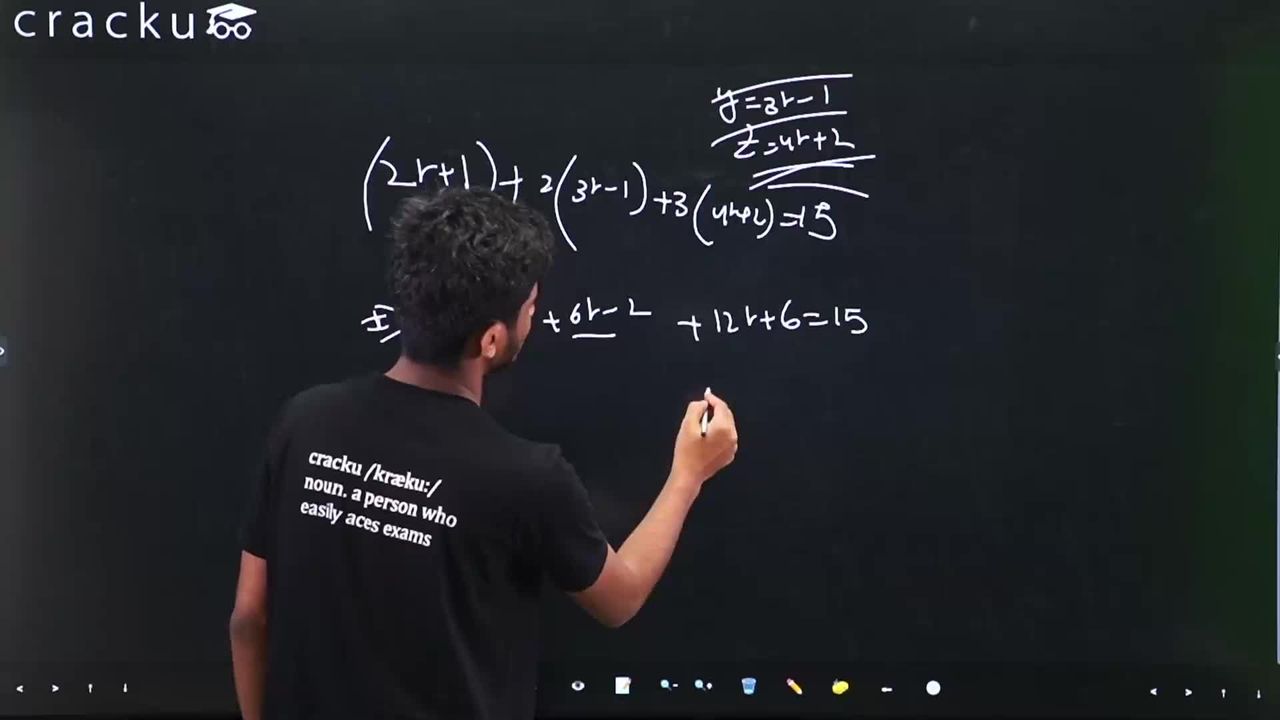
$$\bigl(1 + 2t\bigr) \;+\; 2\bigl(-1 + 3t\bigr) \;+\; 3\bigl(2 + 4t\bigr) \;=\; 15.$$
Let us open all brackets carefully and collect like terms:
First term: $$1 + 2t.$$
Second term: $$2\bigl(-1 + 3t\bigr) = -2 + 6t.$$
Third term: $$3\bigl(2 + 4t\bigr) = 6 + 12t.$$
Adding them:
$$\bigl(1 + 2t\bigr) + \bigl(-2 + 6t\bigr) + \bigl(6 + 12t\bigr) = (1 - 2 + 6) + (2t + 6t + 12t).$$
The constants sum to $$1 - 2 + 6 = 5$$, and the coefficients of $$t$$ sum to $$2 + 6 + 12 = 20$$. Hence
$$5 + 20t = 15.$$
To isolate $$t$$ we transpose 5 to the right and divide by 20:
$$20t = 15 - 5 = 10 \quad\Longrightarrow\quad t = \frac{10}{20} = \frac{1}{2}.$$
So the parameter value corresponding to the intersection point $$P$$ is $$t = \dfrac{1}{2}.$$
We now substitute $$t = \dfrac{1}{2}$$ back into the parametric formulas for $$x,\,y,\,z$$ to obtain the exact coordinates of $$P$$:
$$x = 1 + 2t = 1 + 2\!\left(\frac{1}{2}\right) = 1 + 1 = 2,$$
$$y = -1 + 3t = -1 + 3\!\left(\frac{1}{2}\right) = -1 + \frac{3}{2} = \frac{-2 + 3}{2} = \frac{1}{2},$$
$$z = 2 + 4t = 2 + 4\!\left(\frac{1}{2}\right) = 2 + 2 = 4.$$
Thus the point of intersection is $$P\bigl(2,\; \tfrac{1}{2},\; 4\bigr).$$
Next we must compute the distance of $$P$$ from the origin $$O(0,0,0)$$. The standard three-dimensional distance formula tells us that for a point $$\bigl(x,y,z\bigr)$$, the distance to the origin equals
$$\sqrt{x^{2} + y^{2} + z^{2}}.$$
Applying this formula to $$P(2,\; \tfrac{1}{2},\; 4)$$ we get
$$\text{OP} = \sqrt{2^{2} \;+\; \left(\tfrac{1}{2}\right)^{2} \;+\; 4^{2}} = \sqrt{4 \;+\; \frac{1}{4} \;+\; 16}.$$
Combine the terms inside the square root:
$$4 + 16 = 20,$$
so
$$20 + \frac{1}{4} = \frac{80}{4} + \frac{1}{4} = \frac{81}{4}.$$
Hence
$$\text{OP} = \sqrt{\frac{81}{4}} = \frac{\sqrt{81}}{2} = \frac{9}{2}.$$
The numerical value $$\dfrac{9}{2}$$ equals $$4.5$$, but it is customary to leave it as the exact fraction.
The list of options provided is
A. $$2\sqrt{5}$$ B. $$\dfrac{9}{2}$$ C. $$\dfrac{\sqrt{5}}{2}$$ D. $$\dfrac{7}{2}$$
Our calculated value $$\dfrac{9}{2}$$ matches Option B.
Hence, the correct answer is Option B.
Was this solution helpful?
Click on the Email ☝️ to Watch the Video Solution
Create a FREE account and get:
_1.webp)

Educational materials for JEE preparation

Ask our AI anything

AI can make mistakes. Please verify important information.
AI can make mistakes. Please verify important information.
