
Join Our JEE Preparation Group
Prep with like-minded aspirants; Get access to free daily tests and study material.
Sign in
Please select an account to continue using cracku.in
↓ →
Join Our JEE Preparation Group
Prep with like-minded aspirants; Get access to free daily tests and study material.
A plane passing through the points $$(0, -1, 0)$$ and $$(0, 0, 1)$$ and making an angle $$\frac{\pi}{4}$$ with the plane $$y - z + 5 = 0$$, also passes through the point:
We are asked to locate a point that lies on a plane which (i) passes through the two fixed points $$P(0,-1,0)$$ and $$Q(0,0,1)$$ and (ii) makes an angle $$\dfrac{\pi}{4}$$ with the plane $$y - z + 5 = 0.$$ We analyse everything one algebraic step at a time.
First, every plane that contains the two points $$P$$ and $$Q$$ must also contain the line $$PQ.$$ We therefore start by finding a direction vector along this line.
We have $$ \overrightarrow{PQ}=Q-P=(0-0,\;0-(-1),\;1-0)=(0,1,1). $$
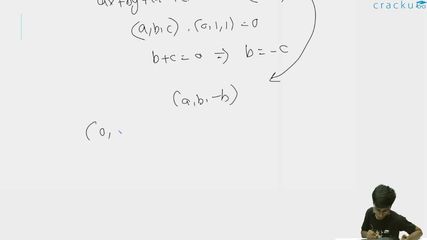
For any plane, its normal vector is perpendicular to every direction lying within that plane; hence the normal vector, say $$(A,B,C),$$ of our required plane must satisfy $$ (A,B,C)\cdot(0,1,1)=0. $$ Performing the dot product gives the simple relation $$ 0\cdot A\;+\;1\cdot B\;+\;1\cdot C\;=\;B+C=0 \;\Longrightarrow\; C=-B. $$
So every admissible normal vector may be written in the form $$ (A,\;B,\;-B), $$ where $$A$$ and $$B$$ are real numbers not both zero.
Using the point-normal form of a plane - “the plane with normal $$(A,B,C)$$ passing through a point $$\bigl(x_0,y_0,z_0\bigr)$$ has equation $$A(x-x_0)+B(y-y_0)+C(z-z_0)=0$$ - we substitute the normal $$(A,B,-B)$$ and the fixed point $$P(0,-1,0).$$ This yields $$ A(x-0)+B\bigl(y-(-1)\bigr)+(-B)(z-0)=0, $$ that is $$ Ax+B(y+1)-Bz=0. $$ Writing the terms in a single line we have $$ A x + B y - B z + B = 0. $$
So the complete one-parameter family of planes through $$P$$ and $$Q$$ is $$ A x + B y - B z + B = 0,\qquad\text{with }(A,B)\neq(0,0). $$
Next we enforce the angular condition. For two planes, the cosine of the angle $$\theta$$ between them equals the absolute value of the dot product of their normals divided by the product of their magnitudes. Symbolically, $$ \cos\theta=\dfrac{|\mathbf n_1\cdot\mathbf n_2|}{\|\mathbf n_1\|\,\|\mathbf n_2\|}. $$ Here:
• The normal of our unknown plane is $$\mathbf n_1=(A,B,-B).$$ • The normal of the given plane $$y-z+5=0$$ is $$\mathbf n_2=(0,1,-1).$$
The two planes are to meet at the angle $$\theta=\dfrac{\pi}{4},$$ for which $$\cos\theta=\cos\dfrac{\pi}{4}=\dfrac1{\sqrt2}.$$ We therefore write
$$ \dfrac{|\,\mathbf n_1\cdot\mathbf n_2\,|}{\|\mathbf n_1\|\;\|\mathbf n_2\|}=\dfrac1{\sqrt2}. $$
Compute each factor explicitly. The dot product is
$$ \mathbf n_1\cdot\mathbf n_2 =(A,B,-B)\cdot(0,1,-1) =0\cdot A\;+\;1\cdot B\;+\;(-1)(-B) =B+B=2B. $$
The magnitudes are
$$ \|\mathbf n_1\|=\sqrt{A^{2}+B^{2}+(-B)^{2}} =\sqrt{A^{2}+2B^{2}}, \qquad \|\mathbf n_2\|=\sqrt{0^{2}+1^{2}+(-1)^{2}}=\sqrt2. $$
Substituting these into the cosine formula gives
$$ \dfrac{|2B|}{\sqrt{A^{2}+2B^{2}}\;\sqrt2}=\dfrac1{\sqrt2}. $$
Multiplying both sides by $$\sqrt2$$ clears the common factor:
$$ \dfrac{|2B|}{\sqrt{A^{2}+2B^{2}}}=1. $$
Squaring both sides (and therefore removing the absolute value) we arrive at
$$ 4B^{2}=A^{2}+2B^{2} \quad\Longrightarrow\quad A^{2}=2B^{2}. $$
Extracting square roots gives the proportionality
$$ A=\pm\sqrt2\,B. $$
Because only the ratio $$A:B$$ matters, we may set $$B=1$$ for convenience. The two legitimate normal vectors are then
$$ (\sqrt2,1,-1)\quad\text{or}\quad(-\sqrt2,1,-1). $$
Correspondingly, the two candidate planes become
$$ \sqrt2\,x+y-z+1=0 \qquad\text{and}\qquad -\sqrt2\,x+y-z+1=0. $$
We now test each of the four options to see which one satisfies at least one of these plane equations.
Option A: $$(\sqrt2,-1,4).$$ Substituting into $$\sqrt2\,x+y-z+1=0$$ gives $$\sqrt2\cdot\sqrt2+(-1)-4+1=2-1-4+1=-2\neq0.$$ Substituting into $$-\sqrt2\,x+y-z+1=0$$ gives $$-\sqrt2\cdot\sqrt2+(-1)-4+1=-2-1-4+1=-6\neq0.$$ So Option A lies on neither plane.
Option B: $$(\sqrt2,1,4).$$ For $$\sqrt2\,x+y-z+1=0$$ we find $$\sqrt2\cdot\sqrt2+1-4+1=2+1-4+1=0,$$ which is indeed satisfied. Hence Option B lies on the required plane and needs no further checking.
Option C: $$( -\sqrt2,-1,-4 ).$$ A quick substitution into either plane immediately fails (the left-hand side evaluates to $$-2\neq0$$ in both cases), so Option C is rejected.
Option D: $$( -\sqrt2,1,-4 ).$$ Substitution again yields a non-zero left-hand side, so Option D is also rejected.
We have therefore identified that only Option B (listed as Option 2 in the question) satisfies all the required conditions.
Hence, the correct answer is Option 2.
Was this solution helpful?
Click on the Email ☝️ to Watch the Video Solution
Create a FREE account and get:
Educational materials for JEE preparation

Ask our AI anything

AI can make mistakes. Please verify important information.
AI can make mistakes. Please verify important information.

_1.webp)
