
Join Our JEE Preparation Group
Prep with like-minded aspirants; Get access to free daily tests and study material.
Sign in
Please select an account to continue using cracku.in
↓ →
Join Our JEE Preparation Group
Prep with like-minded aspirants; Get access to free daily tests and study material.
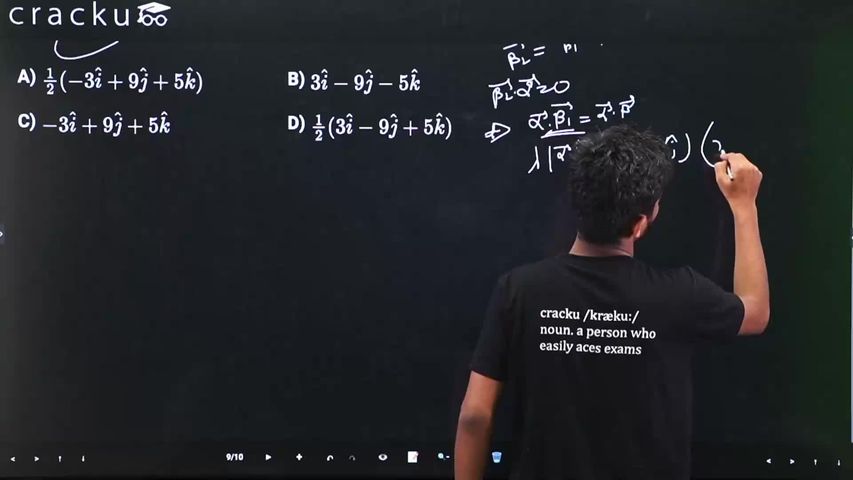
Let $$\vec{\alpha} = 3\hat{i} + \hat{j}$$ and $$\vec{\beta} = 2\hat{i} - \hat{j} + 3\hat{k}$$. If $$\vec{\beta} = \vec{\beta_1} - \vec{\beta_2}$$, where $$\vec{\beta_1}$$ is parallel to $$\vec{\alpha}$$ and $$\vec{\beta_2}$$ is perpendicular to $$\vec{\alpha}$$, then $$\vec{\beta_1} \times \vec{\beta_2}$$ is equal to:
We are given $$\vec{\alpha}=3\hat i+\hat j$$ and $$\vec{\beta}=2\hat i-\hat j+3\hat k$$. We have to split $$\vec{\beta}$$ into two parts in such a way that $$\vec{\beta_1}$$ is parallel to $$\vec{\alpha}$$ while $$\vec{\beta_2}$$ is perpendicular to $$\vec{\alpha}$$, and the relation between them is $$\vec{\beta}= \vec{\beta_1}-\vec{\beta_2}$$.
Because $$\vec{\beta_1}$$ is parallel to $$\vec{\alpha}$$, we can write it as a scalar multiple of $$\vec{\alpha}$$. So we set $$\vec{\beta_1}= \lambda \vec{\alpha}= \lambda(3\hat i+\hat j)= (3\lambda)\hat i+(\lambda)\hat j+0\hat k.$$ Here $$\lambda$$ is a real number that we will determine.
Re-arranging the given relation $$\vec{\beta}= \vec{\beta_1}-\vec{\beta_2}$$, we get $$\vec{\beta_2}= \vec{\beta_1}-\vec{\beta}.$$ Substituting $$\vec{\beta_1}=(3\lambda)\hat i+\lambda\hat j$$ and $$\vec{\beta}=2\hat i-\hat j+3\hat k$$, we obtain $$\vec{\beta_2}= (3\lambda-2)\hat i+(\lambda+1)\hat j-3\hat k.$$ So, in component form, $$\vec{\beta_2}=(3\lambda-2,\;\lambda+1,\;-3).$$
The vector $$\vec{\beta_2}$$ is perpendicular to $$\vec{\alpha}$$. For perpendicular vectors, the scalar (dot) product is zero. Using the dot-product formula $$\vec{u}\cdot\vec{v}=u_xv_x+u_yv_y+u_zv_z,$$ we write $$\vec{\alpha}\cdot\vec{\beta_2}=0.$$ Now $$\vec{\alpha}=(3,1,0)$$ and $$\vec{\beta_2}=(3\lambda-2,\;\lambda+1,\;-3).$$ Therefore $$3(3\lambda-2)+1(\lambda+1)+0(-3)=0.$$ Carrying out the multiplication and addition, $$9\lambda-6+\lambda+1=0,$$ $$10\lambda-5=0.$$ Solving for $$\lambda$$, we get $$\lambda=\frac{5}{10}=\frac12.$$ So $$\vec{\beta_1}= \frac12(3\hat i+\hat j)=\frac32\hat i+\frac12\hat j,$$ and $$\vec{\beta_2}= (3\cdot\frac12-2)\hat i+\Bigl(\frac12+1\Bigr)\hat j-3\hat k =\Bigl(\frac32-2\Bigr)\hat i+\frac32\hat j-3\hat k =-\frac12\hat i+\frac32\hat j-3\hat k.$
Now we compute the cross product $$\vec{\beta_1}\times\vec{\beta_2}$$. The cross product formula in components is $$\vec{a}\times\vec{b}=(a_yb_z-a_zb_y)\hat{i}+(a_zb_x-a_xb_z)\hat{j}+(a_xb_y-a_yb_x)\hat{k}.$$ Taking $$\vec{a}=\vec{\beta_1}=\bigl(\frac{3}{2},\;\frac{1}{2},\;0\bigr)$$ and $$\vec{b}=\vec{\beta_2}=\bigl(-\frac{1}{2},\;\frac{3}{2},\;-3\bigr),$$ we calculate:
$$$\begin{aligned} \vec{\beta_1}\times\vec{\beta_2}&=\Bigl(\frac{1}{2}\cdot(-3)-0\cdot\frac{3}{2}\Bigr)\hat{i} +\Bigl(0\cdot\bigl(-\frac{1}{2}\bigr)-\frac{3}{2}\cdot(-3)\Bigr)\hat{j} +\Bigl(\frac{3}{2}\cdot\frac{3}{2}-\frac{1}{2}\cdot\bigl(-\frac{1}{2}\bigr)\Bigr)\hat{k} \\ &=\Bigl(-\frac{3}{2}\Bigr)\hat{i} +\Bigl(0+\frac{9}{2}\Bigr)\hat{j} +\Bigl(\frac{9}{4}+\frac{1}{4}\Bigr)\hat{k} \\ &=-\frac{3}{2}\hat{i}+\frac{9}{2}\hat{j}+\frac{10}{4}\hat{k} \\ &=-\frac{3}{2}\hat{i}+\frac{9}{2}\hat{j}+\frac{5}{2}\hat{k}. \end{aligned}$$$ Factorising a common $$\frac{1}{2}$$, we get $$\vec{\beta_1}\times\vec{\beta_2}=\frac{1}{2}\bigl(-3\hat{i}+9\hat{j}+5\hat{k}\bigr).$$
Comparing with the given options, this matches exactly with Option A.
Hence, the correct answer is Option A.
Was this solution helpful?
Click on the Email ☝️ to Watch the Video Solution
Create a FREE account and get:
_1.webp)

Educational materials for JEE preparation

Ask our AI anything

AI can make mistakes. Please verify important information.
AI can make mistakes. Please verify important information.
