
Join Our JEE Preparation Group
Prep with like-minded aspirants; Get access to free daily tests and study material.
Sign in
Please select an account to continue using cracku.in
↓ →
Join Our JEE Preparation Group
Prep with like-minded aspirants; Get access to free daily tests and study material.
The solution of the differential equation $$x\frac{dy}{dx} + 2y = x^2$$, $$(x \neq 0)$$ with $$y(1) = 1$$, is:
We begin with the given differential equation
$$x\frac{dy}{dx}+2y=x^{2},\qquad (x\neq 0).$$
To apply the standard linear‐equation method, we first divide every term by $$x$$ so that the derivative term is alone:
$$\frac{dy}{dx}+\frac{2}{x}\,y=x.$$
Now the equation is of the linear form $$\dfrac{dy}{dx}+P(x)\,y=Q(x)$$ where we can read off
$$P(x)=\frac{2}{x},\qquad Q(x)=x.$$
For such an equation we use an integrating factor. The formula for the integrating factor is
$$\text{IF}=e^{\displaystyle\int P(x)\,dx}.$$
Evaluating the integral in the exponent, we have
$$\int P(x)\,dx=\int\frac{2}{x}\,dx=2\ln|x|.$$
Exponentiating gives
$$\text{IF}=e^{2\ln|x|}=|x|^{2}=x^{2}$$
(the absolute value is unnecessary because $$x\neq 0$$, so we simply write $$x^{2}$$).
Next, we multiply every term of the differential equation by this integrating factor $$x^{2}$$:
$$x^{2}\frac{dy}{dx}+2x\,y=x^{3}.$$
The crucial observation is that the left‐hand side is now the derivative of the product $$x^{2}y$$, because we know the product rule tells us
$${d\over dx}(x^{2}y)=x^{2}\frac{dy}{dx}+2x\,y.$$
Thus we can rewrite the entire equation compactly as
$$\frac{d}{dx}\bigl(x^{2}y\bigr)=x^{3}.$$
We now integrate both sides with respect to $$x$$:
$$\int\frac{d}{dx}\bigl(x^{2}y\bigr)\,dx=\int x^{3}\,dx.$$
The left integral simply returns the function inside the derivative, while the right integral is a power integral:
$$x^{2}y=\frac{x^{4}}{4}+C,$$
where $$C$$ is the constant of integration.
Solving for $$y$$ we divide by $$x^{2}$$:
$$y=\frac{x^{4}}{4x^{2}}+\frac{C}{x^{2}}=\frac{x^{2}}{4}+\frac{C}{x^{2}}.$$
To determine the constant $$C$$ we use the initial condition $$y(1)=1$$. Substituting $$x=1$$ and $$y=1$$ into the general solution we get
$$1=\frac{1^{2}}{4}+\frac{C}{1^{2}}=\frac14+C.$$
Hence
$$C=1-\frac14=\frac34.$$
Putting this value back into the expression for $$y$$, we arrive at the particular solution:
$$y=\frac{x^{2}}{4}+\frac{3}{4x^{2}}.$$
Comparing with the options provided, this exactly matches Option C.
Hence, the correct answer is Option C.
Was this solution helpful?
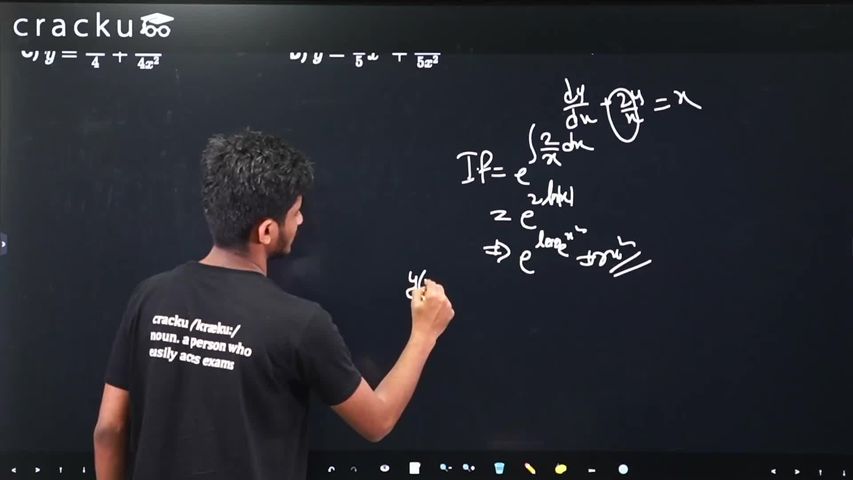
Click on the Email ☝️ to Watch the Video Solution
Create a FREE account and get:
_1.webp)

Educational materials for JEE preparation

Ask our AI anything

AI can make mistakes. Please verify important information.
AI can make mistakes. Please verify important information.
