
Join Our JEE Preparation Group
Prep with like-minded aspirants; Get access to free daily tests and study material.
Sign in
Please select an account to continue using cracku.in
↓ →
Join Our JEE Preparation Group
Prep with like-minded aspirants; Get access to free daily tests and study material.
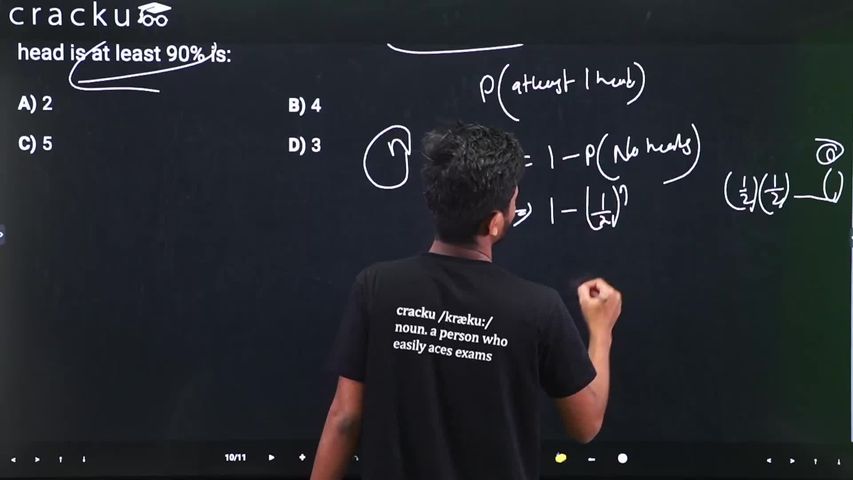
The minimum number of times one has to toss a fair coin so that the probability of observing at least one head is at least 90% is:
We want the probability of getting at least one head to be at least 90 %. A fair coin has probability $$\tfrac12$$ of showing a head and the same probability $$\tfrac12$$ of showing a tail on every toss.
It is often easier to work with the complementary event. The complementary event to “at least one head in $$n$$ tosses” is “no head at all in $$n$$ tosses”, i.e. all the $$n$$ tosses show tails.
For a single toss, the probability of getting a tail is $$\tfrac12$$. Because successive tosses are independent, the probability that all $$n$$ tosses are tails is
$$\left(\tfrac12\right)^n.$$
The required probability of getting at least one head is therefore
$$1-\left(\tfrac12\right)^n.$$
We are told this probability must be at least 90 %, that is $$0.90$$. Translating the verbal condition into an inequality, we write
$$1-\left(\tfrac12\right)^n \;\ge\; 0.9.$$
Rearranging, we subtract 1 from both sides and then multiply by −1; remembering that multiplying an inequality by a negative reverses the inequality sign, we get
$$\left(\tfrac12\right)^n \;\le\; 0.1.$$
To solve for $$n$$ we take natural logarithms (any logarithm base could be used, but using one base consistently is essential). First we state the logarithm rule we are about to use:
If $$a>0$$ and $$0<b<1$$, then $$b^a=c$$ implies $$a=\dfrac{\ln c}{\ln b}.$$
Applying this rule to our inequality
$$\left(\tfrac12\right)^n \le 0.1,$$
we obtain
$$n \,\ln\!\left(\tfrac12\right) \;\le\; \ln(0.1).$$
Because $$\ln\!\left(\tfrac12\right)$$ is negative, dividing by it reverses the inequality once again:
$$n \;\ge\; \dfrac{\ln(0.1)}{\ln\!\left(\tfrac12\right)}.$$
Now we evaluate the logarithms numerically:
$$\ln(0.1) = -2.302585\ldots,$$
$$\ln\!\left(\tfrac12\right) = -0.693147\ldots.$$
Substituting these values, $$ n \ge \dfrac{-2.302585\ldots}{-0.693147\ldots} = 3.321928\ldots $$
The number of tosses $$n$$ must be an integer, and it must be at least the value just obtained, so we round up to the next whole number:
$$n = 4.$$
We can verify quickly: with 4 tosses the probability of at least one head is
$$1-\left(\tfrac12\right)^4 =1-\dfrac1{16} =\dfrac{15}{16} =0.9375,$$ which indeed exceeds 0.90. For 3 tosses the probability is only $$1-\tfrac18=0.875,$$ which is insufficient.
Hence, the correct answer is Option B.
Was this solution helpful?
Click on the Email ☝️ to Watch the Video Solution
Create a FREE account and get:
_1.webp)

Educational materials for JEE preparation

Ask our AI anything

AI can make mistakes. Please verify important information.
AI can make mistakes. Please verify important information.


