
Join Our JEE Preparation Group
Prep with like-minded aspirants; Get access to free daily tests and study material.
Sign in
Please select an account to continue using cracku.in
↓ →
Join Our JEE Preparation Group
Prep with like-minded aspirants; Get access to free daily tests and study material.
From the first 100 natural numbers, two numbers first a and then b are selected randomly without replacement. If the probability that $$a-b \geq 10$$ is $$\frac{m}{n}$$, gcd (m, n) = 1, then m + n is equal to______.
Correct Answer: 311
We select two numbers, $$a$$ and then $$b$$ from the first 100 natural numbers without replacement.
Thus the total number of ordered selections is $$100\times\ 99=9900$$
We need $$P\left(a-b\ge\ 10\right)$$
$$\therefore$$ $$\left(a\ge b+\ 10\right)$$
So for every chosen $$a$$, the value of $$b$$ must be at least 10 or less than $$a$$.
The smallest possible $$a$$ satisfying the condition is 11.
For each $$a$$, the possible values of $$b$$ are:
1,2,3,…,a−10
Number of choices for $$b$$: $$a-10$$
Favourable outcomes:
$$\Sigma_{a=11}^{a=100}\left(a-10\right)$$
Let k=a-10
$$\therefore$$ $$\Sigma_{k=1}^{k=90}\left(k\right)$$
$$sum=\dfrac{\left(90\left(90+1\right)\right)}{2}=4095$$
$$P=\dfrac{4095}{9900}$$
When we simplify for coprime, we get $$\dfrac{4095}{9900}=\dfrac{91}{220}$$
$$\therefore$$ m=91 and n=220
$$m+n=91+220=311$$
Hence, our answer is 311.
Was this solution helpful?
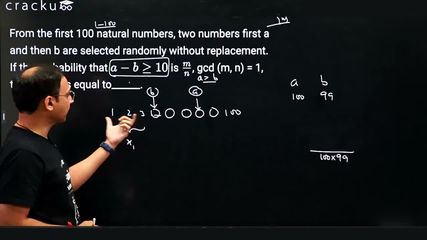
Click on the Email ☝️ to Watch the Video Solution
Create a FREE account and get:
_1.webp)

Educational materials for JEE preparation

Ask our AI anything

AI can make mistakes. Please verify important information.
AI can make mistakes. Please verify important information.
