
Join Our JEE Preparation Group
Prep with like-minded aspirants; Get access to free daily tests and study material.
Sign in
Please select an account to continue using cracku.in
↓ →
Join Our JEE Preparation Group
Prep with like-minded aspirants; Get access to free daily tests and study material.
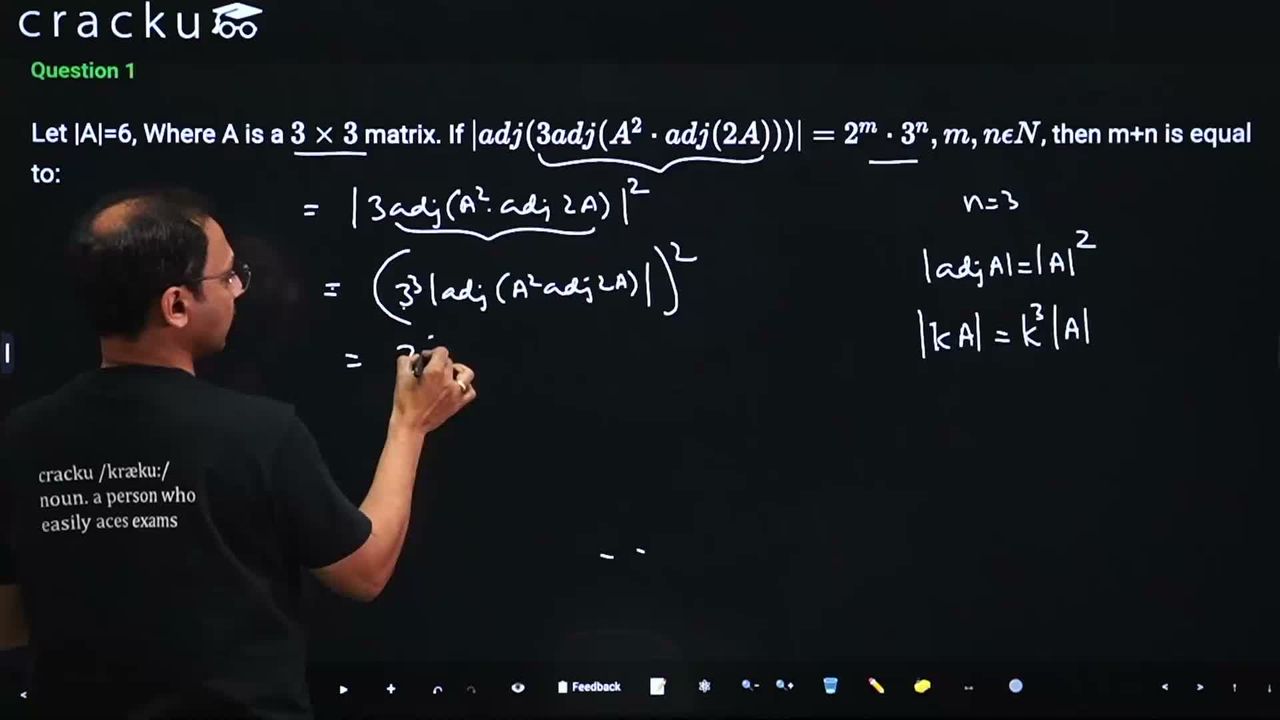
Let |A|=6, Where A is a $$3\times3$$ matrix. If $$|adj(3adj(A^{2}\cdot adj(2A)))|=2^{m}\cdot3^{n},m,n\epsilon N$$, then m+n is equal to:
Correct Answer: 62
Since $$|A| = 6$$ for a $$3 \times 3$$ matrix $$A$$, we need to find $$|\text{adj}(3\,\text{adj}(A^2 \cdot \text{adj}(2A)))| = 2^m \cdot 3^n\,$$.
$$3 \times 3$$ matrix $$M$$, one has $$|\text{adj}(M)| = |M|^2$$ and $$|kM| = k^3 |M|\,$$.
Substituting $$k = 2$$ gives $$|2A| = 2^3 \cdot |A| = 8 \cdot 6 = 48\,$$.
This yields $$|\text{adj}(2A)| = |2A|^2 = 48^2 = 2304\,$$.
Since $$|A^2| = |A|^2 = 36\,$$, it follows that $$|A^2 \cdot \text{adj}(2A)| = |A^2| \cdot |\text{adj}(2A)| = 36 \cdot 2304 = 82944\,$$.
Factoring $$82944 = 36 \cdot 2304 = 6^2 \cdot 48^2 = (6 \cdot 48)^2 = 288^2$$ and noting $$288 = 2^5 \cdot 3^2$$ gives $$288^2 = 2^{10} \cdot 3^4\,$$.
$$|\text{adj}(A^2 \cdot \text{adj}(2A))| = |A^2 \cdot \text{adj}(2A)|^2 = (2^{10} \cdot 3^4)^2 = 2^{20} \cdot 3^8\,$$.
Multiplying by 3 yields $$|3\,\text{adj}(A^2 \cdot \text{adj}(2A))| = 3^3 \cdot |\text{adj}(A^2 \cdot \text{adj}(2A))| = 27 \cdot 2^{20} \cdot 3^8 = 2^{20} \cdot 3^{11}\,$$.
Finally, $$|\text{adj}(3\,\text{adj}(A^2 \cdot \text{adj}(2A)))| = |3\,\text{adj}(A^2 \cdot \text{adj}(2A))|^2 = (2^{20} \cdot 3^{11})^2 = 2^{40} \cdot 3^{22}\,$$, so $$m = 40$$ and $$n = 22$$, giving $$m + n = 62\,$$.
Was this solution helpful?
Click on the Email ☝️ to Watch the Video Solution
Create a FREE account and get:
_1.webp)

Educational materials for JEE preparation

Ask our AI anything

AI can make mistakes. Please verify important information.
AI can make mistakes. Please verify important information.
