
Join Our JEE Preparation Group
Prep with like-minded aspirants; Get access to free daily tests and study material.
Sign in
Please select an account to continue using cracku.in
↓ →
Join Our JEE Preparation Group
Prep with like-minded aspirants; Get access to free daily tests and study material.
Let f be a twice differentiable non-negative function such that $$(f(x))^{2}=25+\int_{0}^{x}\left((f(t))^{2}+(f'(t))^{2}\right)dt$$. Then the mean of $$f(\log_{e}{(1)}),f(\log_{e}{(2)}),.....,f(\log_{e}{(625)})$$ is equal to:
Correct Answer: 1565
differentiating both sides with respect to $$x$$.
$$2f(x)f'(x)$$ = $$(f(x))^2+(f'(x))^2$$
$$(f'(x) - f(x))^{2} = 0$$
$$f'(x) - f(x) = 0\ $$
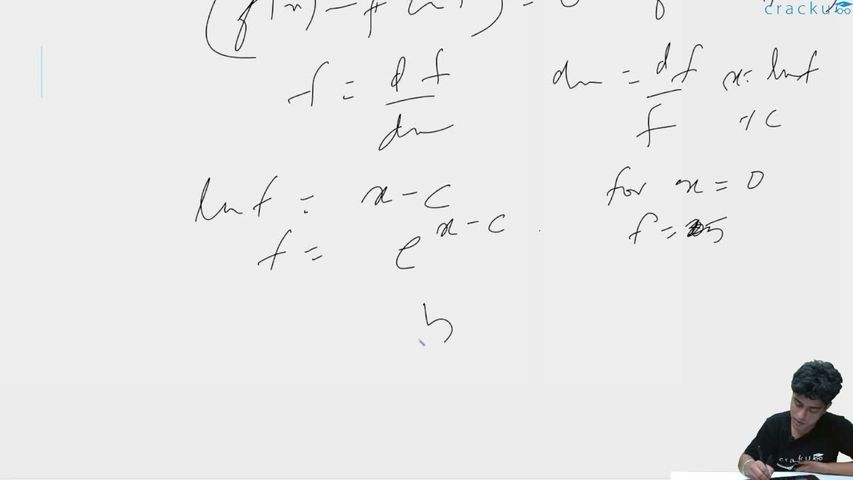
$$\frac{df}{dx} = f(x)$$
$$\frac{1}{f(x)}\,df = dx$$ so integrating both sides leads to $$\int \frac{1}{f(x)}\,df = \int 1\,dx \;\Longrightarrow\; \ln\bigl|f(x)\bigr| = x + C,$$ whence $$f(x) = Ce^{\,x}$$ for some constant $$C$$.
$$\bigl(f(0)\bigr)^{2} = 25 + \int_{0}^{0}\bigl((f(t))^{2}+(f'(t))^{2}\bigr)\,dt = 25.$$
Since $$f$$ is non-negative it follows that $$f(0)=5$$, so $$C=5$$ and
$$f(x)=5e^{\,x}\,. $$
Noting that for any positive integer $$k$$ we have $$f(\ln k) = 5e^{\,\ln k} = 5k\,, $$ the sum of these 625 values is $$\sum_{k=1}^{625}5k = 5\sum_{k=1}^{625}k = 5\cdot\frac{625\cdot626}{2}\,. $$
Therefore the mean is
$$\frac{1}{625}\times5\times\frac{625\times626}{2}
= \frac{5\times626}{2}
= 5\times313
=1565\,. $$
Was this solution helpful?
Click on the Email ☝️ to Watch the Video Solution
Create a FREE account and get:
_1.webp)

Educational materials for JEE preparation

Ask our AI anything

AI can make mistakes. Please verify important information.
AI can make mistakes. Please verify important information.
