
Join Our JEE Preparation Group
Prep with like-minded aspirants; Get access to free daily tests and study material.
Sign in
Please select an account to continue using cracku.in
↓ →
Join Our JEE Preparation Group
Prep with like-minded aspirants; Get access to free daily tests and study material.
A string of area of cross-section 4 mm$$^2$$ and length 0.5 is connected with a rigid body of mass 2 kg. The body is rotated in a vertical circular path of radius 0.5 m. The body acquires a speed of 5 m s$$^{-1}$$ at the bottom of the circular path. Strain produced in the string when the body is at the bottom of the circle is _____ $$\times 10^{-5}$$. (Use Young's modulus $$10^{11}$$ N m$$^{-2}$$ and $$g = 10 \ m s^{-2}$$)
Correct Answer: 30
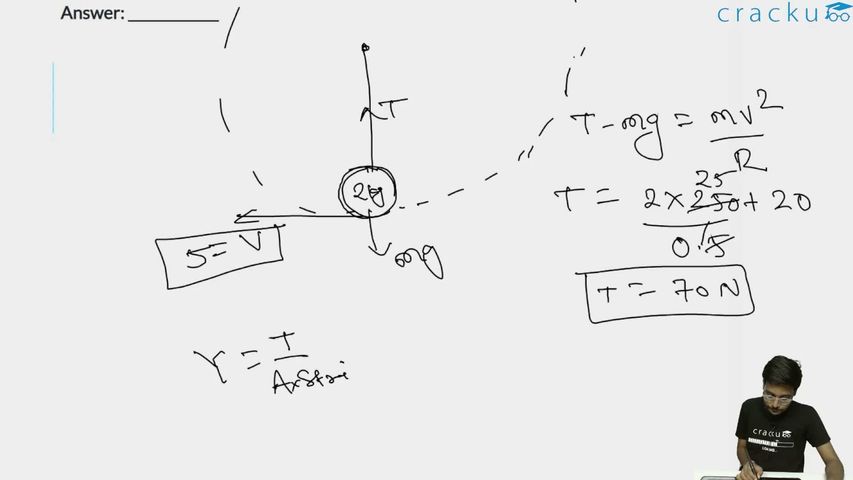
We have a rigid body of mass $$m = 2 \text{ kg}$$ attached to a string of cross-sectional area $$A = 4 \text{ mm}^2 = 4 \times 10^{-6} \text{ m}^2$$ and length $$0.5 \text{ m}$$. The body rotates in a vertical circle of radius $$r = 0.5 \text{ m}$$ and has a speed of $$v = 5 \text{ m/s}$$ at the bottom. We need to find the strain in the string at the bottom.
At the bottom of the circular path, the net upward force provides the centripetal acceleration. Applying Newton's second law along the radial direction (towards the centre, which is upward at the bottom), we get $$T - mg = \frac{mv^2}{r}$$.
So the tension is $$T = m\left(g + \frac{v^2}{r}\right) = 2\left(10 + \frac{25}{0.5}\right) = 2(10 + 50) = 2 \times 60 = 120 \text{ N}$$.
Now, from the definition of Young's modulus, $$Y = \frac{\text{Stress}}{\text{Strain}} = \frac{T/A}{\text{Strain}}$$, so $$\text{Strain} = \frac{T}{AY}$$.
Substituting the values, $$\text{Strain} = \frac{120}{4 \times 10^{-6} \times 10^{11}} = \frac{120}{4 \times 10^{5}} = \frac{120}{400000} = 3 \times 10^{-4} = 30 \times 10^{-5}$$.
Hence, the strain produced is $$\textbf{30} \times 10^{-5}$$.
Was this solution helpful?
Click on the Email ☝️ to Watch the Video Solution
Create a FREE account and get:
_1.webp)

Educational materials for JEE preparation

Ask our AI anything

AI can make mistakes. Please verify important information.
AI can make mistakes. Please verify important information.
