
Join Our JEE Preparation Group
Prep with like-minded aspirants; Get access to free daily tests and study material.
Sign in
Please select an account to continue using cracku.in
↓ →
Join Our JEE Preparation Group
Prep with like-minded aspirants; Get access to free daily tests and study material.
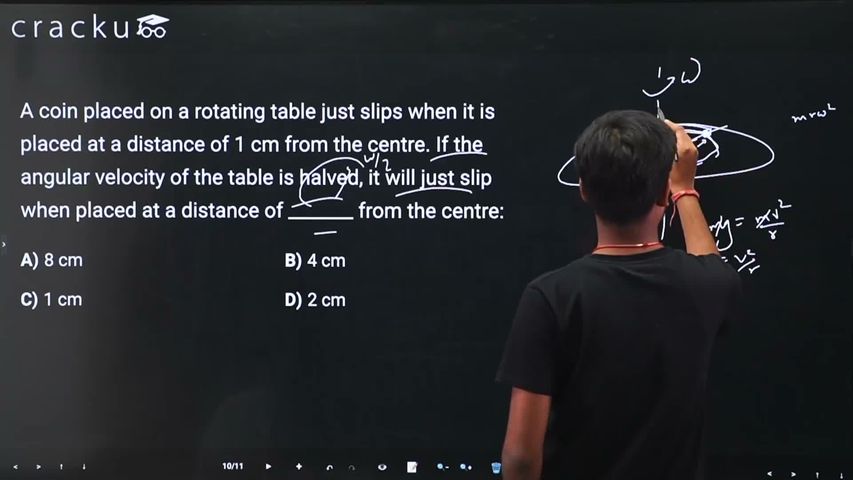
A coin placed on a rotating table just slips when it is placed at a distance of 1 cm from the centre. If the angular velocity of the table is halved, it will just slip when placed at a distance of _______ from the centre:
For a coin on a rotating table, the coin just slips when the centripetal force equals the maximum static friction force:
$$f_s = m\omega^2 r$$
At the point of slipping:
$$\mu m g = m\omega^2 r$$
$$\mu g = \omega^2 r$$
We are given that The coin just slips at $$r_1 = 1$$ cm when angular velocity is $$\omega$$.
So: $$\mu g = \omega^2 \times 1$$ ... (i)
When the angular velocity is halved to $$\frac{\omega}{2}$$, let the coin just slip at distance $$r_2$$:
$$\mu g = \left(\frac{\omega}{2}\right)^2 \times r_2 = \frac{\omega^2}{4} \times r_2$$ ... (ii)
From equations (i) and (ii):
$$\omega^2 \times 1 = \frac{\omega^2}{4} \times r_2$$
$$r_2 = 4 \text{ cm}$$
The coin will just slip when placed at a distance of 4 cm from the centre.
Was this solution helpful?
Click on the Email ☝️ to Watch the Video Solution
Create a FREE account and get:
_1.webp)

Educational materials for JEE preparation

Ask our AI anything

AI can make mistakes. Please verify important information.
AI can make mistakes. Please verify important information.
