
Join Our JEE Preparation Group
Prep with like-minded aspirants; Get access to free daily tests and study material.
Sign in
Please select an account to continue using cracku.in
↓ →
Join Our JEE Preparation Group
Prep with like-minded aspirants; Get access to free daily tests and study material.
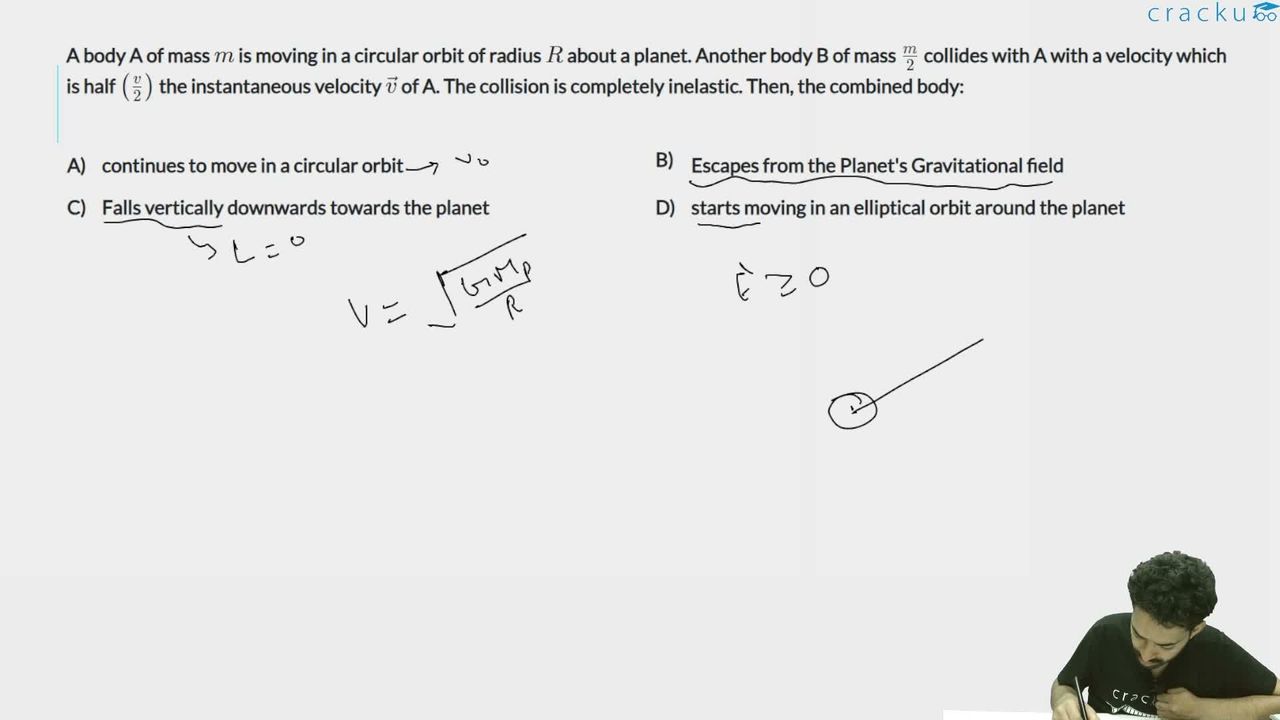
A body A of mass $$m$$ is moving in a circular orbit of radius $$R$$ about a planet. Another body B of mass $$\frac{m}{2}$$ collides with A with a velocity which is half $$\left(\frac{v}{2}\right)$$ the instantaneous velocity $$\vec{v}$$ of A. The collision is completely inelastic. Then, the combined body:
Let the mass of the planet be $$M$$. At the instant just before the collision body $$A$$ of mass $$m$$ is moving in a circular path of radius $$R$$ with speed $$v$$. For a circular orbit we first recall the condition obtained by equating the required centripetal force to the gravitational attraction
$$\frac{m v^{2}}{R}= \frac{G M m}{R^{2}}\; ,\qquad\Rightarrow\qquad v^{2}= \frac{G M}{R}$$
The gravitational potential energy of $$A$$ in that orbit is
$$U_{A}= -\,\frac{G M m}{R}= -m v^{2}$$
and its kinetic energy is
$$K_{A}= \frac12 m v^{2}$$
so the total mechanical energy of $$A$$ is
$$E_{A}=K_{A}+U_{A}=\frac12 m v^{2}-m v^{2}= -\frac12 m v^{2}$$
Now a second body $$B$$ of mass $$\dfrac{m}{2}$$ approaches and collides head-on (along the same tangential direction) with $$A$$ with speed $$\dfrac{v}{2}$$. The collision is completely inelastic, hence the two bodies stick together. During the very short collision the only significant forces are their mutual internal forces; the external gravitational force acts radially and therefore exerts no impulse in the tangential direction. Consequently the linear (tangential) momentum is conserved.
Initial tangential momentum:
$$p_{\text{initial}} \;=\; m\,v \;+\;\frac{m}{2}\,\frac{v}{2}\;=\;m v+\frac14 m v \;=\;\frac54\,m v$$
Total mass after collision:
$$m_{\text{tot}} = m+\frac{m}{2}= \frac32\,m$$
If $$V$$ is the common speed immediately after sticking together, conservation of momentum gives
$$\frac54\,m v = \frac32\,m\,V \quad\Rightarrow\quad V = \frac{\frac54}{\frac32}\,v = \frac{5}{4}\times\frac{2}{3}\,v = \frac56\,v$$
Thus the speed of the combined body has fallen to $$\dfrac56\,v$$.
Its kinetic energy right after the collision is
$$K' = \frac12\Bigl(\frac32\,m\Bigr) V^{2} =\frac34\,m\,\Bigl(\frac56\,v\Bigr)^{2} =\frac34\,m\,\frac{25}{36}\,v^{2} =\frac{25}{48}\,m v^{2}$$
The collision occurs at the same distance $$R$$ from the planet, so the gravitational potential energy of the combined body is
$$U' = -\,\frac{G M}{R}\Bigl(\frac32\,m\Bigr) =-\frac32\,m\,v^{2}$$ (because $$v^{2}= \dfrac{G M}{R}$$)
Hence the total mechanical energy after collision is
$$E' = K' + U' = \frac{25}{48}\,m v^{2} \;-\;\frac32\,m v^{2} = \frac{25}{48}\,m v^{2}-\frac{72}{48}\,m v^{2} = -\frac{47}{48}\,m v^{2}$$
We immediately notice that $$E'$$ is negative, so the system is still gravitationally bound; therefore it cannot escape (escape requires $$E\ge 0$$).
Next, compare the new speed $$V=\dfrac56\,v$$ with the speed required for a circular orbit at radius $$R$$. The circular-orbit speed does not depend on the mass of the moving body, and we have already found it to be $$v$$. Because
$$V=\frac56\,v \;\lt \; v$$
the combined body has less speed than needed for a circular path, so it cannot continue in the same circular orbit. However, its angular momentum about the planet is not zero:
$$L' = m_{\text{tot}} V R = \Bigl(\frac32\,m\Bigr)\Bigl(\frac56\,v\Bigr)R = \frac54\,m v R \ne 0$$
Because angular momentum is non-zero the body cannot fall straight towards the planet; instead it must follow another bound orbit. For a gravitational potential, bound non-circular orbits are elliptical. Hence the new path is an ellipse with the point of collision lying on that ellipse (specifically at the apogee, since the speed there is lower than the circular value).
Therefore the combined body starts moving in an elliptical orbit around the planet.
Hence, the correct answer is Option 4.
Was this solution helpful?
Click on the Email ☝️ to Watch the Video Solution
Create a FREE account and get:
_1.webp)

Educational materials for JEE preparation

Ask our AI anything

AI can make mistakes. Please verify important information.
AI can make mistakes. Please verify important information.
