Join WhatsApp Icon JEE WhatsApp Group

NTA JEE Main 9th January 2020 Shift 1

For the following questions answer them individually

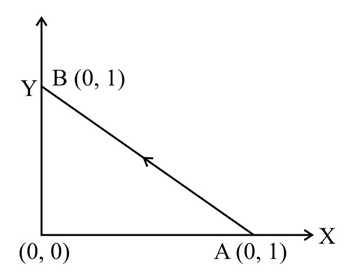
Consider a force $$\vec{F} = -x\hat{i} + y\hat{j}$$. The work done by this force in moving a particle from point $$A(1,0)$$ to $$B(0,1)$$ along the line segment is: (all quantities are in SI units)

Two particles of equal mass $$m$$ have respective initial velocities $$u\hat{i}$$ and $$u\left(\frac{\hat{i}+\hat{j}}{2}\right)$$. They collide completely inelastically. The energy lost in the process is:

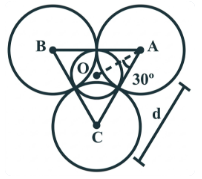
Three solid spheres each of mass $$m$$ and diameter $$d$$ are stuck together such that the lines connecting the centres form an equilateral triangle of side of length $$d$$. The ratio $$\frac{I_0}{I_A}$$ of moment of inertia $$I_0$$ of the system about an axis passing the centroid and about center of any of the spheres $$I_A$$ and perpendicular to the plane of the triangle is:

image

A body A of mass $$m$$ is moving in a circular orbit of radius $$R$$ about a planet. Another body B of mass $$\frac{m}{2}$$ collides with A with a velocity which is half $$\left(\frac{v}{2}\right)$$ the instantaneous velocity $$\vec{v}$$ of A. The collision is completely inelastic. Then, the combined body:

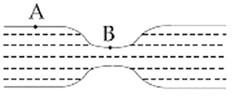
Water flows in a horizontal tube (see figure). The pressure of water changes by $$700 \; Nm^{-2}$$ between $$A$$ and $$B$$ where the area of cross section are $$40 \; cm^2$$ and $$20 \; cm^2$$, respectively. Find the rate of flow of water through the tube. (density of water $$= 1000 \; kgm^{-3}$$)

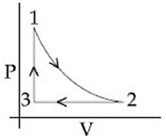
Which of the following is an equivalent cyclic process corresponding to the thermodynamic cyclic given in the figure? Where, $$1 \to 2$$ is adiabatic. (Graphs are schematic and are not to scale)

Consider two ideal diatomic gases $$A$$ and $$B$$ at some temperature $$T$$. Molecules of the gas $$A$$ are rigid, and have a mass $$m$$. Molecules of the gas $$B$$ have an additional vibrational mode and have a mass $$\frac{m}{4}$$. The ratio of the specific heats $$(C_V)_A$$ and $$(C_V)_B$$ of gas $$A$$ and $$B$$, respectively is:

Three harmonic waves having equal frequency $$\nu$$ and same intensity $$I_0$$, have phase angles $$0$$, $$\frac{\pi}{4}$$ and $$-\frac{\pi}{4}$$ respectively. When they are superimposed the intensity of the resultant wave is close to:

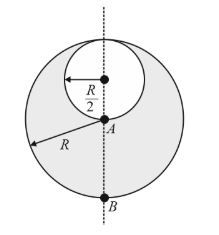
Consider a sphere of radius $$R$$ which carries a uniform charge density $$\rho$$. If a sphere of radius $$\frac{R}{2}$$ is carved out of it, as shown, the ratio $$\frac{|\vec{E_A}|}{|\vec{E_B}|}$$ of magnitude of electric field $$\vec{E_A}$$ and $$\vec{E_B}$$, respectively, at points $$A$$ and $$B$$ due to the remaining portion is:

image

An electric dipole of moment $$\vec{p} = (-\hat{i} - 3\hat{j} + 2\hat{k}) \times 10^{-29}$$ C m at the origin $$(0,0,0)$$. The electric field due to this dipole at $$\vec{r} = +\hat{i} + 3\hat{j} + 5\hat{k}$$ (note that $$\vec{r} \cdot \vec{p} = 0$$) is parallel to:

Radiation, with wavelength $$6561$$ Å falls on a metal surface to produce photoelectrons. The electrons are made to enter a uniform magnetic field of $$3 \times 10^{-4}$$ T. If the radius of the largest circular path followed by the electrons is $$10$$ mm, the work function of the metal is close to:

A long, straight wire of radius $$a$$ carries a current distributed uniformly over its cross-section. The ratio of the magnetic fields due to the wire at distance $$\frac{a}{3}$$ and $$2a$$, respectively from the axis of the wire is:

A charged particle of mass 'm' and charge 'q' moving under the influence of uniform electric field $$E\hat{i}$$ and a uniform magnetic field $$B\hat{k}$$ follows a trajectory from point P to Q as shown in figure. The velocities at P and Q are respectively, $$v\hat{i}$$ and $$-2v\hat{j}$$. Then which of the following statements (A, B, C, D) are the correct? (Trajectory shown is schematic and not to scale)
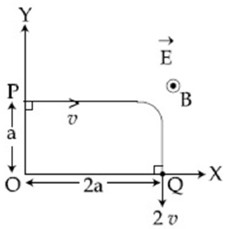
(A) $$E = \frac{3}{2}\left(\frac{mv^2}{qa}\right)$$
(B) Rate of work done by the electric field at P is $$\frac{3}{2}\left(\frac{mv^3}{a}\right)$$
(C) Rate of work done by both the fields at Q is zero
(D) The difference between the magnitude of angular momentum of the particle at P and Q is $$2mav$$.

The electric fields of two plane electromagnetic waves in vacuum are given by $$\vec{E_1} = E_0\hat{j}\cos(\omega t - kx)$$ and $$\vec{E_2} = E_0\hat{k}\cos(\omega t - ky)$$. At $$t = 0$$, a particle of charge $$q$$ is at origin with a velocity $$\vec{v} = 0.8c\hat{j}$$ ($$c$$ is the speed of light in vacuum). The instantaneous force experienced by the particle is:

A vessel of depth $$2h$$ is half filled with a liquid of refractive index $$2\sqrt{2}$$ and the upper half with another liquid of refractive index $$\sqrt{2}$$. The liquids are immiscible. The apparent depth of the inner surface of the bottom of the vessel will be:

The aperture diameter of a telescope is $$5$$ m. The separation between the moon and the earth is $$4 \times 10^5$$ km. With light of wavelength $$5500$$ Å, the minimum separation between objects on the surface of moon, so that they are just resolved, is close to:

The distance $$x$$ covered by a particle in one dimensional motion varies with time $$t$$ as $$x^2 = at^2 + 2bt + c$$. If the acceleration of the particle depends on $$x$$ as $$x^{-n}$$, where $$n$$ is an integer, the value of $$n$$ is ___________.

Backspace
789
456
123
0.-
Clear All

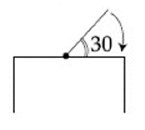
One end of a straight uniform $$1 \; m$$ long bar is pivoted on horizontal table. It is released from rest when it makes an angle $$30°$$ from the horizontal (see figure). Its angular speed when it hits the table is given as $$\sqrt{n}$$ rad $$s^{-1}$$, where $$n$$ is an integer. The value of $$n$$ is ___________.

Backspace
789
456
123
0.-
Clear All

A body of mass $$m = 10$$ kg is attached to one end of a wire of length $$0.3$$ m. What is the maximum angular speed (in rad $$s^{-1}$$) with which it can be rotated about its other end in a space station without breaking the wire?
[Breaking stress of wire $$(\sigma) = 4.8 \times 10^7$$ N $$m^{-2}$$ and area of cross-section of the wire $$= 10^{-2}$$ $$cm^2$$]

Backspace
789
456
123
0.-
Clear All

In a fluorescent lamp choke (a small transformer) $$100V$$ of reverse voltage is produced when the choke current changes uniformly from $$0.25A$$ to $$0$$ in a duration of $$0.025 \; ms$$. The self-inductance of the choke (in $$mH$$) is estimated to be ___________.

Backspace
789
456
123
0.-
Clear All

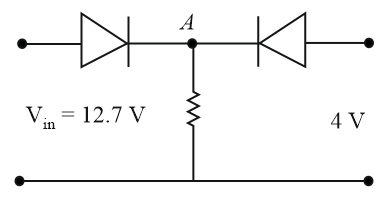
Both the diodes used in the circuit shown are assumed to be ideal and have negligible resistance when these are forward biased. Built in potential in each diode is $$0.7V$$. For the input voltages shown in the figure, the voltage (in Volts) at point A is ___________.

Backspace
789
456
123
0.-
Clear All

B has a smaller first ionization enthalpy than Be. Consider the following statement:
(I) it is easier to remove 2p electron than 2s electron
(II) 2p electron of B is more shielded from the nucleus by the inner core of electrons than the 2s electrons of Be
(III) 2s electron has more penetration power than 2p electron
(IV) atomic radius of B is more than Be
(atomic number B : 5, Be = 4)
The correct statements are:

If enthalpy of atomization for $$Br_2(l)$$ is $$x$$ kJ/mol and bond enthalpy for $$Br_2$$ is $$y$$ kJ/mol, the relation between them:

The $$K_{sp}$$ for the following dissociation is $$1.6 \times 10^{-5}$$
$$PbCl_{2(s)} \rightleftharpoons Pb^{2+}_{(aq)} + 2Cl^{-}_{(aq)}$$
Which of the following choices is correct for a mixture of 300 mL 0.134 M $$Pb(NO_3)_2$$ and 100 mL 0.4 M NaCl?

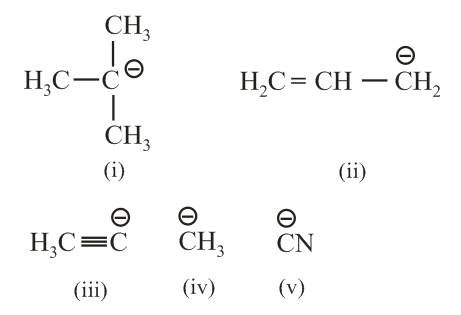
The increasing order of basicity for the following intermediates is (from weak to strong):

For the following reactions:
$$A \xrightarrow{700K} Product$$
$$A \xrightarrow[catalyst]{500K} Product$$
It was found that the $$E_a$$ is decreased by 30 KJ/mol in the presence of catalyst. If the rate remains unchanged, the activation energy for catalysed reaction is (Assume pre-exponential factor is same):

The electronic configurations of bivalent europium and trivalent cerium are:
(atomic number: Xe = 54, Ce = 58, Eu = 63)

Complex X of composition $$Cr(H_2O)_6Cl_n$$ has a spin only magnetic moment of 3.83 B.M. It reacts with $$AgNO_3$$ and shows geometrical isomerism. The IUPAC nomenclature of X is:

$$[Pd(F)(Cl)(Br)(I)]^{2-}$$ has $$n$$ number of geometrical isomers. Then, the spin-only magnetic moment and crystal field stabilization energy [CFSE] of $$[Fe(CN)_6]^{n-6}$$, respectively, are:
[Note: Ignore the pairing energy]

A chemist has 4 samples of artificial sweetener A, B, C and D. To identify these samples, he performed certain experiments and noted the following observations:
(i) A and D both form blue-violet colour with ninhydrin.
(ii) Lassaigne extract of C gives positive $$AgNO_3$$ test and negative $$Fe_4[Fe(CN)_6]_3$$ test.
(iii) Lassaigne extract of B and D gives positive sodium nitroprusside test.
Based on these observations which option is correct?

The hardness of a water sample containing $$10^{-3}$$ M $$MgSO_4$$ expressed as $$CaCO_3$$ equivalents (in ppm) is ___________.
(molar mass of $$MgSO_4$$ is 120.37 g/mol)

Backspace
789
456
123
0.-
Clear All

How much amount of NaCl should be added to 600 g of water $$(\rho = 1.00 \; g/mL)$$ to decrease the freezing point of water to $$-0.2$$ °C? ___________. (The freezing point depression constant for water $$= 2$$ K $$kg \; mol^{-1}$$)

Backspace
789
456
123
0.-
Clear All

108 g of silver (molar mass 108 $$gmol^{-1}$$) is deposited at cathode from $$AgNO_3(aq)$$ solution by a certain quantity of electricity. The volume (in L) of oxygen gas produced at 273 K and 1 bar pressure from water by the same quantity of electricity is ___________.

Backspace
789
456
123
0.-
Clear All

Let $$z$$ be a complex number such that $$\left|\frac{z-i}{z+2i}\right| = 1$$ and $$|z| = \frac{5}{2}$$. Then, the value of $$|z + 3i|$$ is:

The product $$2^{\frac{1}{4}} \cdot 4^{\frac{1}{16}} \cdot 8^{\frac{1}{48}} \cdot 16^{\frac{1}{128}} \cdot \ldots$$ to $$\infty$$ is equal to:

The value of $$\cos^3\left(\frac{\pi}{8}\right) \cdot \cos\left(\frac{3\pi}{8}\right) + \sin^3\left(\frac{\pi}{8}\right) \cdot \sin\left(\frac{3\pi}{8}\right)$$ is:

A circle touches the y-axis at the point $$(0, 4)$$ and passes through the point $$(2, 0)$$. Which of the following lines is not a tangent to this circle?

If $$e_1$$ and $$e_2$$ are the eccentricities of the ellipse $$\frac{x^2}{18} + \frac{y^2}{4} = 1$$ and the hyperbola $$\frac{x^2}{9} - \frac{y^2}{4} = 1$$ respectively and $$(e_1, e_2)$$ is a point on the ellipse $$15x^2 + 3y^2 = k$$, then the value of $$k$$ is equal to:

Negation of the statement: $$\sqrt{5}$$ is an integer or 5 is irrational is:

Let the observation $$x_i(1 \le i \le 10)$$ satisfy the equations $$\sum_{i=1}^{10}(x_i - 5) = 10$$, $$\sum_{i=1}^{10}(x_i - 5)^2 = 40$$. If $$\mu$$ and $$\lambda$$ are the mean and the variance of the observations, $$x_1 - 3, x_2 - 3, \ldots, x_{10} - 3$$, then the ordered pair $$(\mu, \lambda)$$ is equal to:

Let $$f$$ be any function continuous on $$[a, b]$$ and twice differentiable on $$(a, b)$$. If all $$x \in (a, b)$$, $$f'(x) > 0$$ and $$f''(x) < 0$$, then for any $$c \in (a, b)$$, $$\frac{f(c) - f(a)}{f(b) - f(c)}$$ is:

A spherical iron ball of 10 cm radius is coated with a layer of ice of uniform thickness that melts at a rate of $$50 \; cm^3/min$$. When the thickness of ice is 5 cm, then the rate (in cm/min) at which the thickness of ice decreases, is:

The integral $$\int \frac{dx}{(x+4)^{\frac{8}{7}}(x-3)^{\frac{6}{7}}}$$ is equal to: (where $$C$$ is a constant of integration)

If for all real triplets $$(a, b, c)$$, $$f(x) = a + bx + cx^2$$; then $$\int_0^1 f(x) \; dx$$ is equal to:

If $$f'(x) = \tan^{-1}(\sec x + \tan x)$$, $$-\frac{\pi}{2} < x < \frac{\pi}{2}$$ and $$f(0) = 0$$, then $$f(1)$$ is equal to:

Let $$D$$ be the centroid of the triangle with vertices $$(3, -1)$$, $$(1, 3)$$ and $$(2, 4)$$. Let P be the point of intersection of the lines $$x + 3y - 1 = 0$$ and $$3x - y + 1 = 0$$. Then, the line passing through the points $$D$$ and $$P$$ also passes through the point:

In a box, there are 20 cards, out of which 10 are labelled as $$A$$ and the remaining 10 are labelled as $$B$$. Cards are drawn at random, one after the other and with replacement, till a second $$A$$ card is obtained. The probability that the second $$A$$ card appears before the third $$B$$ card is:

If for $$x \ge 0$$, $$y = y(x)$$ is the solution of the differential equation,
$$(x + 1)dy = ((x + 1)^2 + y - 3)dx$$, $$y(2) = 0$$ then $$y(3)$$ is equal to ___________.

Backspace
789
456
123
0.-
Clear All

If the vectors, $$\vec{p} = (a+1)\hat{i} + a\hat{j} + a\hat{k}$$, $$\vec{q} = a\hat{i} + (a+1)\hat{j} + a\hat{k}$$ and $$\vec{r} = a\hat{i} + a\hat{j} + (a+1)\hat{k}$$ $$(a \in R)$$ are coplanar and $$3(\vec{p} \cdot \vec{q})^2 - \lambda|\vec{r} \times \vec{q}|^2 = 0$$, then the value of $$\lambda$$ is ___________.

Backspace
789
456
123
0.-
Clear All