
Join Our JEE Preparation Group
Prep with like-minded aspirants; Get access to free daily tests and study material.
Sign in
Please select an account to continue using cracku.in
↓ →
Join Our JEE Preparation Group
Prep with like-minded aspirants; Get access to free daily tests and study material.
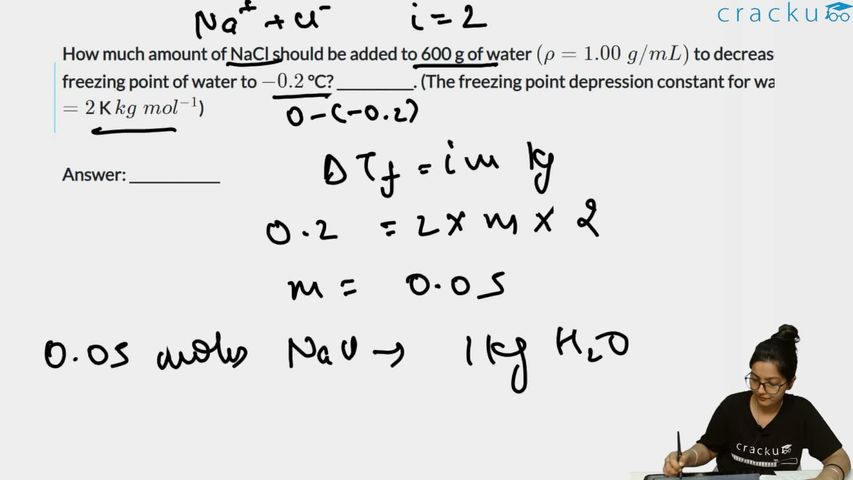
How much amount of NaCl should be added to 600 g of water $$(\rho = 1.00 \; g/mL)$$ to decrease the freezing point of water to $$-0.2$$ °C? ___________. (The freezing point depression constant for water $$= 2$$ K $$kg \; mol^{-1}$$)
Correct Answer: 1.755
We want to lower the freezing point of water by $$0.2^{\circ}\text{C}$$. The relation between freezing-point depression and molality is given by the formula
$$\Delta T_f = i\,K_f\,m$$
where
$$\Delta T_f$$ is the decrease in freezing point,
$$i$$ is the van’t Hoff factor,
$$K_f$$ is the molal freezing-point depression constant of the solvent,
$$m$$ is the molality of the solution in $$\text{mol}\, \text{kg}^{-1}$$.
For water we have $$K_f = 2 \; \text{K}\, \text{kg}\, \text{mol}^{-1}$$ (given). Sodium chloride dissociates completely as
$$\text{NaCl} \rightarrow \text{Na}^+ + \text{Cl}^-$$
producing two ions, so the van’t Hoff factor is
$$i = 2$$.
The desired depression is
$$\Delta T_f = 0.2 \; \text{K}$$ (since a drop of $$0.2^{\circ}\text{C}$$ is numerically the same as $$0.2\;\text{K}$$).
Substituting these values into the formula, we can solve for the required molality $$m$$:
$$m = \frac{\Delta T_f}{i\,K_f} = \frac{0.2}{2 \times 2} = \frac{0.2}{4} = 0.05 \;\text{mol}\,\text{kg}^{-1}.$$
This means we need $$0.05$$ moles of NaCl per kilogram of water. The mass of water given is
$$600 \;\text{g} = 0.600 \;\text{kg}.$$
So the number of moles of NaCl required for this amount of water is
$$n_{\text{NaCl}} = m \times \text{kg of water} = 0.05 \times 0.600 = 0.030 \;\text{mol}.$$
Next we convert moles to grams. The molar mass of NaCl is
$$M_{\text{NaCl}} = 23 + 35.5 = 58.5 \;\text{g}\,\text{mol}^{-1}.$$
Hence the mass needed is
$$\text{mass} = n_{\text{NaCl}} \times M_{\text{NaCl}} = 0.030 \times 58.5 = 1.755 \;\text{g}.$$
Was this solution helpful?
Click on the Email ☝️ to Watch the Video Solution
Create a FREE account and get:
_1.webp)

Educational materials for JEE preparation

Ask our AI anything

AI can make mistakes. Please verify important information.
AI can make mistakes. Please verify important information.
