
Join Our JEE Preparation Group
Prep with like-minded aspirants; Get access to free daily tests and study material.
Sign in
Please select an account to continue using cracku.in
↓ →
Join Our JEE Preparation Group
Prep with like-minded aspirants; Get access to free daily tests and study material.
The hardness of a water sample containing $$10^{-3}$$ M $$MgSO_4$$ expressed as $$CaCO_3$$ equivalents (in ppm) is ___________.
(molar mass of $$MgSO_4$$ is 120.37 g/mol)
Correct Answer: 100
We have a water sample in which the concentration of magnesium sulphate is given as $$10^{-3}\ \text{mol L}^{-1}$$.
First, let us convert this molar concentration into the mass of $$MgSO_4$$ present in one litre of the water sample.
The molar mass of $$MgSO_4$$ is given to be $$120.37\ \text{g mol}^{-1}$$. Using the relation
$$\text{mass (g)} = \text{molarity (mol L}^{-1}\text{)}\times\text{molar mass (g mol}^{-1}\text{)},$$
we obtain
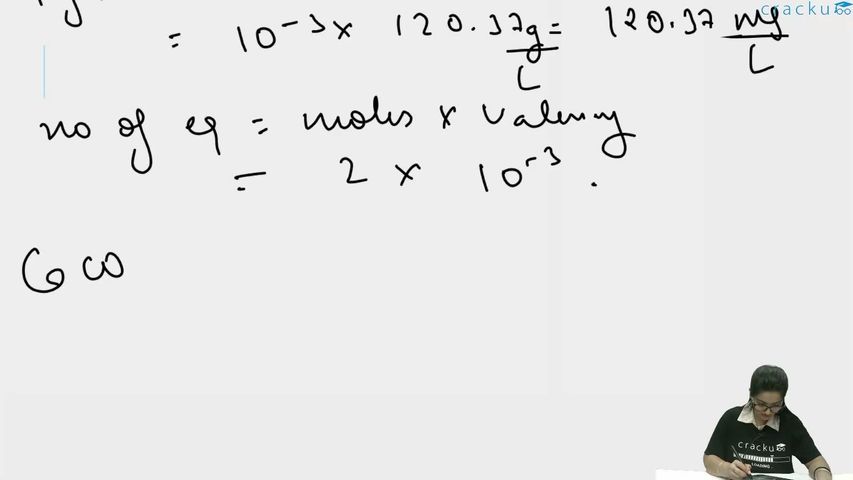
$$\text{mass of }MgSO_4 = 10^{-3}\ \text{mol L}^{-1}\times120.37\ \text{g mol}^{-1} = 0.12037\ \text{g L}^{-1}.$$
Changing grams to milligrams (since $$1\ \text{g}=1000\ \text{mg}$$):
$$0.12037\ \text{g L}^{-1} = 0.12037\times1000\ \text{mg L}^{-1} = 120.37\ \text{mg L}^{-1}.$$
The hardness of water is always expressed as the equivalent concentration of $$CaCO_3$$. To carry out this conversion we must compare the equivalent amounts of the two compounds.
For any species,
$$\text{number of equivalents} = \text{moles}\times\text{valency},$$
and the corresponding mass in terms of any reference compound equals
$$\text{Number of equivalents}\times\text{equivalent weight of reference compound}.$$
Here, the hardness-producing ion from $$MgSO_4$$ is $$Mg^{2+}$$, which possesses a valency of 2. Thus, one mole of $$MgSO_4$$ provides two equivalents. For the present sample:
$$\text{equivalents of }MgSO_4 = 10^{-3}\ \text{mol L}^{-1}\times2 = 2\times10^{-3}\ \text{equiv L}^{-1}.$$
The reference compound is $$CaCO_3$$. Its molar mass is $$100\ \text{g mol}^{-1}$$ and its valency with respect to hardness (coming from $$Ca^{2+}$$) is also 2, so its equivalent weight is
$$\frac{\text{molar mass}}{\text{valency}} = \frac{100\ \text{g mol}^{-1}}{2} = 50\ \text{g equiv}^{-1}.$$
The mass of $$CaCO_3$$ that possesses the same number of equivalents as the given $$MgSO_4$$ is therefore
$$\text{mass of }CaCO_3 = 2\times10^{-3}\ \text{equiv L}^{-1}\times50\ \text{g equiv}^{-1} = 0.1\ \text{g L}^{-1}.$$
Again converting grams to milligrams,
$$0.1\ \text{g L}^{-1} = 0.1\times1000\ \text{mg L}^{-1} = 100\ \text{mg L}^{-1}.$$
Since 1 milligram per litre is numerically equal to 1 part per million (ppm) for aqueous solutions, the hardness of the given water sample is
$$100\ \text{ppm}.$$
So, the answer is $$100$$.
Was this solution helpful?
Click on the Email ☝️ to Watch the Video Solution
Create a FREE account and get:
_1.webp)

Educational materials for JEE preparation

Ask our AI anything

AI can make mistakes. Please verify important information.
AI can make mistakes. Please verify important information.
