
Join Our JEE Preparation Group
Prep with like-minded aspirants; Get access to free daily tests and study material.
Sign in
Please select an account to continue using cracku.in
↓ →
Join Our JEE Preparation Group
Prep with like-minded aspirants; Get access to free daily tests and study material.
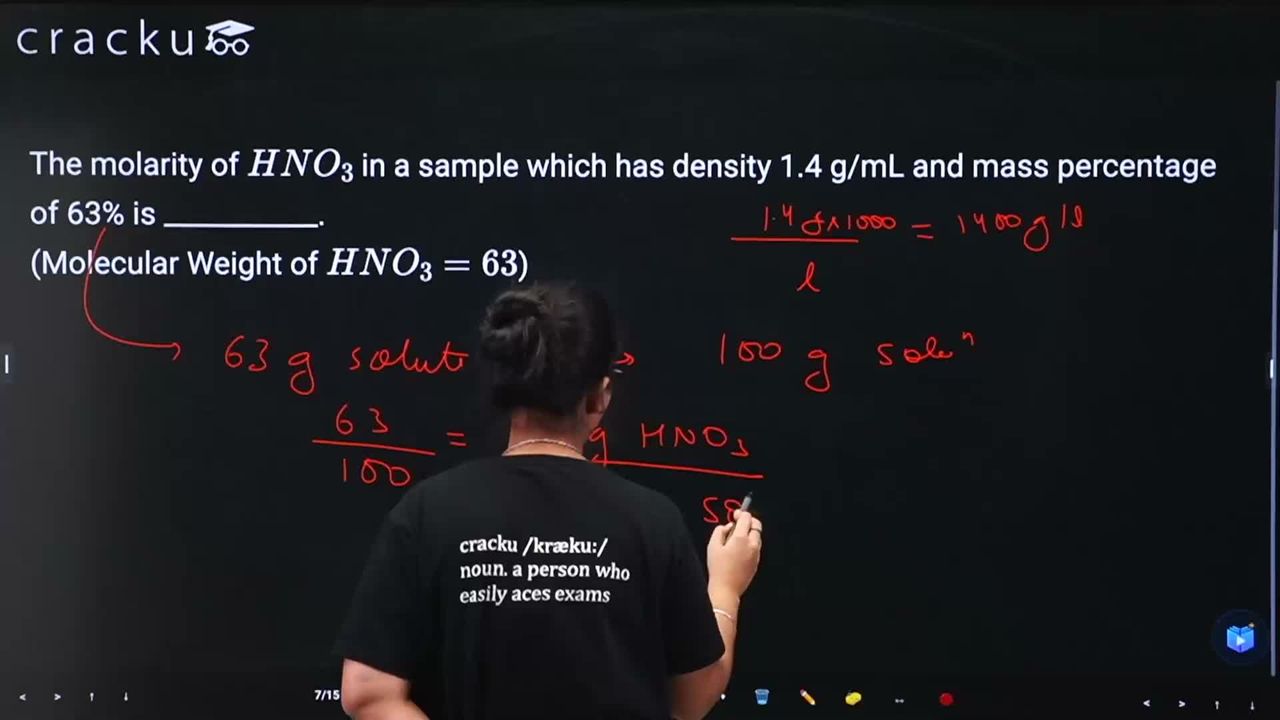
The molarity of $$HNO_3$$ in a sample which has density 1.4 g/mL and mass percentage of 63% is ___________.
(Molecular Weight of $$HNO_3 = 63$$)
Correct Answer: 14
We start by recalling that density tells us the mass of the solution per unit volume. The given density is $$1.4\ \text{g mL}^{-1}$$. Because there are $$1000\ \text{mL}$$ in $$1\ \text{L}$$, we convert this to grams per litre:
$$1.4\ \text{g mL}^{-1}\times 1000\ \text{mL L}^{-1}=1400\ \text{g L}^{-1}.$$
This means that one litre of the solution has a total mass of $$1400\ \text{g}$$.
Next, the mass percentage of nitric acid is $$63\%$$. By definition of mass percentage, $$63\%$$ $$\bigl(\text{w/w}\bigr)$$ means that in every $$100\ \text{g}$$ of the solution, the mass of $$HNO_3$$ present is $$63\ \text{g}$$. Therefore, we set up a direct proportion for one litre of the solution:
$$\frac{63\ \text{g HNO}_3}{100\ \text{g solution}}=\frac{x\ \text{g HNO}_3}{1400\ \text{g solution}}.$$
Cross-multiplying, we obtain
$$x=1400\times\frac{63}{100}=1400\times0.63=882\ \text{g HNO}_3.$$
So, one litre of the solution contains $$882\ \text{g}$$ of nitric acid.
To find molarity, we need the number of moles of $$HNO_3$$ present in this one-litre volume. The formula for moles is stated first:
$$\text{Moles}=\frac{\text{Mass}}{\text{Molar Mass}}.$$
The molar mass (molecular weight) of $$HNO_3$$ is given as $$63\ \text{g mol}^{-1}$$. Substituting the values:
$$\text{Moles of }HNO_3=\frac{882\ \text{g}}{63\ \text{g mol}^{-1}}=14\ \text{mol}.$$
Because these $$14$$ moles are present in exactly $$1\ \text{L}$$ of solution, the Molarity (moles per litre) is simply
$$M=14\ \text{mol L}^{-1}.$$
So, the answer is $$14$$.
Was this solution helpful?
Click on the Email ☝️ to Watch the Video Solution
Create a FREE account and get:
_1.webp)

Educational materials for JEE preparation

Ask our AI anything

AI can make mistakes. Please verify important information.
AI can make mistakes. Please verify important information.
