
Join Our JEE Preparation Group
Prep with like-minded aspirants; Get access to free daily tests and study material.
Sign in
Please select an account to continue using cracku.in
↓ →
Join Our JEE Preparation Group
Prep with like-minded aspirants; Get access to free daily tests and study material.
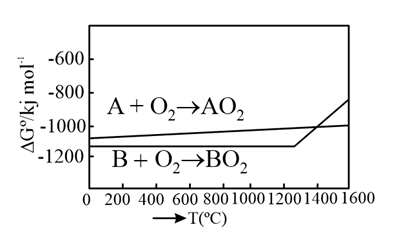
According to the following diagram, A reduces $$BO_2$$ when the temperature is:
Stability of Oxides:
On an Ellingham diagram, a lower position (more negative $$\Delta G^\circ$$ value) indicates a more stable oxide. The metal corresponding to the lower curve has a higher affinity for oxygen.
Criteria for Reduction:
For a metal to reduce another metal's oxide, the free energy of formation of its own oxide must be more negative than that of the oxide being reduced. In graphical terms, a metal can reduce the oxide of any metal whose line lies above its own line on the diagram.
Below $$1400^\circ\text{C}$$:
The curve for the formation of $$\text{BO}_2$$ ($$\text{B} + \text{O}_2 \rightarrow \text{BO}_2$$) lies below the curve for $$\text{AO}_2$$ ($$\text{A} + \text{O}_2 \rightarrow \text{AO}_2$$). This means that below $$1400^\circ\text{C}$$, $$\text{BO}_2$$ is more stable than $$\text{AO}_2$$, and B can reduce $$\text{AO}_2$$, but A cannot reduce $$\text{BO}_2$$.
At the Intersection Point ($$T = 1400^\circ\text{C}$$):
The two curves intersect. At this specific temperature, the standard Gibbs free energy change ($$\Delta G^\circ$$) for both oxidation reactions is equal, meaning the system is in a state of dynamic equilibrium.
Above $$1400^\circ\text{C}$$:
The curve for the formation of $$\text{AO}_2$$ cross over and now lies below the curve of $$\text{BO}_2$$. As a result, $$\text{AO}_2$$ becomes thermodynamically more stable than $$\text{BO}_2$$. Therefore, element A can spontaneously reduce $$\text{BO}_2$$ to element B according to the net reaction:
$$\text{BO}_2 + \text{A} \rightarrow \text{AO}_2 + \text{B} \quad (\Delta G^\circ < 0)$$Element A reduces $$\text{BO}_2$$ only in the temperature region where the line for $$\text{AO}_2$$ is below the line for $$\text{BO}_2$$, which occurs when the temperature is greater than $$1400^\circ\text{C}$$.
Answer: Option B — $$> 1400^\circ\text{C}$$
Was this solution helpful?
Click on the Email ☝️ to Watch the Video Solution
Create a FREE account and get:
_1.webp)

Educational materials for JEE preparation

Ask our AI anything

AI can make mistakes. Please verify important information.
AI can make mistakes. Please verify important information.
