
Join Our JEE Preparation Group
Prep with like-minded aspirants; Get access to free daily tests and study material.
Sign in
Please select an account to continue using cracku.in
↓ →
Join Our JEE Preparation Group
Prep with like-minded aspirants; Get access to free daily tests and study material.
For the following reactions:
$$A \xrightarrow{700K} Product$$
$$A \xrightarrow[catalyst]{500K} Product$$
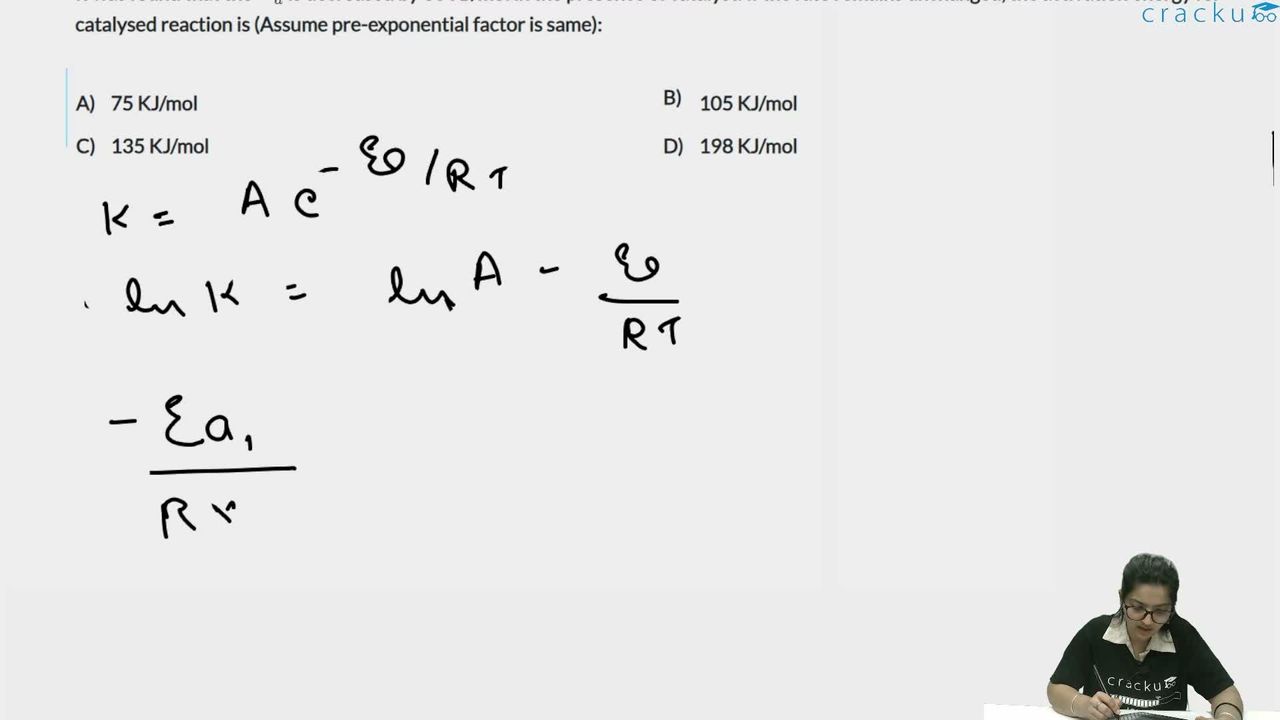
It was found that the $$E_a$$ is decreased by 30 KJ/mol in the presence of catalyst. If the rate remains unchanged, the activation energy for catalysed reaction is (Assume pre-exponential factor is same):
For chemical reactions we use the Arrhenius equation
$$k = A\,e^{-E_a/RT}$$
where $$k$$ is the rate constant, $$A$$ is the pre-exponential factor, $$E_a$$ is the activation energy, $$R$$ is the universal gas constant and $$T$$ is the absolute temperature.
We are told that the reaction proceeds with the same rate (hence the same rate constant) under two different conditions:
$$A \xrightarrow{700\,\text{K}} \text{Product} \quad\text{(uncatalysed)}$$
$$A \xrightarrow{500\,\text{K, catalyst}} \text{Product} \quad\text{(catalysed)}$$
Let the activation energies be $$E_1$$ (uncatalysed) and $$E_2$$ (catalysed). Because the rates are equal and the problem states that the pre-exponential factor $$A$$ remains unchanged, we write
$$A\,e^{-E_1/(R\;700)} \;=\; A\,e^{-E_2/(R\;500)}.$$
Cancelling the common factor $$A$$ and taking natural logarithms on both sides gives
$$-\dfrac{E_1}{R\;700} \;=\; -\dfrac{E_2}{R\;500}.$$
Multiplying through by $$-R$$ removes the negatives and the gas constant:
$$\dfrac{E_1}{700} \;=\; \dfrac{E_2}{500}.$$
So we have a simple proportion:
$$E_2 \;=\; \dfrac{500}{700}\,E_1 \;=\; \dfrac{5}{7}\,E_1.$$
The question also states that the catalyst lowers the activation energy by $$30\;\text{kJ mol}^{-1}$$, so
$$E_2 \;=\; E_1 \;-\; 30.$$
Substituting the proportional relation $$E_2 = \dfrac{5}{7}E_1$$ into the reduction statement gives
$$\dfrac{5}{7}E_1 = E_1 - 30.$$
Bringing like terms together:
$$E_1 - \dfrac{5}{7}E_1 = 30.$$
The left side simplifies because $$1 - \dfrac{5}{7} = \dfrac{2}{7}$$, so
$$\dfrac{2}{7}E_1 = 30.$$
Solving for $$E_1$$:
$$E_1 = 30 \times \dfrac{7}{2} = 105\;\text{kJ mol}^{-1}.$$
Finally, the catalysed activation energy is
$$E_2 = E_1 - 30 = 105 - 30 = 75\;\text{kJ mol}^{-1}.$$
Hence, the correct answer is Option A.
Was this solution helpful?
Click on the Email ☝️ to Watch the Video Solution
Create a FREE account and get:
_1.webp)

Educational materials for JEE preparation

Ask our AI anything

AI can make mistakes. Please verify important information.
AI can make mistakes. Please verify important information.
