Join Our JEE Preparation Group
Prep with like-minded aspirants; Get access to free daily tests and study material.
Sign in
Please select an account to continue using cracku.in
↓ →
Join Our JEE Preparation Group
Prep with like-minded aspirants; Get access to free daily tests and study material.
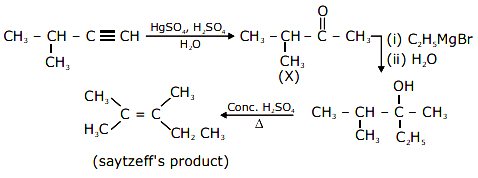
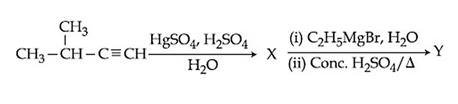
Step 1: Kucherov Reaction (Formation of X)
When 3-methylbut-1-yne ($$\text{CH}_3\text{--CH(CH}_3\text{)--C}\equiv\text{CH}$$) undergoes hydration in the presence of $$\text{HgSO}_4$$ and $$\text{H}_2\text{SO}_4$$, Markovnikov addition of water occurs to form an enol intermediate, which rapidly tautomerizes to a stable methyl ketone:
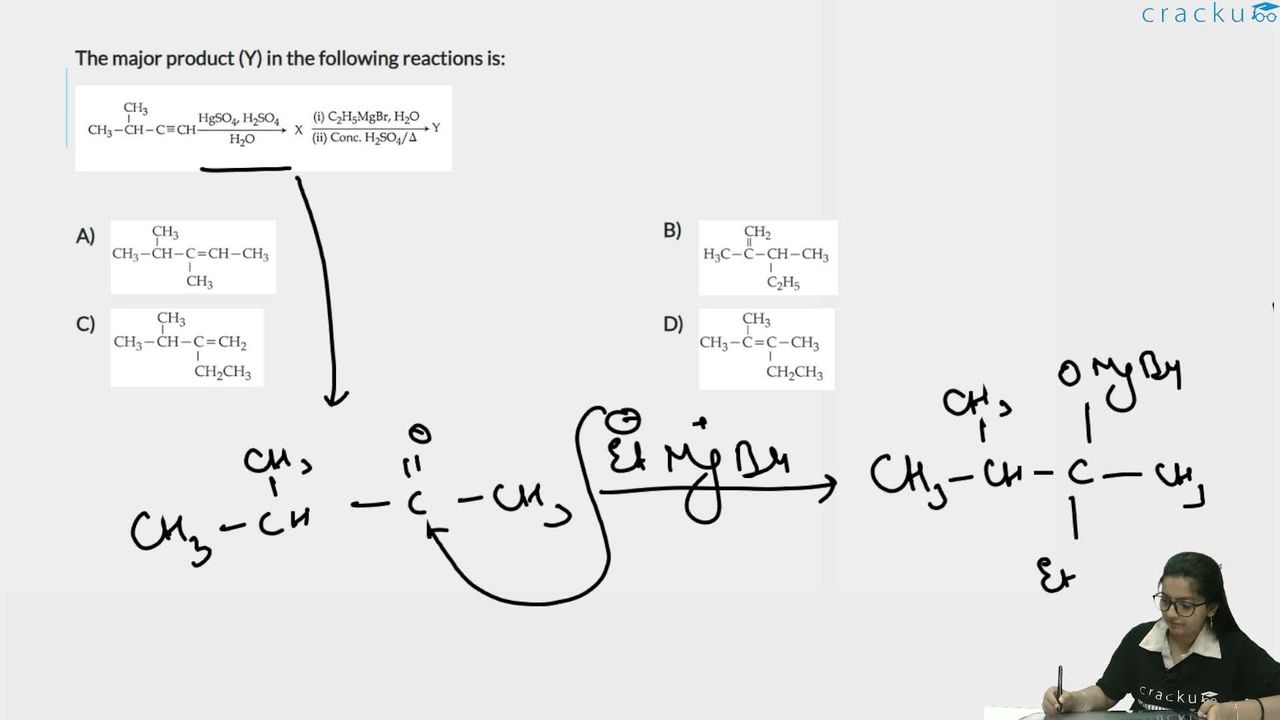
$$\text{Product X} = \text{3-methylbutan-2-one } \left[\text{CH}_3\text{--CH(CH}_3\text{)--C}(=\text{O})\text{--CH}_3\right]$$Step 2: Grignard Reaction
The carbonyl carbon of ketone X is attacked by the ethyl nucleophile from ethylmagnesium bromide ($$\text{C}_2\text{H}_5\text{MgBr}$$). Subsequent acid hydrolysis ($$\text{H}_2\text{O}$$) gives a tertiary alcohol:
$$\text{Intermediate Alcohol} = \text{3,4-dimethylhexan-3-ol } \left[\text{CH}_3\text{--CH(CH}_3\text{)--C(OH)(CH}_3\text{)--CH}_2\text{CH}_3\right]$$Step 3: Acid-Catalyzed Dehydration (Formation of Y)
Heating the tertiary alcohol with concentrated $$\text{H}_2\text{SO}_4$$ drives a dehydration reaction via a stable carbocation intermediate. Following Saytzeff's rule, elimination yields the most highly substituted and thermodynamically stable alkene as the major product:
$$\text{Product Y} = \text{2,3-dimethylpent-2-ene } \left[(\text{CH}_3)_2\text{C}=\text{C(CH}_3\text{)CH}_2\text{CH}_3\right]$$The sequence proceeds via oxymercuration-hydration of the alkyne, Grignard addition to form a tertiary alcohol, and subsequent elimination to deliver the most substituted alkene.
Answer: Option D — 2,3-dimethylpent-2-ene
Was this solution helpful?
Click on the Email ☝️ to Watch the Video Solution
Create a FREE account and get:
_1.webp)

Educational materials for JEE preparation

Ask our AI anything

AI can make mistakes. Please verify important information.
AI can make mistakes. Please verify important information.