Join WhatsApp Icon JEE WhatsApp Group
Question 35

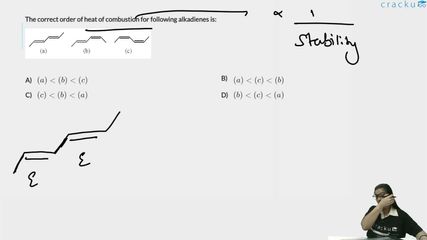
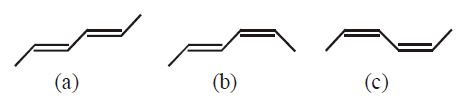
The correct order of heat of combustion for following alkadienes is:
For structural isomers or compounds sharing the exact same molecular formula, the heat of combustion is inversely proportional to the thermodynamic stability of the molecule:

$$\text{Heat of Combustion} \propto \frac{1}{\text{Stability}}$$

A more stable molecule sits at a lower potential energy level, thereby releasing less energy (heat) when completely burned into $$\text{CO}_2$$ and $$\text{H}_2\text{O}$$.


Factors Influencing Alkadiene Stability:

  1. Conjugation: Conjugated dienes (alternating double-single-double bonds) are significantly more stable than isolated dienes due to continuous $$\pi$$-electron delocalization.
  2. Steric Geometries (Cis vs. Trans): Trans-alkenes experience less steric hindrance than cis-alkenes, making the trans,trans-isomer more stable than cis,trans or cis,cis arrangements.

Evaluating the Alkadienes:

  • Structure (a): Trans,Trans-Conjugated Diene

    This structure has maximum conjugation along with the most sterically favorable trans,trans geometry. Because it has the lowest internal potential energy, it is the most stable and releases the least heat of combustion.


  • Structure (b): Cis,Trans-Conjugated Diene

    This structure maintains the stable conjugated network, but contains a less favorable cis-alkene alignment creating minor steric strain. It possesses intermediate stability and intermediate heat of combustion.


  • Structure (c): Cis,Cis-Conjugated or Non-Conjugated / Sterically Strained Diene

    This configuration experiences severe steric hindrance due to the crowded cis,cis arrangement of groups. Being the least stable isomer, it sits at the highest potential energy level and releases the highest heat of combustion.


Conclusion:

Reversing the overall stability trend ($$\text{a} > \text{b} > \text{c}$$) gives the correct increasing order of heat of combustion:

$$\mathbf{(a) < (b) < (c)}$$

Answer: Option A — (a) < (b) < (c)

Get AI Help

Video Solution

video

Create a FREE account and get:

  • Free JEE Mains Previous Papers PDF
  • Take JEE Mains paper tests

JEE Quant Questions | JEE Quantitative Ability

JEE DILR Questions | LRDI Questions For JEE

JEE Verbal Ability Questions | VARC Questions For JEE

Free JEE Topicwise Questions

JEE Rotational MotionJEE Units & MeasurementsJEE Atomic StructureJEE GravitationJEE Periodic Table & PeriodicityJEE StatisticsJEE Inverse Trigonometric FunctionsJEE Magnetism & Magnetic MaterialsJEE Sequences & SeriesJEE MatricesJEE Alternating CurrentsJEE Carboxylic AcidsJEE Permutations & CombinationsJEE Work, Energy & PowerJEE Electromagnetic InductionJEE Electronic DevicesJEE d and f-Block ElementsJEE Chemical KineticsJEE Heat TransferJEE Three Dimensional GeometryJEE Magnetic Effects of CurrentJEE Hydrocarbons - AromaticJEE Electromagnetic WavesJEE Aldehydes & KetonesJEE Hydrocarbons - AlkanesJEE Applications of DerivativesJEE EquilibriumJEE Indefinite IntegrationJEE Chemical ThermodynamicsJEE ElectrochemistryJEE ProbabilityJEE BiomoleculesJEE Continuity & DifferentiabilityJEE Kinetic Theory of GasesJEE Vector AlgebraJEE Hydrocarbons - AlkynesJEE Differential EquationsJEE Current & ResistanceJEE Straight LinesJEE WavesJEE Redox ReactionsJEE Hydrocarbons - AlkenesJEE DeterminantsJEE SolutionsJEE Ray OpticsJEE Dual Nature of Matter & RadiationJEE Chemical Bonding & Molecular StructureJEE Complex NumbersJEE Sets, Relations & FunctionsJEE Electric Charges & FieldsJEE Laws of MotionJEE Fluid MechanicsJEE Basic Concepts in ChemistryJEE Trigonometric FunctionsJEE LimitsJEE Laws of ThermodynamicsJEE Kinematics - 2D MotionJEE p-Block Elements (Groups 13-18)JEE Simple Harmonic MotionJEE Electric Potential & CapacitanceJEE Coordination CompoundsJEE JEE 2D GeometryJEE CirclesJEE Definite IntegrationJEE EMF & Circuit AnalysisJEE Surface TensionJEE Atoms & NucleiJEE Laboratory Experiments - XIJEE Number SystemJEE Basic Principles of Organic ChemistryJEE Wave OpticsJEE Quadratic EquationsJEE Alcohols, Phenols & EthersJEE Organic Compounds with HalogensJEE DifferentiationJEE Conic SectionsJEE Nitrogen-Containing CompoundsJEE ElasticityJEE Practical Organic ChemistryJEE Kinematics - 1D MotionJEE Purification & CharacterisationJEE Binomial Theorem
Ask AI