
Join Our JEE Preparation Group
Prep with like-minded aspirants; Get access to free daily tests and study material.
Sign in
Please select an account to continue using cracku.in
↓ →
Join Our JEE Preparation Group
Prep with like-minded aspirants; Get access to free daily tests and study material.
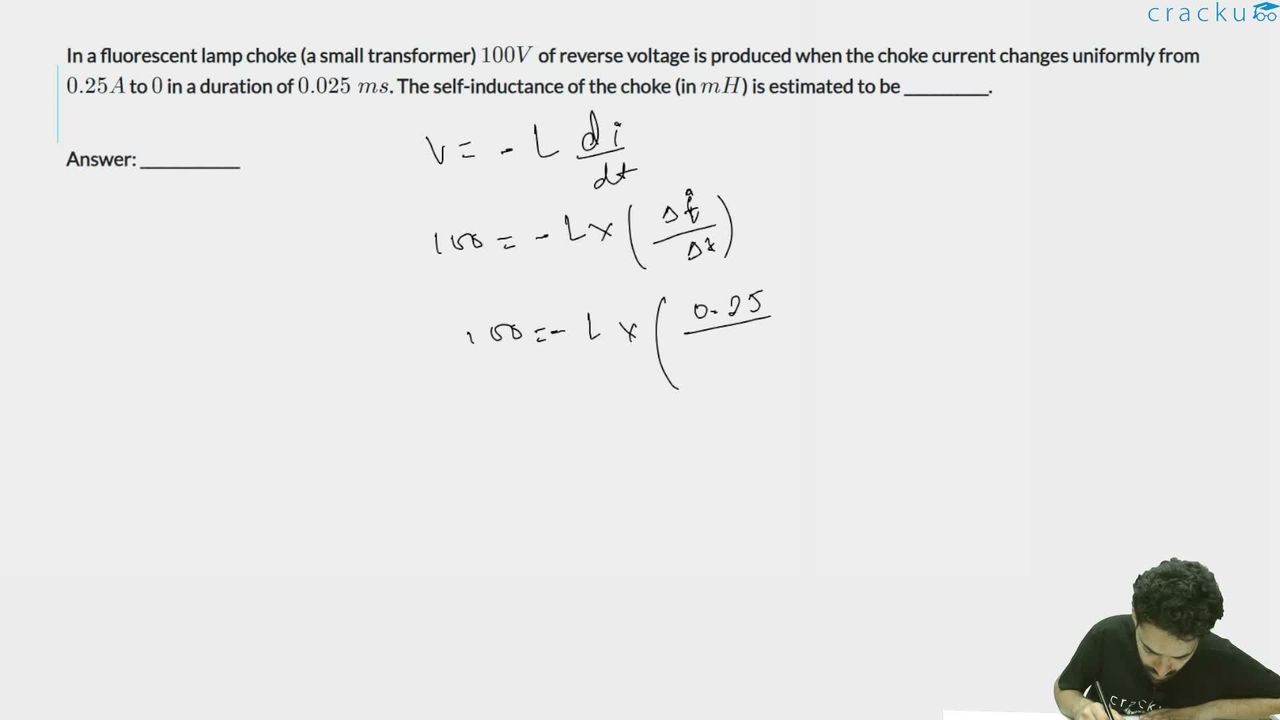
In a fluorescent lamp choke (a small transformer) $$100V$$ of reverse voltage is produced when the choke current changes uniformly from $$0.25A$$ to $$0$$ in a duration of $$0.025 \; ms$$. The self-inductance of the choke (in $$mH$$) is estimated to be ___________.
Correct Answer: 10
We have a choke in which an induced reverse voltage of $$100\ \text{V}$$ appears while the current falls uniformly from $$0.25\ \text{A}$$ to $$0\ \text{A}$$ in a short time interval of $$0.025\ \text{ms}$$.
First convert the given time into seconds, because in the SI system the unit of time is the second:
$$0.025\ \text{ms}=0.025 \times 10^{-3}\ \text{s}=0.000025\ \text{s}$$
The basic formula for the self-induced emf (Faraday-Lenz law for an inductor) is stated as
$$V = -L\,\frac{di}{dt}$$
where
$$V$$ is the induced voltage (here the given $$100\ \text{V}$$, we will use only its magnitude),
$$L$$ is the self-inductance we have to find, and
$$\dfrac{di}{dt}$$ is the rate of change of current.
Because the current drops from $$0.25\ \text{A}$$ to $$0\ \text{A}$$, the change in current is
$$\Delta i = i_\text{final}-i_\text{initial}=0-0.25=-0.25\ \text{A}$$
and the time interval is $$\Delta t = 0.000025\ \text{s}$$. Assuming the change is uniform, the rate of change of current is
$$\frac{di}{dt} = \frac{\Delta i}{\Delta t} = \frac{-0.25}{0.000025}\ \frac{\text{A}}{\text{s}} = -10000\ \frac{\text{A}}{\text{s}}.$$
The magnitude of this rate is $$|di/dt| = 10000\ \text{A s}^{-1}$$.
Ignoring the negative sign (it only shows that the voltage is a reverse emf), we substitute the magnitudes into the formula:
$$V = L\,\Bigl|\frac{di}{dt}\Bigr| \quad\Longrightarrow\quad L = \frac{V}{|di/dt|} = \frac{100\ \text{V}}{10000\ \text{A s}^{-1}}$$
So,
$$L = 0.01\ \text{H}.$$
To express this in millihenry, recall that $$1\ \text{H}=1000\ \text{mH},$$ hence
$$0.01\ \text{H}=0.01 \times 1000\ \text{mH}=10\ \text{mH}.$$
So, the answer is $$10\ \text{mH}$$.
Was this solution helpful?
Click on the Email ☝️ to Watch the Video Solution
Create a FREE account and get:
_1.webp)

Educational materials for JEE preparation

Ask our AI anything

AI can make mistakes. Please verify important information.
AI can make mistakes. Please verify important information.
