
Join Our JEE Preparation Group
Prep with like-minded aspirants; Get access to free daily tests and study material.
Sign in
Please select an account to continue using cracku.in
↓ →
Join Our JEE Preparation Group
Prep with like-minded aspirants; Get access to free daily tests and study material.
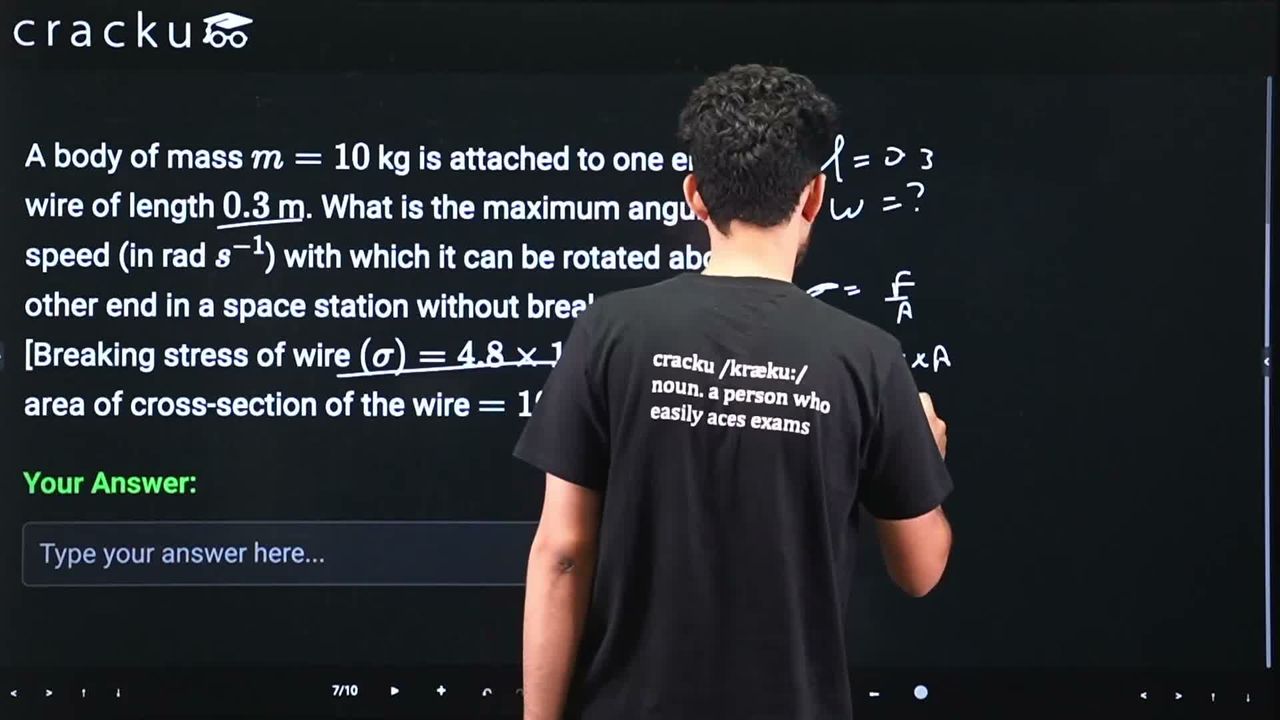
A body of mass $$m = 10$$ kg is attached to one end of a wire of length $$0.3$$ m. What is the maximum angular speed (in rad $$s^{-1}$$) with which it can be rotated about its other end in a space station without breaking the wire?
[Breaking stress of wire $$(\sigma) = 4.8 \times 10^7$$ N $$m^{-2}$$ and area of cross-section of the wire $$= 10^{-2}$$ $$cm^2$$]
Correct Answer: 4
We first note that the wire will break when the tension in it produces a stress equal to the breaking stress. By definition, the stress $$\sigma$$ in a wire is given by the formula
$$\sigma = \dfrac{F}{A},$$
where $$F$$ is the tensile force (tension) and $$A$$ is the cross-sectional area of the wire. From this relation the maximum permissible tension before breaking is
$$F_{\text{max}} = \sigma A.$$
Substituting the given numerical values, we have
$$\sigma = 4.8 \times 10^{7}\; \text{N m}^{-2},$$ $$A = 10^{-2}\; \text{cm}^2.$$
Because the standard SI unit for area is square metres, we convert the area from square centimetres to square metres. Remember that $$1\; \text{cm} = 10^{-2}\; \text{m}$$, so
$$1\; \text{cm}^2 = (10^{-2}\; \text{m})^2 = 10^{-4}\; \text{m}^2.$$
Therefore,
$$A = 10^{-2}\; \text{cm}^2 = 10^{-2} \times 10^{-4}\; \text{m}^2 = 10^{-6}\; \text{m}^2.$$
Now we calculate the breaking force:
$$F_{\text{max}} = \sigma A = (4.8 \times 10^{7}\; \text{N m}^{-2})\,(10^{-6}\; \text{m}^2) = 4.8 \times 10^{1}\; \text{N} = 48\; \text{N}.$$
This $$48\; \text{N}$$ is the greatest tension the wire can withstand without snapping.
Next, we relate this tension to the required angular speed. In a space station there is no effective weight, so the only force providing the necessary centripetal acceleration for circular motion is the tension in the wire. For a body of mass $$m$$ moving in a circle of radius $$L$$ with angular speed $$\omega$$, the centripetal force is given by the well-known formula
$$F_{\text{centripetal}} = m\,\omega^{2}\,L.$$
The wire will be on the verge of breaking when this centripetal force equals $$F_{\text{max}}$$ calculated above. Hence we set
$$m\,\omega^{2}\,L = F_{\text{max}}.$$
Substituting the known quantities,
$$m = 10\; \text{kg}, \qquad L = 0.3\; \text{m}, \qquad F_{\text{max}} = 48\; \text{N},$$
we obtain
$$10 \times \omega^{2} \times 0.3 = 48.$$
Simplifying step by step,
$$10 \times 0.3 = 3,$$
so the equation becomes
$$3\,\omega^{2} = 48.$$
Dividing both sides by $$3$$, we find
$$\omega^{2} = \dfrac{48}{3} = 16.$$
Taking the positive square root (because speed is positive),
$$\omega = \sqrt{16} = 4\; \text{rad s}^{-1}.$$
Thus the body can be rotated with a maximum angular speed of $$4\; \text{rad}\,\text{s}^{-1}$$ without the wire breaking.
Hence, the correct answer is Option 4.
Was this solution helpful?
Click on the Email ☝️ to Watch the Video Solution
Create a FREE account and get:
_1.webp)

Educational materials for JEE preparation

Ask our AI anything

AI can make mistakes. Please verify important information.
AI can make mistakes. Please verify important information.
