
Join Our JEE Preparation Group
Prep with like-minded aspirants; Get access to free daily tests and study material.
Sign in
Please select an account to continue using cracku.in
↓ →
Join Our JEE Preparation Group
Prep with like-minded aspirants; Get access to free daily tests and study material.
If $$f(x) = \begin{cases} \frac{\sin(a+2)x + \sin x}{x} & ; x < 0 \\ b & ; x = 0 \\ \frac{(x+3x^2)^{1/3} - x^{1/3}}{x^{1/3}} & ; x > 0 \end{cases}$$ is continuous at $$x = 0$$, then $$a + 2b$$ is equal to:
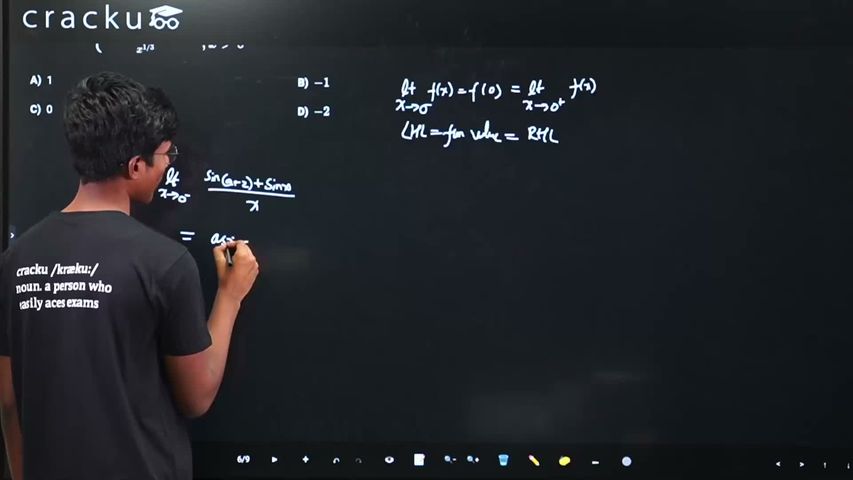
For the function$$f(x)$$ to be continuous at $$x = 0$$, the following condition must be satisfied:
$$\lim_{x \to 0^-} f(x) = f(0) = \lim_{x \to 0^+} f(x)$$
Using the piece defined for $$x < 0$$:
$$\text{LHL} = \lim_{x \to 0^-} \left( \frac{\sin(a+2)x + \sin x}{x} \right)$$
We can split this into two separate limits:
$$\text{LHL} = \lim_{x \to 0^-} \frac{\sin(a+2)x}{x} + \lim_{x \to 0^-} \frac{\sin x}{x}$$
Using the standard trigonometric limit $$\lim_{\theta \to 0} \frac{\sin(k\theta)}{\theta} = k$$, we get:
$$LHL\ =\ \left(a+2\right)\ +\ 1$$
$$LHL\ =\ a+3$$
Using the piece defined for $$x > 0$$:
$$\text{RHL} = \lim_{x \to 0^+} \frac{(x + 3x^2)^{1/3} - x^{1/3}}{x^{4/3}}$$
Factor $x^{1/3}$ out of the numerator to simplify:
$$\text{RHL} = \lim_{x \to 0^+} \frac{x^{1/3} \left[ (1 + 3x)^{1/3} - 1 \right]}{x^{4/3}} = \lim_{x \to 0^+} \frac{(1 + 3x)^{1/3} - 1}{x}$$
Applying the binomial approximation $$\left(1+z\right)^n\approx\ 1+nz\ for\ z\longrightarrow\ 0:$$:
$$\text{RHL} = \lim_{x \to 0^+} \frac{\left( 1 + \frac{1}{3}(3x) \right) - 1}{x} = \lim_{x \to 0^+} \frac{x}{x} = 1$$
Since $$f(0) = b$$, we equate the LHL and RHL to $$b$$:
The problem asks for the value of $$a + 2b$$:
$$a + 2b = (-2) + 2(1) = 0$$
Was this solution helpful?
Click on the Email ☝️ to Watch the Video Solution
Create a FREE account and get:
_1.webp)

Educational materials for JEE preparation

Ask our AI anything

AI can make mistakes. Please verify important information.
AI can make mistakes. Please verify important information.
