
Join Our JEE Preparation Group
Prep with like-minded aspirants; Get access to free daily tests and study material.
Sign in
Please select an account to continue using cracku.in
↓ →
Join Our JEE Preparation Group
Prep with like-minded aspirants; Get access to free daily tests and study material.
Let $$f$$ be any function continuous on $$[a, b]$$ and twice differentiable on $$(a, b)$$. If all $$x \in (a, b)$$, $$f'(x) > 0$$ and $$f''(x) < 0$$, then for any $$c \in (a, b)$$, $$\frac{f(c) - f(a)}{f(b) - f(c)}$$ is:
We have a function $$f$$ which is continuous on the closed interval $$[a,b]$$ and twice differentiable on the open interval $$(a,b)$$. For every point $$x$$ in $$(a,b)$$ it satisfies $$f'(x)>0$$ and $$f''(x)<0$$. The inequality $$f'(x)>0$$ tells us that the graph of $$f$$ rises as we move from left to right, while $$f''(x)<0$$ tells us that this rise is at a decreasing rate; that is, the first derivative $$f'$$ itself is strictly decreasing on $$(a,b)$$.
Fix any point $$c$$ with $$a<c<b$$ and consider the ratio
$$R=\frac{f(c)-f(a)}{f(b)-f(c)}.$$
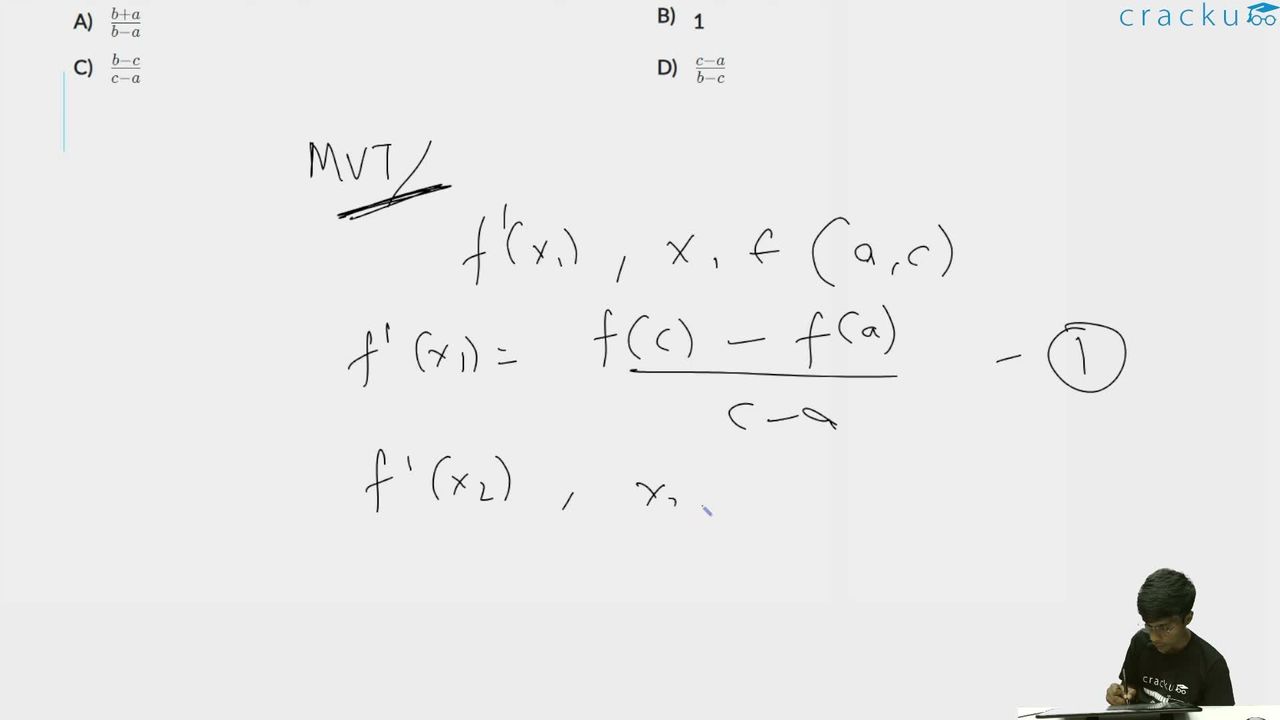
Because $$f$$ is continuous on each closed sub-interval and differentiable on each open sub-interval, we can apply the Mean Value Theorem separately to the intervals $$[a,c]$$ and $$[c,b]$$.
Mean Value Theorem on the interval $$[a,c]$$. There exists some point $$x_{1}\in(a,c)$$ such that
$$f(c)-f(a)=f'(x_{1})(c-a).$$
Mean Value Theorem on the interval $$[c,b]$$. There exists some point $$x_{2}\in(c,b)$$ such that
$$f(b)-f(c)=f'(x_{2})(b-c).$$
Substituting these two Mean Value Theorem identities into the ratio $$R$$, we obtain
$$ R=\frac{f(c)-f(a)}{f(b)-f(c)} =\frac{f'(x_{1})(c-a)}{f'(x_{2})(b-c)}. $$
Now, observe the relative positions of the points: $$a<x_{1}<c<x_{2}<b.$$ Because $$f''(x)<0$$ on $$(a,b)$$, the first derivative $$f'(x)$$ is strictly decreasing. Hence, moving to the right decreases its value, so
$$f'(x_{1}) > f'(x_{2}).$$
Using this inequality we can compare $$R$$ with the ratio of the lengths of the sub-intervals:
$$ R =\frac{f'(x_{1})(c-a)}{f'(x_{2})(b-c)} > \frac{f'(x_{2})(c-a)}{f'(x_{2})(b-c)} =\frac{c-a}{\,b-c\,}. $$
Thus we have established the strict inequality
$$ \boxed{\displaystyle\frac{f(c)-f(a)}{f(b)-f(c)} \; >\; \frac{c-a}{\,b-c\,}}. $$
This inequality holds for every $$c\in(a,b)$$ whenever $$f'(x)>0$$ and $$f''(x)<0$$ on $$(a,b)$$. Looking at the options supplied, the right-hand side of this inequality is exactly the expression in Option D.
Hence, the correct answer is Option D.
Was this solution helpful?
Click on the Email ☝️ to Watch the Video Solution
Create a FREE account and get:
_1.webp)

Educational materials for JEE preparation

Ask our AI anything

AI can make mistakes. Please verify important information.
AI can make mistakes. Please verify important information.
