
Join Our JEE Preparation Group
Prep with like-minded aspirants; Get access to free daily tests and study material.
Sign in
Please select an account to continue using cracku.in
↓ →
Join Our JEE Preparation Group
Prep with like-minded aspirants; Get access to free daily tests and study material.
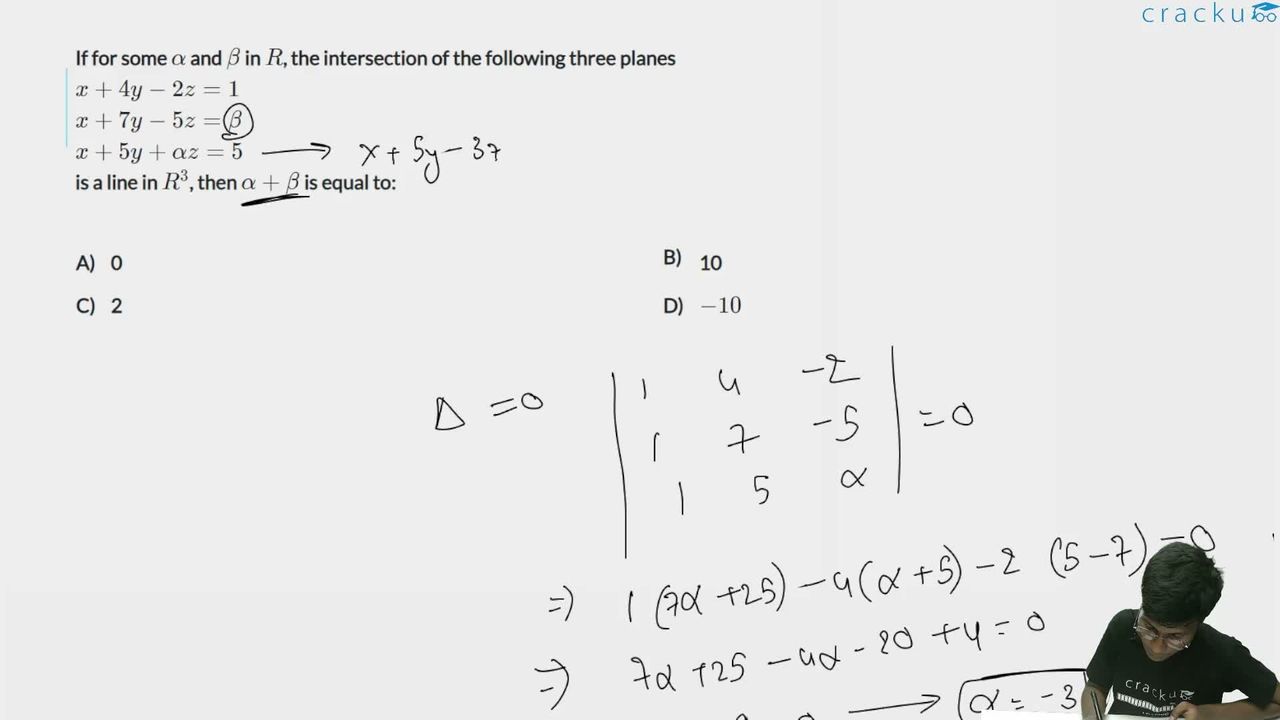
If for some $$\alpha$$ and $$\beta$$ in $$R$$, the intersection of the following three planes
$$x + 4y - 2z = 1$$
$$x + 7y - 5z = \beta$$
$$x + 5y + \alpha z = 5$$
is a line in $$R^3$$, then $$\alpha + \beta$$ is equal to:
We have three planes in $$\mathbb R^{3}$$
$$\begin{aligned}
\Pi_{1}&:;;x+4y-2z=1,\\[2mm]
\Pi_{2}&:;;x+7y-5z=\beta,\\[2mm]
\Pi_{3}&:;;x+5y+\alpha z=5,
\end{aligned}$$
and we are told that their common intersection is a line. In a system of three linear equations this means
Therefore the determinant of the coefficient matrix must be zero. Writing the coefficient matrix $$A$$
$$A=\begin{bmatrix}
1&4&-2\\
1&7&-5\\
1&5&\alpha
\end{bmatrix},$$
we compute its determinant. Using the expansion formula
$$\det A=\begin{vmatrix}
1&4&-2\\
1&7&-5\\
1&5&\alpha
\end{vmatrix}
=1\Bigl(7\alpha-(-5)(5)\Bigr)-4\Bigl(1\alpha-(-5)(1)\Bigr)+(-2)\Bigl(1\cdot5-7\cdot1\Bigr).$$
Simplifying each term we get
$$\det A=1\bigl(7\alpha+25\bigr)-4\bigl(\alpha+5\bigr)+(-2)(5-7)
=7\alpha+25-4\alpha-20+4
=3\alpha+9
=3(\alpha+3).$$
For a line of intersection we must have $$\det A=0,$$ so
$$3(\alpha+3)=0\;\Longrightarrow\;\alpha=-3.$$
Now the rank of the augmented matrix must also be $$2$$ (not $$3$$) so that the system is consistent. To find the required value of $$\beta$$ we keep $$\alpha=-3$$ and look at the first and the third planes, which are already independent (their normal vectors are not proportional). We solve those two equations first and then impose the second.
With $$\alpha=-3$$, the third plane is
$$x+5y-3z=5.$$
From the first plane we isolate $$x$$:
$$x=1-4y+2z\qquad(1).$$
From the third plane we also write $$x$$:
$$x=5-5y+3z\qquad(2).$$
Equating the right-hand sides of (1) and (2)
$$1-4y+2z=5-5y+3z,$$
$$1-4y+2z-5+5y-3z=0,$$
$$-4+y-z=0,$$
$$y=z+4.$$
Substituting this $$y$$ into (1) we obtain
$$x=1-4(z+4)+2z
=1-4z-16+2z
=-15-2z.$$
Thus every point on the intersection of $$\Pi_{1}$$ and $$\Pi_{3}$$ can be written with the parameter $$t=z$$ as
$$\bigl(x,y,z\bigr)=\bigl(-15-2t,\;t+4,\;t\bigr).$$
For the same point to lie on $$\Pi_{2}$$ we substitute into the left side of the second plane:
$$\begin{aligned}
x+7y-5z&=(-15-2t)+7(t+4)-5t\\
&=-15-2t+7t+28-5t\\
&=(-15+28)+(-2t+7t-5t)\\
&=13+0t\\
&=13.
\end{aligned}$$
The value is the constant $$13$$, independent of the parameter. Therefore the right-hand side of the second equation must be
$$\beta=13.$$
Finally, with $$\alpha=-3$$ and $$\beta=13,$$ we have
$$\alpha+\beta=-3+13=10.$$
Hence, the correct answer is Option B.
Was this solution helpful?
Click on the Email ☝️ to Watch the Video Solution
Create a FREE account and get:
_1.webp)

Educational materials for JEE preparation

Ask our AI anything

AI can make mistakes. Please verify important information.
AI can make mistakes. Please verify important information.
