
Join Our JEE Preparation Group
Prep with like-minded aspirants; Get access to free daily tests and study material.
Sign in
Please select an account to continue using cracku.in
↓ →
Join Our JEE Preparation Group
Prep with like-minded aspirants; Get access to free daily tests and study material.
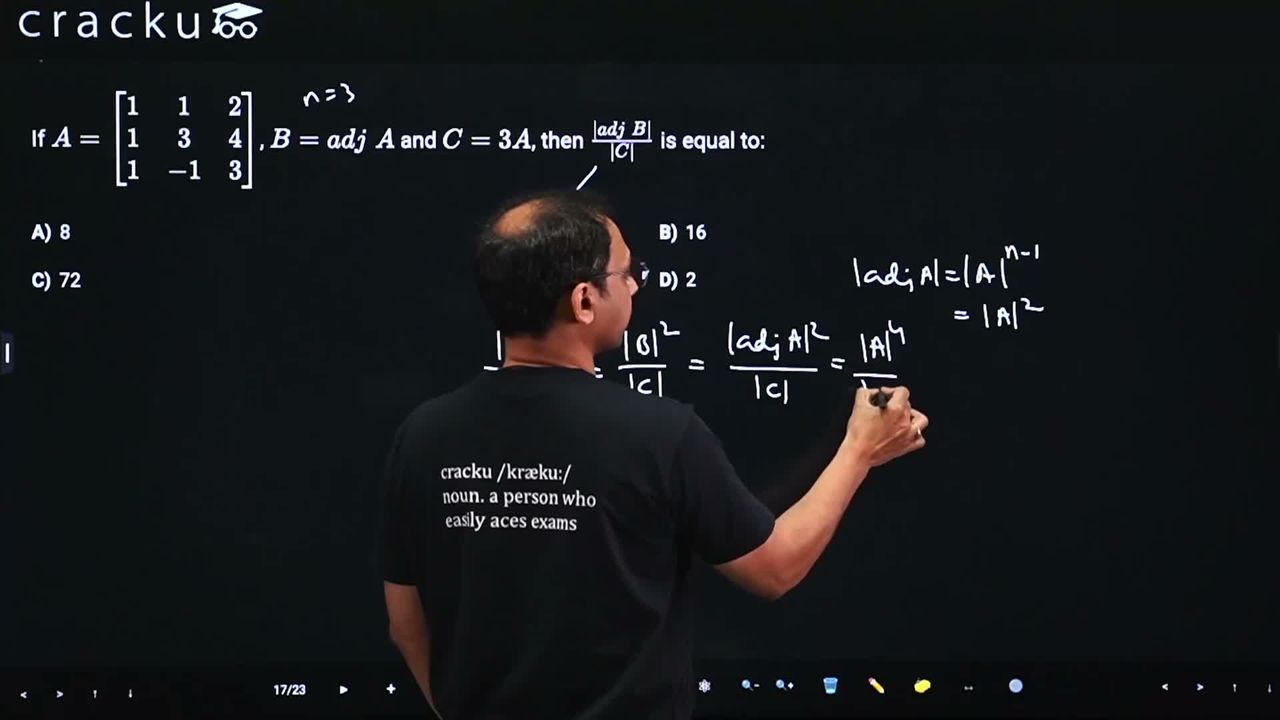
If $$A = \begin{bmatrix} 1 & 1 & 2 \\ 1 & 3 & 4 \\ 1 & -1 & 3 \end{bmatrix}$$, $$B = adj \; A$$ and $$C = 3A$$, then $$\frac{|adj \; B|}{|C|}$$ is equal to:
We have the three $$3 \times 3$$ matrices
$$$A=\begin{bmatrix}1 & 1 & 2 \\ 1 & 3 & 4 \\ 1 & -1 & 3\end{bmatrix}, \qquad B=\operatorname{adj}A, \qquad C=3A.$$$
First we evaluate the determinant of $$A$$. Expanding along the first row (Laplace expansion):
$$$\begin{aligned} |A| &=1\begin{vmatrix}3 & 4\\ -1 & 3\end{vmatrix} \;-\;1\begin{vmatrix}1 & 4\\ 1 & 3\end{vmatrix} \;+\;2\begin{vmatrix}1 & 3\\ 1 & -1\end{vmatrix}\\[4pt] &=1\,(3\cdot3-4\cdot(-1)) \;-\;1\,(1\cdot3-4\cdot1) \;+\;2\,(1\cdot(-1)-3\cdot1)\\[4pt] &=1\,(9+4) \;-\;1\,(3-4) \;+\;2\,(-1-3)\\[4pt] &=13-(-1)+2(-4)\\[4pt] &=13+1-8\\[4pt] &=6. \end{aligned}$$$
So $$$|A|=6.$
Now recall the standard result for an $$$n $$\times$$ n$$ matrix:
$$|\operatorname{adj}M|=|M|^{\,n-1}.$$
Because $$A$$ is a $$3$$\times$$3$$ matrix ($$n=3$$), we get
$$|B| = |\operatorname{adj}A| = |A|^{\,3-1}=|A|^2 = 6^{2}=36.$$
We must find $$|\,\operatorname{adj}B|.$$$ Applying the same formula to the matrix $$$B$$ (again of order 3):
$$|\operatorname{adj}B| = |B|^{\,3-1}=|B|^2 = 36^{2}=1296.$$
Next we evaluate $$|C|.$$ For any scalar $$k$$ and an $$n $$\times$$ n$$ matrix $$M,$$$ the determinant scales as
$$$|kM| = k^{\,n}\,|M|.$$
With $$k=3,\;M=A,\;n=3$$ we obtain
$$|C| = |3A| = 3^{3}\,|A| = 27 $$\times$$ 6 = 162.$$$
Finally, the required quotient is
$$$$$\frac{|\operatorname{adj}$$B|}{|C|} \;=\;$$\frac{1296}{162}$$=8.$$
Hence, the correct answer is Option A.
Was this solution helpful?
Click on the Email ☝️ to Watch the Video Solution
Create a FREE account and get:
_1.webp)

Educational materials for JEE preparation

Ask our AI anything

AI can make mistakes. Please verify important information.
AI can make mistakes. Please verify important information.
