
Join Our JEE Preparation Group
Prep with like-minded aspirants; Get access to free daily tests and study material.
Sign in
Please select an account to continue using cracku.in
↓ →
Join Our JEE Preparation Group
Prep with like-minded aspirants; Get access to free daily tests and study material.
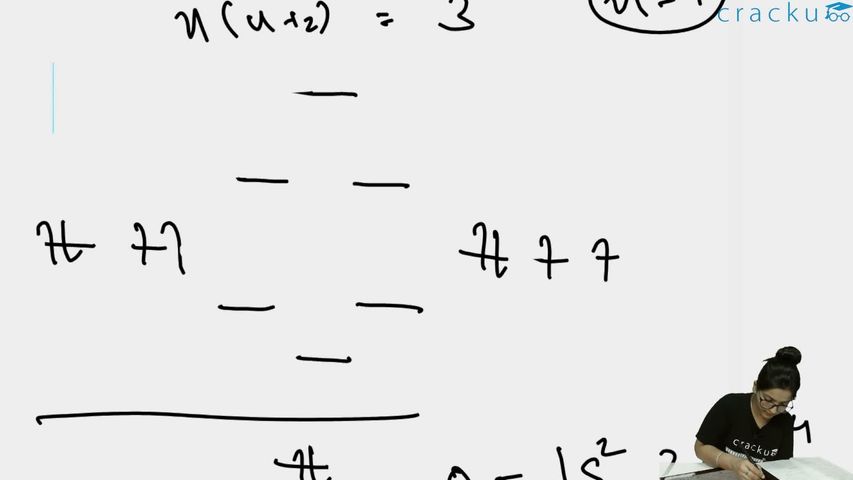
The spin-only magnetic moment ($$\mu$$) of any chemical species is directly calculated from the number of unpaired electrons ($$n$$) using the formula:
$$\mu = \sqrt{n(n + 2)}\text{ B.M.}$$
Given that $$\mu = 1.73\text{ B.M.}$$:
$$1.73 = \sqrt{n(n + 2)}$$
$$1.73^2 = n(n + 2)$$
$$3 \approx n^2 + 2n \implies n = 1$$
A magnetic moment of $$1.73\text{ B.M.}$$ precisely corresponds to the presence of exactly one unpaired electron.
According to Molecular Orbital Theory, the filling order for the valence shells of di-oxygen systems (containing 14 or more electrons) is:
$$\sigma_{1\text{s}}^2 \ \sigma_{1\text{s}}^{*2} \ \sigma_{2\text{s}}^2 \ \sigma_{2\text{s}}^{*2} \ \sigma_{2\text{p}_\text{z}}^2 \ (\pi_{2\text{p}_\text{x}}^2 = \pi_{2\text{p}_\text{y}}^2) \ (\pi_{2\text{p}_\text{x}}^{*1} = \pi_{2\text{p}_\text{y}}^{*1})$$
Let's count the total electrons and identify the number of unpaired electrons in the highest occupied antibonding pi orbitals ($$\pi^*_{2\text{p}_\text{x}}$$ and $$\pi^*_{2\text{p}_\text{y}}$$) for each choice:
Superoxide Ion ($$\text{O}_2^-$$):
Total electrons = $$16 + 1 = 17$$.
The valence configuration ends with: $$(\pi_{2\text{p}_\text{x}}^{*2} = \pi_{2\text{p}_\text{y}}^{*1})$$.
It contains exactly 1 unpaired electron (n = 1).
Dioxygenyl Cation ($$\text{O}_2^+$$):
Total electrons = $$16 - 1 = 15$$.
The valence configuration ends with: $$(\pi_{2\text{p}_\text{x}}^{*1} = \pi_{2\text{p}_\text{y}}^{*0})$$.
It contains exactly 1 unpaired electron (n = 1).
Both $$\text{O}_2^-$$ and $$\text{O}_2^+$$ contain exactly one unpaired electron in their molecular orbital arrangement, yielding a spin-only magnetic moment value of $$1.73\text{ B.M.}$$
Answer: Option A — $$\text{O}_2^-$$ or $$\text{O}_2^+$$
Was this solution helpful?
Click on the Email ☝️ to Watch the Video Solution
Create a FREE account and get:
_1.webp)

Educational materials for JEE preparation

Ask our AI anything

AI can make mistakes. Please verify important information.
AI can make mistakes. Please verify important information.
